


A crypto trading group gives you instructions for opening what looks like a secure account. The first deposit goes through, and the balance seems to be where you expected.
That still leaves one question: who can actually move the money once it gets there?
Overview
A court forfeited $674,469.58 linked to an online investment scam
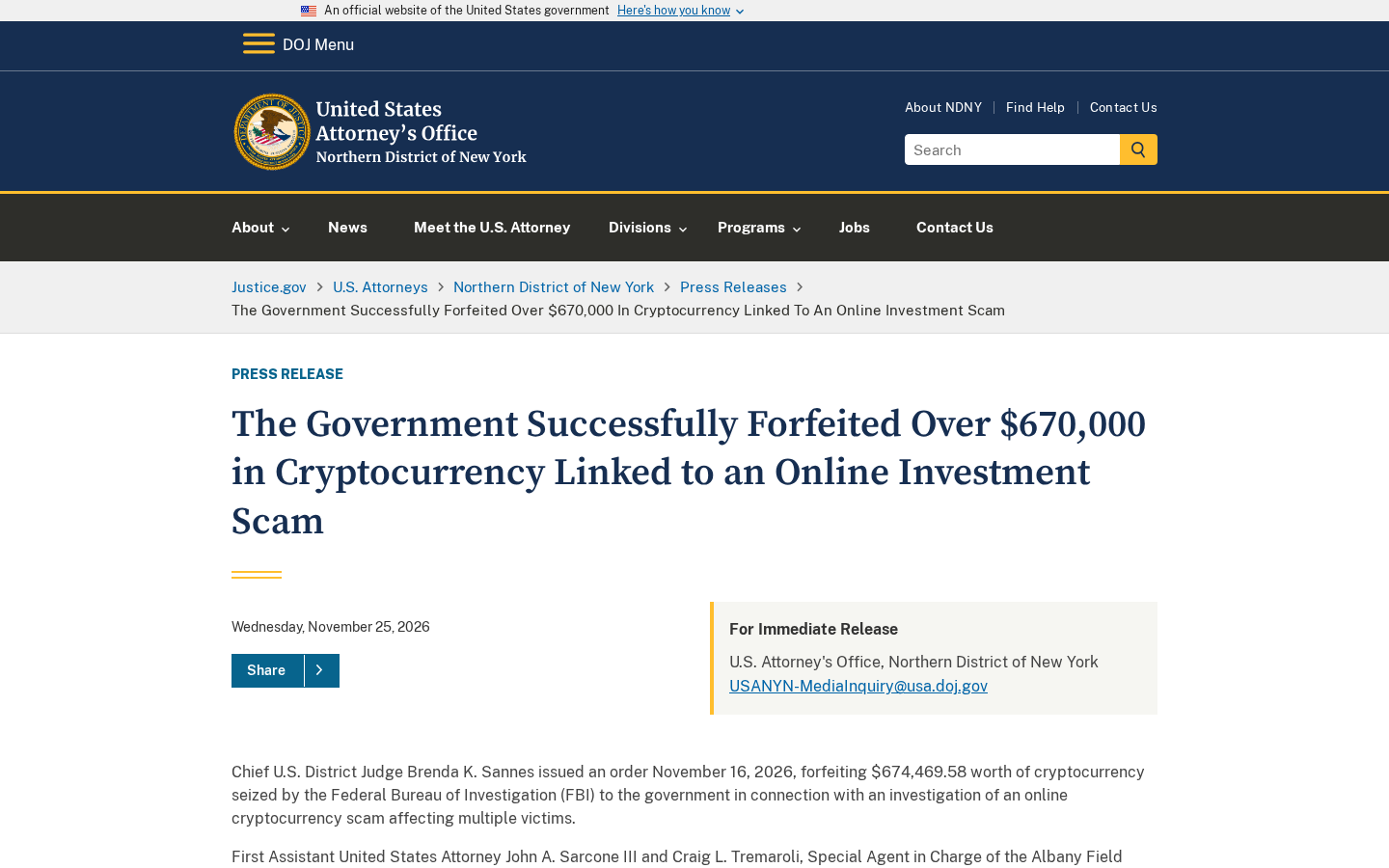
The Northern District of New York’s November 25, 2026 announcement describes cryptocurrency identified and seized by the FBI in an online investment fraud investigation.
Chief US District Judge Brenda K. Sannes issued the forfeiture order on November 16. The government announced that the affected cryptocurrency was valued at $674,469.58.
The announcement describes a court order securing assets for possible recovery. It does not say that every affected person has been repaid or that any stranger can arrange repayment.
The initial offer was for trading guidance
According to the complaint summarized by prosecutors, a person in Onondaga County was approached in May 2024 about an online platform offering guidance on cryptocurrency trading.
The person transferred cryptocurrency to what seemed to be a secure exchange account linked to that platform. An attempt to withdraw it later failed because it had been stolen.
The FBI found additional victims in the same scheme. The government calls it a confidence-based investment scam, but the release does not identify a platform brand readers can look up.
What readers can confirm from their own records
- A visible balance can tell you what a website claims without telling you who controls the funds.
- A transfer identifier can show that assets moved, but the records around it explain why you authorized the move.
- A real forfeiture order establishes a legal outcome for specified property, not a general right to a payout.
- The office handling a case can explain how it wants potential victims to come forward.
Ask where your own transfer went before matching it with a headline. A similar story or amount is not enough to connect the cases.
How the Trading Guidance Scam Worked
Step 1: The first conversation offered help with trading
A pitch for strategies sounds less demanding than an immediate request to hand over savings. It invites you to treat the person as a guide before you assess the investment.
In this case, the complaint identifies the promise of trading guidance but does not specify which message service the contact used. The lesson does not depend on a particular app.
Find out who is offering the service and which business will hold any transferred money. A person can discuss a market without needing custody of your crypto.
Step 2: An exchange account sounded like a safe place for the transfer
The Onondaga County victim believed their cryptocurrency was going to a secure exchange account connected to the platform. The label did not reflect who controlled the assets.
Sign in independently to confirm that the provider actually received the transfer. A screen the promoter controls cannot confirm what reached an account in your name.
If a guide supplies a destination, do not assume that the address belongs to a familiar platform just because the accompanying message uses its name.
Step 3: The first attempted withdrawal exposed the problem
The victim later tried to withdraw the assets and could not. The complaint says the funds had been stolen, not simply held for a normal processing period.
The release does not document a withdrawal fee in this case. If a new contact demands money to unlock your balance, do not test that demand with another transfer.
Capture the failure message and record when it appeared. A screenshot of the problem plus the original sending record gives investigators more context than either one alone.
Step 4: Investigators found a connected wallet and the court ordered forfeiture
The FBI identified a wallet linked to the scheme and seized the cryptocurrency. A federal judge later ordered the property forfeited in November 2026.
Identifying property, seizing it and obtaining forfeiture are distinct events. A recovery marketer who uses all three terms as if they mean money has reached victims is misleading you.
After forfeiture, authorities may be able to return assets through the applicable process. The November announcement does not open a public portal for anyone who lost crypto.
How to Build a Record of Your Own Crypto Transfer
Start at the wallet or exchange you actually used
Open your own wallet or exchange from its verified app or website. Look in the account activity or transaction history instead of opening a link the trading group supplied.
Find the outgoing transfer by date and asset. Open its details and copy the transaction identifier, receiving address, amount, asset name and network exactly as displayed.
Note whether the app shows the transfer as pending, completed or failed. If the service uses a transfer reference instead of an on-chain identifier, preserve that reference too.
Keep the time and time zone if available, especially when you made several same-day transfers. Attach a screenshot from your account without exposing recovery words or private keys.
The FBI’s cryptocurrency reporting guidance explains why transaction records matter. Authorities need to connect the payment you describe with a specific transaction, not a claimed dashboard balance.
Connect the address to the contact without guessing the operator
Save the message in which someone gave you the destination or told you what to do. Keep the date, displayed username and the original conversation around that message.
If a second person joined the conversation later, note which instructions each one gave and when. A different screen name does not prove that you dealt with different operators.
Preserve the website address in your private records, but do not send a clickable invitation to others. The purpose is to trace what happened, not direct people to the platform.
If a site displayed more than you actually sent, record the advertised amount separately. Your payment history is a better starting point for describing what left your control.
Separate what was sent from what was returned
List each transfer rather than adding every balance you saw. Mark any refund or withdrawal you can verify in your own account with its date and amount.
If a person says you received funds, ask which specific transaction they mean. Do not sign anything, connect a wallet or enter a recovery phrase just to check the claim.
Keep the schedule readable for someone who wasn’t there. A record with one row per transfer and one source for each figure does not depend on your memory.
How to Check a Recovery Notice Without Exposing Your Wallet
Separate legitimate case information from an unsolicited approach
Someone can copy an official press release into an email you never asked to receive. The genuine release supports the case facts, not the sender’s claim to represent the government.
Look for the district that issued the notice and find its contact page independently. Ask whether officials sent the communication and whether it relates to the specific payments you report.
Do not rely on the name of a judge, an amount from the headline or a reference copied from a court document. Those facts can be visible to anyone.
If a person asks you to open a private message group, check whether the agency actually uses that route. Do not assume a familiar logo makes the group official.
Save the notice and record how it reached you. Keeping the full message helps distinguish a real agency address from a familiar name someone put in the sender field.
Know which information ordinary identification does not require
You can give an investigator the public transfer identifier without handing over control of the wallet. A recovery phrase is not a receipt for a transaction.
Do not connect a wallet to a site because someone says it needs to look at your losses. Ask an independently verified investigator which records can be submitted separately.
A test transaction or a signed request should not be the price of receiving an ordinary case update. Stop if someone insists you do it before answering a basic question.
Keep private addresses and account records away from public message threads. Report where money went through the verified channel rather than asking strangers to identify the person behind a wallet.
It is reasonable to ask exactly which office needs each document. You can preserve evidence in a private copy without sending sensitive credentials to the person asking for it.
Keep a verified claim separate from a new payment solicitation
Ask the responsible office what identifies a claimant in its records. Dates, transfer details and earlier reports are more useful than an estimate from a supposed recovery service.
If the office confirms a process, record the method it gives you, submission deadline and documents requested. Ask how to confirm that what you sent was actually received.
Different cases can have different deadlines, so don’t borrow an application date from a similar headline. The relevant clock is the one in the instructions verified for this case.
If you were told to pay to join a claimant list, save that demand. Report the solicitation without pursuing someone who says the fee can be refunded later.
When you help someone close to you, let them retain their own account access. Offer to organize their evidence or sit with them during a call to the real office.
Ask the verified office what it can trace now. Keep the evidence whether or not anyone can tell you when, or if, a payment might return.
What to Do If You Have Fallen Victim to This Scam
-
Stop sending money and secure your own account. Cancel any transfer you can still stop in your legitimate account and tell the exchange why you suspect a scam.
If you disclosed a password or account code, sign in through the official route or call verified support. Ask how to regain control and end unfamiliar sessions.
Do not use anyone’s promise of a test withdrawal as a reason to add funds. Keep messages that show the amount and destination they requested.
-
Give the exchange the actual transfer details. Ask its verified fraud team whether it can flag the destination or assist with lawful requests from investigators.
Be clear if you authorized the transfer after being deceived. That is different from reporting that someone signed in and sent the money without your permission.
A completed transfer usually cannot be undone from your screen. Ask what the provider can document now, rather than relying on a promise that someone can reverse it later.
-
File an internet crime report promptly. In the United States, open IC3 yourself and start a complaint with the payment timeline, identifiers and contacts you have.
Include what the person promised and what prevented withdrawal. If the loss involves more than one asset, identify which network corresponds to each payment.
Record your confirmation and keep the original material. Add newly identified transfer information through an authorized contact if investigators tell you how to submit it.
-
Check a possible match with the government office handling it. If the Onondaga County case seems relevant, reach the district through justice.gov rather than using a number from a message.
Ask what details the office needs to decide whether your transfer is connected. Do not assume your report matches simply because the message mentioned a trading platform.
Ask whether any official process is open and who sends verified instructions. A forfeiture announcement alone does not tell you where to file an individual claim.
-
Decline any charge to enter a federal recovery process. A case name, real headline or transaction screenshot does not authenticate someone offering to get your funds back.
The DOJ’s forfeited-assets FAQ explains that filing a government remission petition carries no fee. Verify case-specific instructions directly before providing claim information.
If you already paid someone promising recovery, record that as a second payment. Tell your payment provider about both events without combining the amounts.
Frequently Asked Questions
How much cryptocurrency did the court forfeit?
Federal prosecutors reported $674,469.58 worth of cryptocurrency in the November order. That figure describes the property forfeited, not the total deposited by all victims.
Was the payment already returned to everyone affected?
The announcement describes forfeiture and an opportunity for victims to seek recovery. It does not report a completed distribution or promise that every loss will be covered.
Can the government recover money someone says I lost on a dashboard?
Start with what you actually paid and can document. A supposed account balance or projected gain does not by itself show what left your control.
Can a stranger verify my claim if I give them my recovery phrase?
Do not give anyone your wallet recovery phrase. Investigators can use public transaction details and supporting records without needing the words that control your wallet.
What if the website name does not appear in the announcement?
The release does not name the trading platform. Record your exact domain, dates and payment destinations, then let the investigating office decide whether the records match.
Is this the same as the nationwide $17 billion announcement?
This is a particular Northern District of New York case with its own property order. Do not use a separate national announcement to estimate what one victim might receive.
The Bottom Line
Do not send crypto to a supposed trading account you cannot verify independently. A balance shown by the group does not establish that you control the funds.
If you sent money, preserve the original transaction details and report it quickly. Confirm any recovery instructions through the agency handling the case and do not pay a release fee.

Join the discussion
0 commentsShare your experience or ask a question about this article.
Community experiences
Did this happen to you?
Your experience could help someone recognize the same scam. Submit a private report for our team to review.
I experienced this tooReports are reviewed before publication. Sharing publicly is always your choice.
Discussion
Start the conversation
Have a question or something useful to share? Add the first comment.