


The game matters, the seats are hard to find, and someone says they can get you in. Paying now can feel easier than missing the opportunity.
The Matthew Neet case puts that familiar ticket-buying decision beside another promise he was making, with expensive consequences for the people who trusted him.
Overview
Football tickets were part of a proven fraud case
Matthew Neet offered University of Georgia football tickets that he did not intend to provide. The case also involved purported property investments rather than ticket sales alone.
The DOJ’s December 2025 announcement described the underlying charges. Subsequent reporting from court records established a sentence, rather than leaving the case at an allegation.
WSB-TV reported from sentencing documents that Neet received four years in prison for wire fraud in May 2026, followed by three years of supervised release.
The money figures include investors as well as fans
Prosecutors described approximately $943,000 paid by at least two dozen people for purported investments or game tickets. That figure should not be presented as football-ticket losses alone.
The court’s restitution order was $948,104.91, according to the sentencing report. That obligation does not establish that everyone has already been repaid.
- The ticket offers concerned Georgia games against Alabama, Texas, and Mississippi.
- The separate investment pitch involved purported Costa Rican teak or timberland property.
- Money was obtained for promises that were not fulfilled as represented.
- Georgia Athletics was not identified as the operator of Neet’s fraud.
A ticket promise needs more than a reassuring conversation
This was not simply a complaint that seats were disappointing or a real game was canceled. The criminal case concerned obtaining money through false offers.
The lesson is to verify the actual ticket transaction and delivery route before relying on access someone promises to arrange.
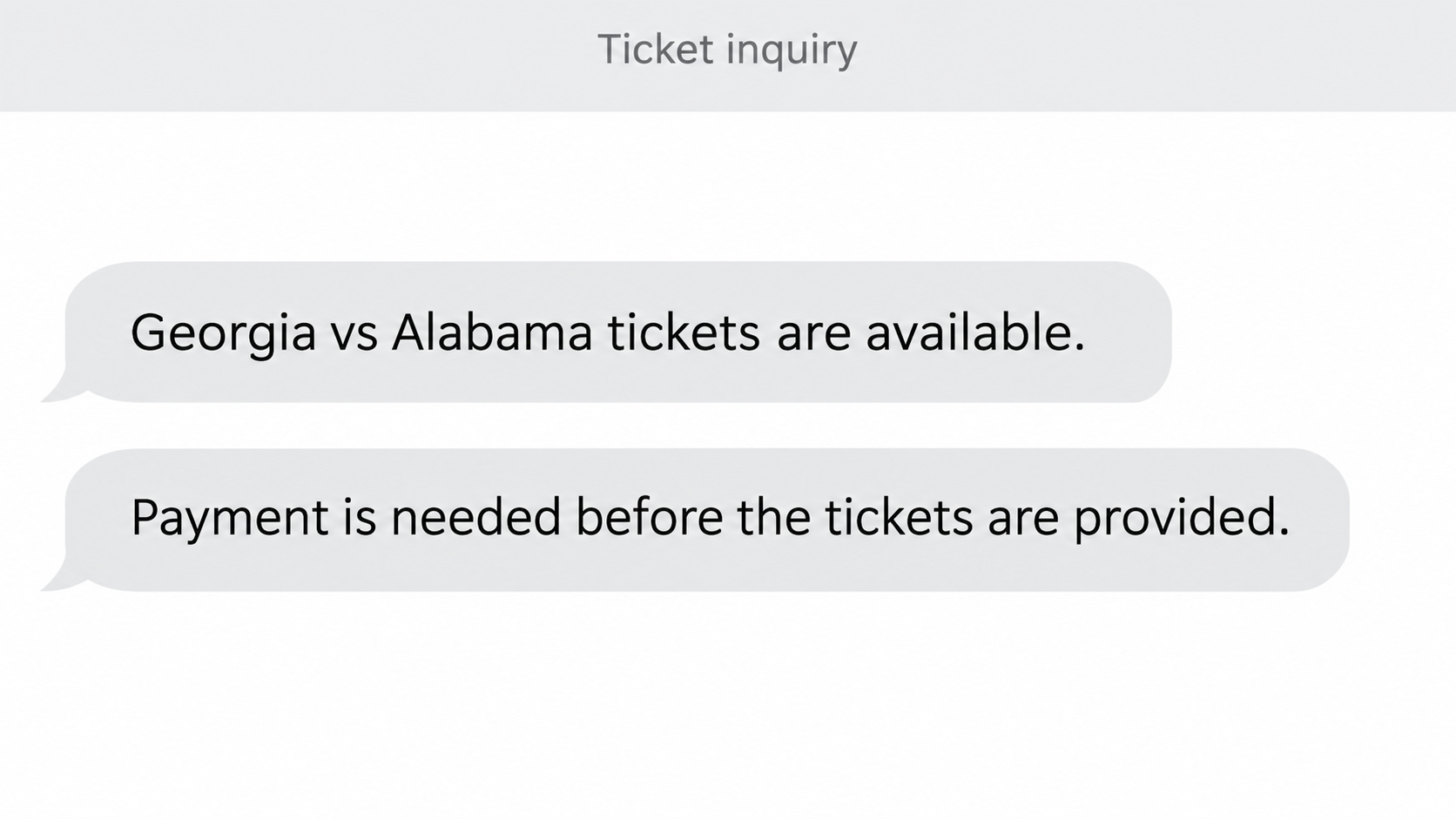
The lead chat is a reconstruction illustrating an offer of Georgia tickets. It is not a recovered Neet conversation, genuine ticket, or representation of a current sale.
Why Scarce Tickets Make the Decision Feel Urgent
A major game has a fixed date, and the available seats can change quickly. That makes a seller’s promise feel different from an ordinary product listing.
You may already be coordinating travel, friends, or a weekend around the event. Finding someone who appears to solve the ticket problem can create immediate relief.
The danger is letting that relief replace the transaction checks. Knowing the matchup, discussing seats, or sounding like a knowledgeable fan does not establish ownership of tickets.
Even a familiar introduction cannot supply something the seller does not possess. The same questions about delivery and payment still need answers.
The Neet case is especially useful because the tickets were tied to recognizable, desirable games. The genuine event made the false offer plausible.
Fans did not need to believe in an imaginary sport or venue. They needed to believe that one particular person could deliver real access.
That is why the relevant check concerns the ticket in your own verified account. A seller’s confidence, enthusiasm, or personal story cannot substitute for it.
You do not have to prove a stranger is dishonest before declining an unsupported sale. A transaction can be unsuitable even while you are still checking the facts.
How the Matthew Neet Football Ticket Scam Works
Step 1: A real game supplies the attraction
Neet claimed to have tickets for Georgia football games against Alabama, Texas, and Mississippi. Those recognizable events provided an understandable reason for fans to be interested.
The legitimacy of the game did not establish the legitimacy of the seller. The false claim concerned his ability and intention to provide the tickets.
Before buying from an unfamiliar person, identify the exact event, quantity, seats, delivery method, and payment terms. Do not let the matchup stand in for those details.
Keep the conversation in writing when possible. A clear record of what was offered is useful if the promised ticket never arrives.
Step 2: Buyers rely on a promise of future delivery
The case describes people paying for tickets Neet never intended to provide. Payment created a financial commitment without delivering the access the buyer expected.
That should not be confused with every legitimate advance purchase. Authorized sellers and protected marketplaces can have defined delivery schedules and remedies when something goes wrong.
The problem is an unsupported promise presented as something the seller can fulfill. Establish the actual purchase and protection terms before sending money.
A screenshot, informal receipt, or personal assurance does not create the same relationship as an order recorded through the genuine seller’s account system.
Step 3: Payment leaves the buyer without the promised seats
The DOJ described funds being used for Neet’s own purposes. The ticket offer did not produce the delivery buyers had paid to receive.
The published case figures combine these transactions with a separate investment scheme. They do not establish an average ticket price or the loss suffered by every fan.
If your ticket has not arrived, begin with your own order and payment records. You do not need a case-wide loss estimate to explain the specific unfulfilled promise.
Ask the actual marketplace or ticket office about the expected delivery route. Do not accept the seller’s instructions as the only explanation of why access remains unavailable.
Step 4: A separate investment pitch reaches other victims
Neet also offered purported investments in teak or timberland property in Costa Rica. Prosecutors said he did not intend to invest those funds as represented.
Those offers belong in the case because they explain the combined financial totals. They should not be blended into a claim that every ticket buyer also became an investor.
The common issue was reliance on a false promise about what the money would obtain. The underlying products and the records needed to assess them were different.
Keep ticket and investment losses separate if your own experience involved both. An event order and a property-investment agreement do not establish the same rights or delivery obligations.
A Screenshot Is Not a Digital Ticket Transfer
Georgia Athletics’ official digital-ticket guide explains that tickets live in the holder’s ticket account and are downloaded to a supported mobile wallet.
Its guidance also says screenshots, photocopies, and printed digital tickets are not accepted for entry. A convincing picture therefore cannot perform the function of a valid transfer.
This is separate from whether a picture was edited. An authentic screenshot can still be the wrong thing to rely on for admission.
The account system also changes access when tickets are transferred and accepted. A seller keeping an earlier image does not establish that both people can enter.
Do not buy a login to someone else’s ticket account as a substitute. Sharing account access creates a different problem from receiving the ticket through its proper transfer process.
Georgia’s Apple Account Binding guidance specifically warns against sharing logins and forwarding ticket links instead of using the official transfer feature.
That Apple-specific protection should not be described as applying identically to Android. Both buyers still need to use the genuine ticketing route rather than a stranger’s screenshot.
Check Your Own Ticket Account Before Depending on Admission
Use a stable internet connection and the official Georgia Bulldogs app or the ticket-account link reached through Georgia Athletics. Keep your login private throughout the process.
-
In the official app, tap the Ticket icon, then Manage Tickets. Sign in with your own Georgia Athletics ticket-account details.
If you do not have the correct account or cannot sign in, use the genuine account recovery or ticket-office route. Do not borrow the seller’s password.
-
Look in My Tickets for the relevant event and seats. Compare the actual account entry with what you purchased, rather than comparing two screenshots supplied by the seller.
A missing event needs checking against its delivery schedule. Georgia notes that some advance season purchases become active closer to the season.
-
For an available ticket, open it and use the supported wallet option. On iPhone, the published guide uses Add to Apple Wallet, followed by Add.
Confirm the ticket appears in your own wallet before traveling. Android users should use the Google Wallet route described by Georgia’s guide.
-
If the ticket is missing, disabled, or cannot be added, contact the Georgia ticket office at 706-542-1231, extension 2.
Explain the event, account, purchase, and exact error. Keep any order confirmation available and follow the office’s instructions before assuming the seller’s proposed extra payment will fix anything.
These checks do not create buyer protection for an unrelated payment. Read the marketplace’s purchase terms as well as verifying the ticket account itself.
For resale, use Georgia’s linked marketplace and complete its actual checkout. A listing mentioning a platform does not make a separate private payment equivalent.
What to Do if You Have Fallen Victim to This Scam
-
Save the full ticket offer, event details, seller profile, correspondence, and payment confirmation. Include any promise about when and how the tickets would be delivered.
Keep an order number if the transaction used a marketplace. Distinguish that genuine order record from a screenshot or receipt created by the seller.
If no ticket arrives, note the missed delivery promise and your attempts to resolve it. A chronological record makes the problem easier to explain.
-
Contact the actual marketplace through its own account or published help route. Ask whether it recognizes your order and which remedy applies to the failed delivery.
If you paid the seller privately, explain that fact accurately. A marketplace mentioned in a message may have no record of the transaction.
Ask for the claim deadline and the documents required. Do not wait until after the game if the platform already provides a way to report the missing tickets.
-
Notify the bank, card issuer, or payment service that handled the payment. Describe the nonexistent-ticket offer and provide the transaction identifier and recipient.
Ask about cancellation, reversal, or dispute options appropriate to that payment method. The FTC’s recovery instructions recommend promptly requesting help from the company used to pay.
A truthful account matters, including whether you intentionally authorized the payment. Do not describe a purchase as an account takeover simply to obtain a different dispute category.
-
Use the genuine Georgia ticket office to check any supposed ticket or transfer problem. Its published number is 706-542-1231, extension 2.
If a seller demands an additional transfer, activation, or release payment, keep that demand with your evidence. Verify the claimed requirement outside the seller’s conversation.
Do not share your Georgia account or Apple account password to make a transfer easier. The official account-transfer process is the relevant starting point.
-
For online solicitation or electronic payments, report through IC3 using File A Complaint. Include the seller’s identifiers, payment details, event, and promised delivery.
Report the account to the platform where the offer appeared after preserving your evidence. Avoid publishing ticket barcodes or other buyers’ personal information in a public warning.
If your transaction may relate to Neet, identify him and explain the connection in your report. A public case amount is not a substitute for your own payment records.
-
Separate a compensation inquiry from another purchase. Someone claiming to recover ticket money should be independently verified before receiving documents or payment.
The restitution order in this case does not guarantee a full or immediate refund. Keep actual repayments distinct from amounts someone says you should receive.
If you also paid for a property investment, preserve that agreement separately and seek qualified advice. Do not merge the two transactions into one unsupported claim.
Frequently Asked Questions
Was Neet only accused, or was there a sentence?
The DOJ announced charges in December 2025. WSB-TV subsequently reported from court records that Neet received a four-year wire-fraud sentence on May 28, 2026.
Was approximately $943,000 lost on Georgia tickets alone?
No, prosecutors’ figure combined purported investments and football-ticket purchases by at least two dozen people. The restitution order reported after sentencing was $948,104.91.
Neither figure should be used as an average ticket loss or as proof that every person bought the same product.
Which games were mentioned in the case?
The DOJ identified claimed Georgia football tickets for games against Alabama, Texas, and Mississippi. These were details of the historical offers in the case.
They do not establish that any present listing for those opponents belongs to Neet. Assess a current seller through its own identity and transaction records.
Is a screenshot enough to enter a Georgia game?
Georgia Athletics says screenshots, photocopies, and printed digital tickets are not accepted. Use the actual ticket in your own supported wallet through the official account process.
That restriction applies even if the image looks authentic. A picture is not the same thing as completed transfer and usable admission access.
Does a missing ticket in my account automatically prove fraud?
No, delivery timing and account problems can have legitimate explanations. Check the event’s schedule and contact the genuine ticket office with your order details.
Keep further private payments stopped while the problem is checked. An unverified seller’s explanation should not be the only information guiding your decision.
What should I do first after paying for tickets that never arrive?
Preserve the offer and payment, then promptly contact the actual marketplace and payment provider. Ask what dispute options and deadlines apply to the missed delivery.
Do not purchase another promise to activate or recover the tickets. Verify any new demand through the genuine ticketing organization independently.
The Bottom Line
Do not buy access to a major game based only on screenshots or an unsupported promise. Use genuine ticket transfers and understand the protection offered by the actual checkout.
If you paid for seats that never arrived, preserve the seller’s offer, notify your payment provider, and contact the real marketplace. Keep any investment loss documented separately.

Join the discussion
0 commentsShare your experience or ask a question about this article.
Community experiences
Did this happen to you?
Your experience could help someone recognize the same scam. Submit a private report for our team to review.
I experienced this tooReports are reviewed before publication. Sharing publicly is always your choice.
Discussion
Start the conversation
Have a question or something useful to share? Add the first comment.