


A preorder for a sought-after sneaker can seem worthwhile when the price is lower and the seller already has a following.
The Zadeh Kicks case raises a question every waiting buyer recognizes: what actually stands behind the order confirmation sitting in your inbox?
Overview
Customers paid before the sneakers were available
Zadeh Kicks sold sneakers online, including advance orders for upcoming releases, and collected customers’ money before it could deliver those purchases.
Buying ahead can involve a genuine wait, but the seller still needs a credible way to obtain the promised goods.
The important distinction is whether the retailer reasonably expects to fulfill an order or knowingly takes payment for something it cannot supply.
The fraud led to federal prison sentences
Michael Malekzadeh received a 70-month prison sentence in January 2026 after pleading guilty to wire fraud and conspiracy to commit bank fraud.
The Justice Department’s sentencing announcement describes more than $65 million owed to customers for unfilled sneaker orders by April 2022.
It also describes more than $15 million obtained through bank-loan fraud, which was separate from the money customers paid for shoes.
An order balance cannot replace the missing goods
For affected buyers, the practical issues are the undelivered purchase, the payment records and any legitimate case-related instructions about their losses.
- Keep your original order details and payment receipts, including records showing whether a promised refund became store credit instead.
- Distinguish a retailer’s account balance from money actually returned to your bank, card or other original payment method.
- Check case information through the genuine Justice Department website, rather than trusting someone who requests payment to release your refund.
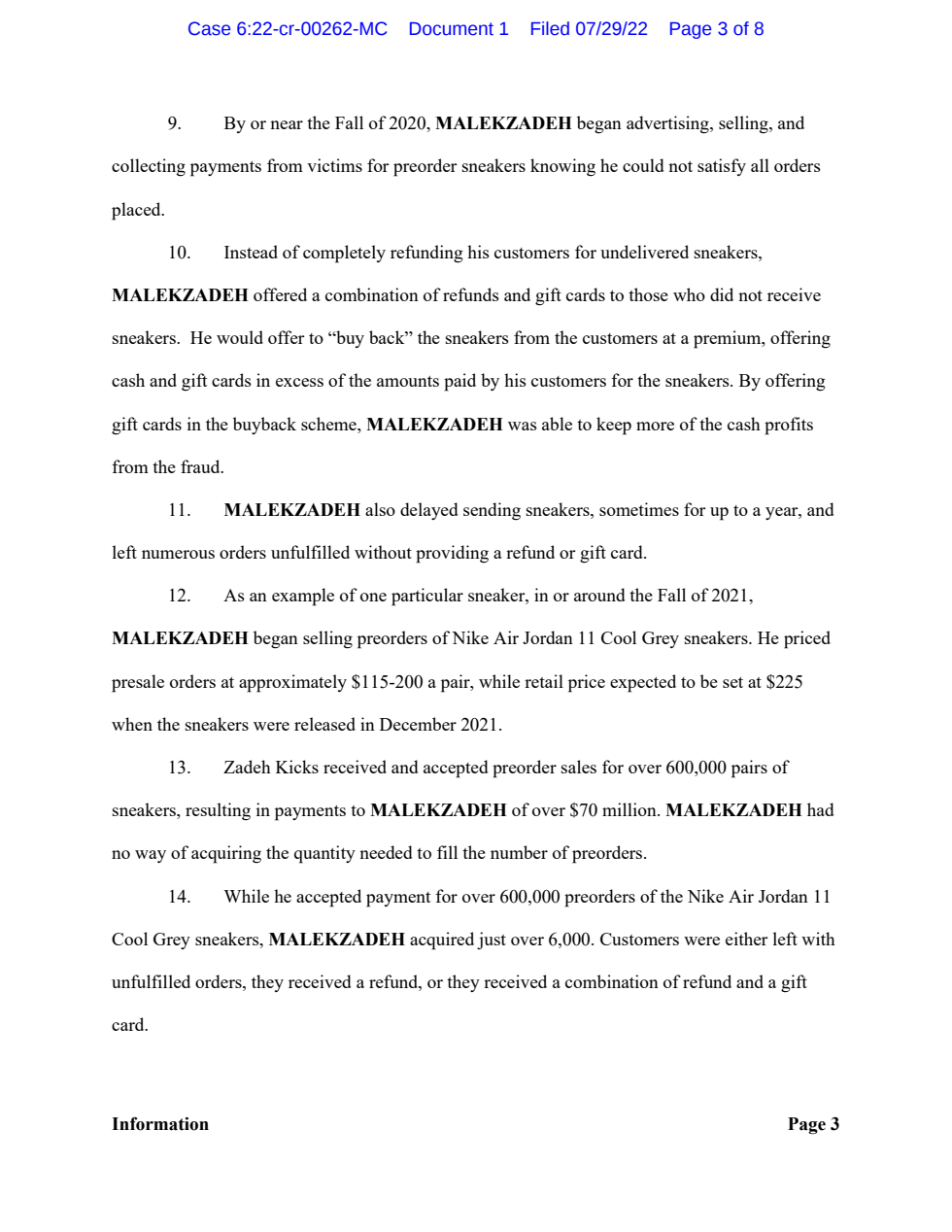
The image shows an actual page of the original charging document, describing the preorder shortages and the use of gift-card refunds.
The Preorder Numbers That Explain the Case
The business began reselling sneakers in 2013, but prosecutors identified a change to fraudulent preorder selling beginning around January 2020.
The sentencing announcement says Malekzadeh advertised and collected money for sneakers before release while knowing he could not fulfill every order.
That finding goes beyond a delivery delay, an unpopular return policy or a buyer disagreeing with the quality of a purchase.
The 2022 criminal information gives a particularly clear example involving the Air Jordan 11 Cool Grey release and the orders accepted beforehand.
It describes prices between $115 and $200, compared with an expected $225 retail price, and more than 600,000 pairs ordered by customers.
The business obtained just over 6,000 pairs, leaving a vast gap between the number sold and the shoes available for delivery.
Those figures describe that particular release in the earlier charging document, rather than a current price comparison or a new shopping recommendation.
The sentencing announcement’s customer-loss figure concerns the wider scheme, so it should not be added to the earlier document’s payment figures.
For buyers, the lesson is that an unusually attractive preorder price needs a realistic supply explanation before the payment becomes a waiting game.
Popularity, previous deliveries and an order number cannot answer how a retailer will obtain the particular quantity it has promised to customers.
How the Zadeh Kicks Scam Works
Step 1: A discounted preorder brings in the payment
The offer let buyers order sought-after sneakers before release, with money collected in advance instead of after the seller secured the inventory.
A lower price can make waiting seem reasonable, especially when a customer expects demand to increase once the shoes become available.
Before placing a comparable preorder elsewhere, establish whether the seller holds stock, has confirmed supply or is simply hoping to obtain pairs later.
Those arrangements have different risks, and a receipt should not be mistaken for proof that the goods already exist in the seller’s possession.
Read the delivery commitment and refund terms before payment, keeping a copy that records the particular promise attached to your order.
Step 2: Orders exceed the shoes the business can provide
In the confirmed scheme, Malekzadeh knew he could not fulfill all the orders but continued advertising and accepting payment for them.
The Cool Grey example makes the shortage concrete, because the quantity acquired was only a small fraction of the quantity ordered.
A customer could hold a genuine order confirmation while the underlying purchase remained impossible for the business to fulfill as promised.
That difference matters when a seller answers questions with account records or sales totals instead of evidence about your actual shipment.
Ask for a realistic delivery explanation tied to the goods ordered, rather than treating a busy order system as proof of supply.
Step 3: Delays keep the customer waiting for fulfillment
The original information describes serious delays affecting orders, including some that remained unfilled for as long as a year after payment.
Waiting consumes time that may matter to a payment dispute, particularly when the customer keeps accepting a new explanation for the same missing goods.
An amended delivery estimate should therefore be saved alongside the original promise, with the date the seller supplied each new explanation.
Do not let a merchant’s request for patience replace a separate conversation with your payment provider about any deadline affecting your options.
The provider can explain how it treats the original transaction and delivery promise, including whether any dispute route is still available.
Step 4: Cash and gift cards replace a full refund
The charging document describes offering customers cash and gift cards together instead of completely refunding payments for sneakers that were never delivered.
The proposed buyback exceeded the original sneaker price, but its gift-card portion let the operator keep more cash within the business.
A credit visible in a retailer’s account is not equivalent to money returned, particularly when using it requires placing another order.
Before accepting store credit elsewhere, ask whether it replaces a cash refund and what happens if the business cannot fulfill the next purchase.
Keep the proposed terms and your response, because the difference between a refund request and acceptance of credit may matter later.
Step 5: The criminal case leaves a separate recovery process
The guilty pleas and prison sentences establish criminal responsibility, but they do not mean every customer has already received their money back.
Malekzadeh was ordered to forfeit more than $15 million in assets, while the Justice Department’s case page separately addresses restitution proceedings.
Forfeited assets, customer losses and eventual distributions are different figures, and none should be treated as a guaranteed repayment percentage for your order.
Affected buyers should retain their evidence and verify current instructions, including any applicable deadline, through the actual government case page.
Do not pay someone who claims a private fee will move your order ahead of other victims or unlock seized money immediately.
Who Operated Zadeh Kicks?
The retailer was connected to a named owner
The sentencing announcement identifies Malekzadeh as the owner of Zadeh Kicks LLC and describes his responsibility for the fraudulent sneaker preorders.
This was a case involving a real resale business, making its history of trading part of the context rather than proof of future reliability.
A retailer can have supplied goods previously and still commit fraud later, which is why the particular promises and conduct matter.
Mockerman’s conviction involved the bank-fraud conspiracy
Bethany Mockerman, identified in the case as the company’s chief financial officer, pleaded guilty to conspiracy to commit bank fraud.
The Justice Department’s updated case page records her January 2026 sentence of 18 months in prison, followed by five years of supervised release.
Keep her conviction separate from Malekzadeh’s wire-fraud conviction, rather than assuming every defendant was convicted of every allegation mentioned in the case.
Bank applications formed another part of the fraud
The Justice Department describes more than 15 loan applications using altered financial statements and more than $15 million obtained through bank fraud.
Those applications help explain the wider criminal case, but an affected sneaker buyer’s records should focus on their own payments and missing orders.
Do not combine a business’s bank borrowing with your purchase total when reporting the amount you personally lost through an undelivered preorder.
The official case page is the place for updates
The Justice Department’s Zadeh Kicks case page provides victim information and court updates, including changes to the timetable for restitution proceedings.
It currently lists a restitution hearing for February 23, 2027, replacing earlier dates that should not be treated as current instructions.
Verify the page again before relying on that date, because court schedules can change and a hearing date is not a payment promise.
A Refund, Store Credit and Restitution Are Different
Several different records can arise from the same missing order, and confusing them can make a buyer overestimate what has actually been recovered.
Use the following distinctions when organizing your evidence or discussing an older purchase with a provider, investigator or legitimate victim-services contact.
| Record or term | What it shows | What to check next |
|---|---|---|
| Preorder confirmation | The goods ordered and the seller’s promise | Original delivery date and amount paid |
| Gift card or store credit | Value recorded with the retailer | Whether cash was returned or credit remained unusable |
| Payment-provider dispute | A request to review a particular transaction | Eligibility, deadline and the provider’s decision |
| Restitution proceeding | Court consideration of compensation obligations | Current official instructions and any required victim information |
An old purchase may be outside ordinary dispute windows, but the provider should explain that position using the actual transaction and delivery history.
Keep any earlier claim decision as well, so a later inquiry does not lose the reasons, dates or evidence already considered.
What to Do if You Have Fallen Victim to This Scam
-
Collect your order confirmation, invoice, payment receipt and the delivery terms that applied when you paid, keeping the original files where possible.
Add subsequent delay messages, refund requests and any gift-card offer, arranging them by date so the change from the original promise remains clear.
List each missing order separately and record any money actually returned, rather than treating an unused store balance as a completed refund.
-
Contact your original payment provider through its established support route and describe the undelivered goods, purchase date and promised delivery date.
Ask whether any dispute or recovery option remains available, what evidence is required and which deadline applies to your particular transaction.
If the payment is too old for that process, request the explanation and reference number instead of assuming a later sentence reopens the window.
-
Open the Justice Department case page linked above and check its current victim information, court notices and any instructions relevant to your loss.
Read the applicable notice before supplying documents, using only contact routes reached through the genuine agency page rather than an unsolicited recovery message.
Keep any confirmation or reference provided, and retain your prepared records if the page is unavailable until you can verify the proper route.
-
To report your online purchase loss, begin at IC3.gov and select File a Complaint to reach the FBI’s process for reporting internet crime.
Read the terms, provide accurate transaction and business details, then review the account before submitting it and retaining the confirmation supplied.
Separate documented payments from estimates and explain any refund already received, so the report does not overstate the amount still missing.
-
Reject messages demanding an advance payment, banking password or private wallet access to release compensation connected with the Zadeh Kicks case.
A person repeating genuine court details can still be an impostor, so verify the request independently before sending documents or discussing financial information.
If you already paid that new contact, tell the payment provider it was a separate transaction and preserve the recovery offer as additional evidence.
-
Track provider decisions and official case correspondence together, recording dates, references and the amount recovered through each route for your own orders.
If a notice gives you a deadline, confirm the required action and retain proof that you completed it through the stated legitimate channel.
Ask the issuing office about unclear instructions, because neither an old retailer balance nor a criminal sentence confirms that your individual claim is complete.
Frequently Asked Questions
Was the Zadeh Kicks scam confirmed in court?
Yes, Malekzadeh pleaded guilty to wire fraud and conspiracy to commit bank fraud, and received a 70-month federal prison sentence in January 2026.
The confirmed conduct included taking sneaker preorder payments while knowing the business could not fulfill all the orders it was accepting.
Why was this more than an ordinary shipping delay?
The sentencing announcement describes knowing deception when payments were collected, while the original information illustrates the extreme shortage behind a major sneaker release.
A missed delivery date alone would not establish those facts, but the admitted scheme and sentencing outcome provide evidence beyond customer dissatisfaction.
Did every preorder involve the same sneaker or price?
No, the Cool Grey example concerns one release described in the earlier charging document, while the scheme involved a wider range of preorder activity.
Use your own invoice and payment records when documenting a loss, rather than borrowing another release’s price or quantity for your report.
Is a gift-card refund the same as getting my money back?
A gift card keeps value with the retailer, while a completed cash refund returns money through an actual payment route you can verify.
Preserve any credit offer and acceptance terms, and record whether you received spendable money, replacement goods or only an account balance.
Does the restitution hearing guarantee a payment date?
No, a hearing concerns court proceedings and should not be treated as a promise that every buyer will receive money on that date.
Follow current official notices for the action relevant to your situation, and reject anyone offering to accelerate compensation for an upfront payment.
Does this case mean all sneaker preorders are fraudulent?
No, the confirmed deception concerned this operator’s conduct, including knowingly accepting orders the business could not fill and the separate bank-fraud conspiracy.
For another seller, assess its actual supply, delivery commitment and refund terms rather than treating the entire resale market as the same case.
The Bottom Line
Do not send more money to recover a Zadeh Kicks preorder, and do not mistake store credit for a refund already received.
The confirmed fraud involved orders the seller knew it could not fulfill, leaving buyers without the sneakers promised in exchange for their payments.
If you were affected, organize each missing order, ask your provider about remaining options and use the genuine government case page for current instructions.

Join the discussion
0 commentsShare your experience or ask a question about this article.
Community experiences
Did this happen to you?
Your experience could help someone recognize the same scam. Submit a private report for our team to review.
I experienced this tooReports are reviewed before publication. Sharing publicly is always your choice.
Discussion
Start the conversation
Have a question or something useful to share? Add the first comment.