


Someone says a wireless company might pay rent for a small corner of your land. At first, the paperwork sounds like the hardest part.
Before you picture a monthly deposit, find out who is actually willing to put their name on the other side of the lease.
Overview
Property owners paid for a search that was not performed as promised
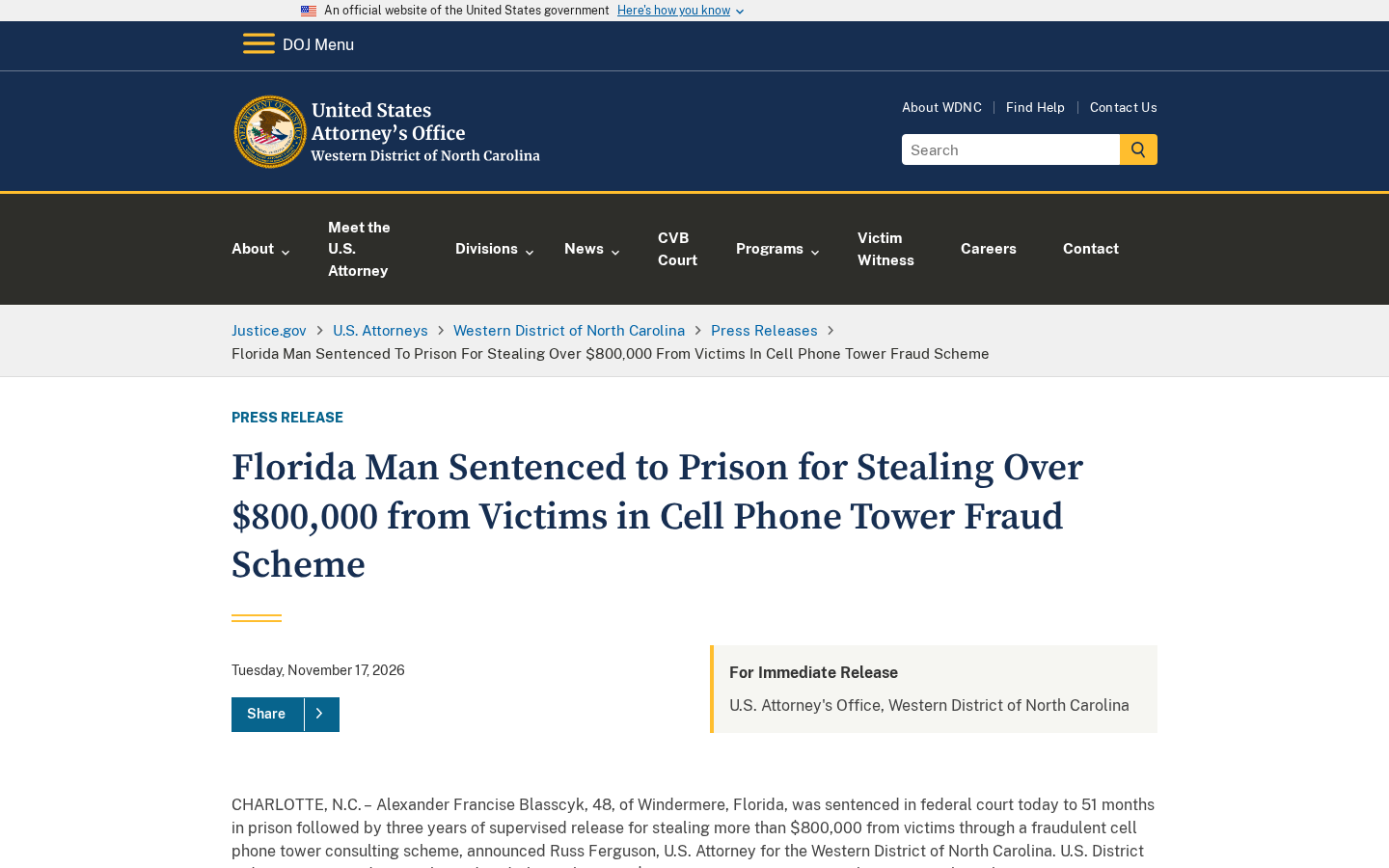
A cell tower lease can be a real source of rent. In Alexander Francise Blasscyk’s case, the fraud began with the paid promise to market property to wireless companies.
The U.S. Attorney’s Office for the Western District of North Carolina says Blasscyk took money from hundreds of individuals and businesses between 2018 and 2024.
He promised to market their land and negotiate lease agreements. According to the federal case, he did not market the properties or negotiate the leases as promised.
Blasscyk pleaded guilty to wire fraud in October 2025. On November 17, 2026, a federal judge sentenced him to 51 months in prison, followed by three years of supervised release.
A pile of paperwork did not establish a willing tenant
The Justice Department describes false consulting agreements, letters of intent and lease papers. Their promised rent schedules were no evidence that a wireless provider would pay.
A consultant can describe possible rent without having a carrier ready to lease. The questions to ask are who would pay you and who independently verified their interest.
Separate these items before you treat a request as a real deal:
- A paid consultant’s agreement spells out work, not whether a tenant will agree to lease your property.
- A letter of intent can describe terms under discussion without starting rent.
- An invoice for a study or filing is not proof the work was ordered or completed.
- A company’s name on a lease draft does not show that a representative signed or authorized it.
The loss number and the restitution order answer different questions
The DOJ reported approximately $816,460.29 in losses. The judge ordered $1,039,115.30 in restitution, a different figure from the losses described in the announcement.
An order to pay is not a payment that has reached your account. A message asking you to cover processing costs before receiving restitution should not be trusted.
The companies named in the case were Main Stream Telecom II, LLC and Organic Telecommunications, LLC. A similar business name alone does not identify either entity.
How the Cell Tower Lease Scam Works
Step 1: The offer gives your existing land a new purpose
The pitch works because you already own the asset. You are not asked to buy a tower; you are told a consultant can make space on your property valuable.
A proposal can sound especially plausible if service in the neighborhood is poor. That local observation does not establish that a carrier needs equipment on your particular parcel.
For an actual project, someone has to decide whether a site fits their network and secure the required rights and approvals. The landowner’s willingness is only one piece.
Ask who requested the work, who is considering the site and who is paying whom. A vague reference to multiple carriers does not answer any of those questions.
Step 2: A consulting fee puts the landowner on the paying side
Blasscyk collected fees for supposed marketing and negotiations. Someone who thought they were about to collect rent instead had to pay to get the process moving.
Some independent advisers charge for real professional work. That makes the scope and completion evidence important, rather than making all professional fees suspicious by definition.
Ask what you get if no tenants are interested. A promised report, list of inquiries or other defined work should be verifiable even if no carrier makes an offer.
If the contract promises nothing you can check, you are paying for the consultant’s explanation of what might happen. An expected monthly rent is not proof of a deliverable.
Step 3: Official-looking documents make the promise seem further along
The case involved false documents purporting to show milestones that matter in actual real estate work. Some described lease terms and payment schedules that the recipients expected to rely on.
A clear-looking lease draft reduces uncertainty on paper without showing that an actual tenant approved it. Check for communication from the proposed tenant that you initiated through an independent channel.
With letters of intent, ask what still needs approval before any obligation arises. If a tenant cannot confirm the parcel or reference, pause before sharing more information or paying.
An address and map can identify a real piece of land in a bad proposal. They show what property the pitch mentions, not that the deal exists.
Step 4: More expenses appear before any rent arrives
Prosecutors describe later requests for purported title searches, legal fees, Federal Communications Commission applications, bird studies and equipment upgrades. Their familiar names did not make those bills genuine.
Different legitimate parties can be responsible for studies, permit applications or site work, depending on the project. A demand from the same intermediary does not establish responsibility for a fee.
Ask which professional, agency or company supposedly received payment for the work. Contact that organization independently rather than through the number on the demand.
Consider the sequence, not just each invoice. When the fees pile up and rent never begins, do not pay again to protect what you already spent.
What Would Independently Verify a Tower Deal?
Start with a parcel and a counterparty, not a rent estimate
Find the parcel number on your own county property record or tax bill. Document which part of the parcel the proposal identifies, including access across any adjoining property.
Ask the consultant to provide the exact legal name of the company that would be the tenant. A carrier, tower operator and site acquisition contractor have different roles.
Look up the named company independently. Contact its official real estate or site acquisition office, or ask its public corporate number to direct you to the right team.
Ask whether the office recognizes the project reference, parcel and intermediary. It may restrict what it can disclose, and that is a reason to pause, not to accept missing confirmation.
Verify a filing according to what it actually covers
Ask your county planning or zoning office how to search by parcel or address. Have the application number or applicant’s legal name ready if available.
If a supposed receipt names a county fee, ask the county office to check that reference and what it covers. Do not send another payment just to find out.
A local filing may not mean a lease was signed. A permitting record can describe a proposed site, and a real lease can still have conditions that delay rent.
Treat a federal fee claim the same way. Ask what filing supposedly applies, what agency would receive it and how the amount can be confirmed through an official route.
Get the payment terms and the property rights read together
A real lease or option can affect access roads, utility routes and use of your land. Those provisions may matter years after the person who first contacted you leaves.
Have a local real estate attorney explain what rights any signature creates and whether the agreement can be recorded. Ask which obligations start now and which start later.
A document called an option can give someone a future choice to lease without promising immediate rent. Pay attention to when dates, conditions and payment amounts actually apply.
Do not assume that a verbal promise upgrades a written agreement. If the two disagree, resolve the difference before signing, paying or allowing anyone on the land.
Match the consultant’s business name to each invoice
A real person can work for more than one company, but each contract should still identify who owes you a service and whose account should receive payment.
In this case, prosecutors named both Main Stream Telecom II and Organic Telecommunications. The names appearing on documents were not the same thing as a carrier agreeing to rent.
Check the exact entity in the relevant state’s business search if a consultant names it in an agreement. A registration may identify the company without verifying its work.
If the invoice uses a different entity from the agreement, ask for a written explanation before paying. Contact the purported tenant or vendor through details you found independently.
Ask whether the consultant earns a fee from you, the proposed tenant or both, and whether any amount is refundable if the promised work is not delivered.
If an outside lawyer or engineer really did a job, ask for their invoice and who commissioned it. Do not rely on a secondhand statement that a study happened.
Keep separate copies of an initial fee proposal and any later payment request. A difference in scope can matter more than the same business logo on both documents.
What to Do if You Have Fallen Victim to This Scam
-
Hold the proposed payment and suspend further commitments.
Tell anyone handling the property that the purported lease and invoices are unverified. Do not pay a final fee to unlock the first check or accept a revised payee.
If a visit is planned, do not authorize access or work until you know who ordered it. Inform co-owners if the request reached one person first.
-
Call the verified payment provider with each transaction reference.
Use the bank’s normal fraud contact and give the amount, date, recipient and reference. Explain whether you authorized the transfer and later discovered deception.
Ask whether the provider can stop a pending transfer, request a recall or open a dispute for the method you used. The outcome depends on payment status and provider rules.
If a check has cleared, ask for the paid item if available. It can help distinguish the person you intended to pay from the account that accepted it.
-
Find out whether you signed away any property rights.
Save every agreement, letter and map. Write down which pages were signed, whether anyone else signed, and whether you were told a document would be recorded.
Ask the county recording office how to check records by name or parcel. Get copies of unfamiliar filings for your own real estate attorney to review.
Do not try to fix a possible recording problem by signing a document supplied by the same person. Get advice about the particular agreement and local record first.
-
Group the evidence by property, fee and represented service.
Keep the first pitch, any tenant names or project numbers, and each invoice for a named report or filing. Put bank confirmation and correspondence beside each payment.
Preserve statements that claimed a carrier had approved the property. Those representations can explain why you incurred costs that look routine when read in isolation.
Save evidence of who was contacted independently. The bank or investigator should be able to distinguish what the consultant promised from what a real office confirmed.
-
Report the fraud through an independently opened route.
For internet-enabled contact or payments, start at the FBI’s Internet Crime Complaint Center. Provide the payment sequence without guessing who received money that you cannot trace.
If you believe you are part of the federal Blasscyk case, contact the prosecuting U.S. Attorney’s Office using its official site. Ask how to reach its victim assistance team.
Save the official confirmation with your other evidence. Do not pay a private service to add your name to restitution or to collect the same money a second time.
Frequently Asked Questions
Do legitimate cell tower leases ever pay property owners?
Yes, a lease can provide rent when a real tenant agrees and the contractual conditions are met. The issue here was an unperformed promise to market and negotiate.
Does a consultant have to work directly for the wireless company?
Independent advisers can assist landowners, but that is not the same as being authorized by a carrier. Verify the consultant’s role before assuming they speak for the tenant.
What if the land is in a good place for a tower?
A plausible location does not verify a particular deal. Ask the proposed tenant whether it recognizes the parcel and consult the relevant local office about any claimed filing.
How did Blasscyk make the proposal feel real?
The Justice Department described false letters of intent, agreements and expense requests. They gave the appearance of a project without the marketing and negotiations he had promised.
Why is the restitution order different from the announced losses?
The sentencing release lists the two figures separately. Treat the restitution order as a court obligation, not a schedule or promise that each individual has already been paid.
Can I tell whether a site is real from a project number alone?
No, a number is useful when the real company or agency can confirm it. A genuine-looking reference on a piece of paper is not independent confirmation.
The Bottom Line
Do not pay for a tower deal the supposed tenant cannot confirm. If the agreement is only for consulting, require evidence of the specific work before paying.
If you already paid, contact your payment provider now. If you also signed a document about access or a lease, check its status with the county and an independent attorney.

Join the discussion
0 commentsShare your experience or ask a question about this article.
Community experiences
Did this happen to you?
Your experience could help someone recognize the same scam. Submit a private report for our team to review.
I experienced this tooReports are reviewed before publication. Sharing publicly is always your choice.
Discussion
Start the conversation
Have a question or something useful to share? Add the first comment.