


A passenger name on a report looks ordinary until the person does not recognize the ride. A driver’s name can raise exactly the same question.
The records in the Pearl Transit case looked like evidence of services. Checking the names helped show what the paperwork was hiding.
Overview
Pearl Transit claimed to provide rides and outreach it had never delivered
The company said it used drivers to take older people and people with disabilities to destinations and provided outreach to people experiencing homelessness.
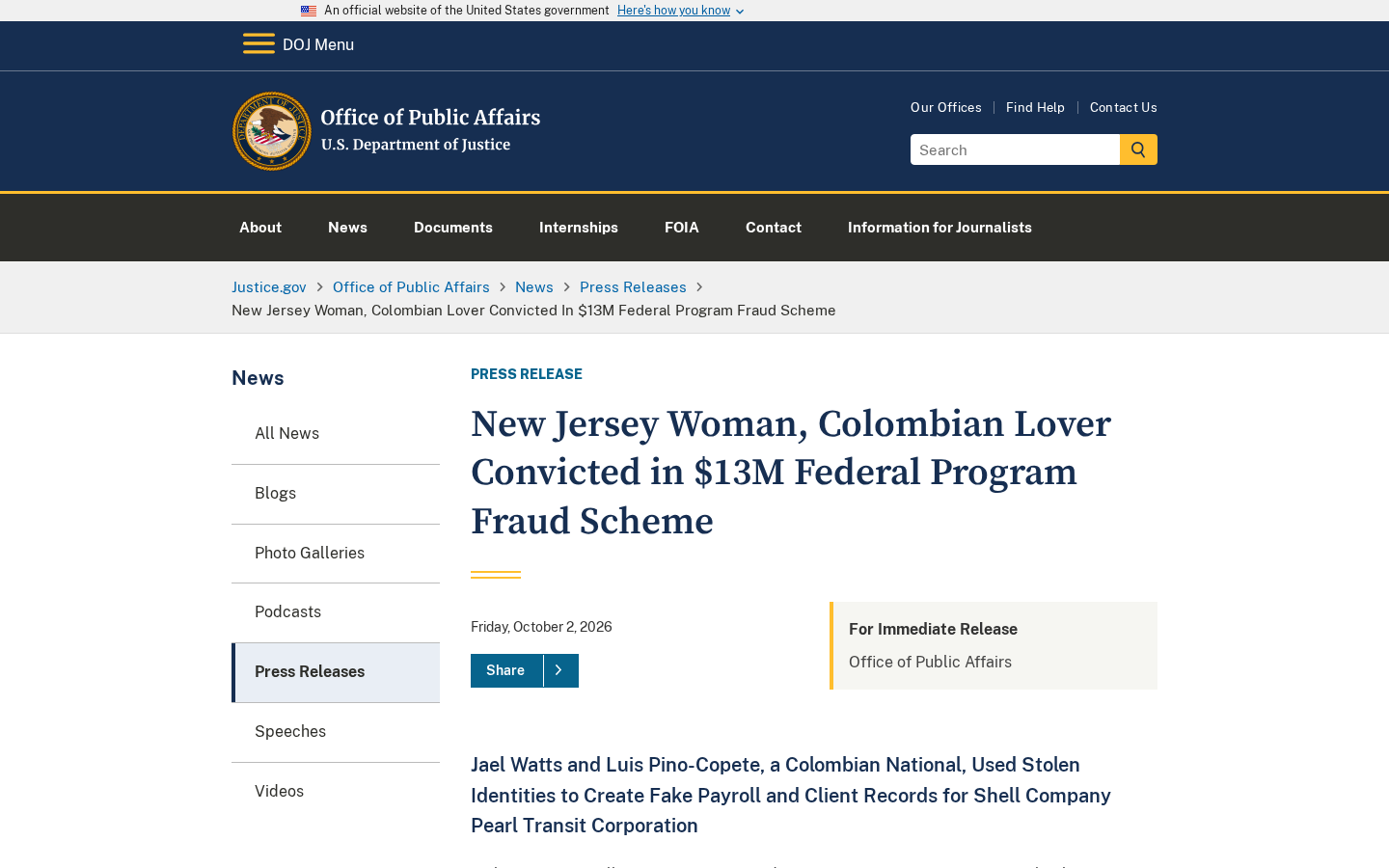
The Justice Department’s October 2, 2026 verdict announcement says Pearl Transit Corporation did not employ the drivers or perform those services. A jury convicted Jael Watts and Luis Pino-Copete.
The case concerned false reimbursement requests through public grant programs. Government administrators were the targets of those claims, which were not sent as passenger invoices.
Prosecutors described false employment and customer records using the identities of real people. A person did not have to take a ride or cash a paycheck to appear in them.
More than $13 million was requested, but that is not the amount paid
According to the DOJ, the scheme sought more than $13 million through false claims. The evidence at trial showed more than $1.6 million was actually obtained.
The first number measures what the filings asked for. The second measures money obtained, which was far less than the amount requested.
Prosecutors reported payments from programs administered in Georgia, California and North Carolina. Suspicious New York requests prompted an audit rather than proving the requested money was disbursed.
- A grant award or an approved provider can be real while a specific reimbursement request is false.
- A name on a payroll list does not establish that any work was done by that person.
- A list of riders does not prove any trip took place.
- An amount requested is different from an amount an agency disbursed.
A state audit tested whether there was evidence outside the forms
The DOJ says New York officials became suspicious after a request for nearly $750,000 in transportation reimbursements. The state comptroller’s office initiated an audit.
Investigators found that supporting records submitted in response were false. The DOJ says some purported passengers had died before the reported rides and some named drivers did not drive.
A claim, the papers offered to support it, and records held outside the claiming organization are three separate things. That distinction matters if you are reviewing a questionable service.
How the Pearl Transit Reimbursement Scam Works
Step 1: A request is attached to a program that really pays for services
The Federal Transit Administration’s Section 5310 program is real. So are HUD programs such as the Community Development Block Grant and Emergency Solutions Grants named in the case.
Some funding flows through state or local administrators. That means the organization requesting reimbursement, the government office paying and the federal funding source can all have different names.
In the Pearl case, the claimed services included rides and outreach. Those are services public programs can support, which makes a request worth reading rather than immediately implausible.
The useful question is not simply whether the program exists. It is whether the particular provider actually did the work it is claiming under the applicable program.
Step 2: A real name makes a false service record harder to dismiss
An invented passenger and a stolen identity can lead to different consequences. A real passenger name might pass a quick search while recording a ride that was never taken.
The trial evidence described records listing real people as purported workers or service recipients. Some people were assigned roles that could not match their actual circumstances.
If your own name appears, you may not know how it was obtained. Record exactly which role it was tied to before asserting that your benefits or bank account changed.
A person used as a supposed driver should ask about any payroll or tax records. A person listed as a rider should ask about the particular service entry.
Step 3: Reimbursement is requested for work the provider says is complete
A routine reimbursement is supposed to repay an eligible cost. A supporting invoice only shows what someone claims to have paid or done until the records are checked.
The Pearl Transit filings sought money for services that did not take place. The court case is about false performance, not merely a real ride that missed a reporting deadline.
An administrator can compare the specific claim with the period, authorized activity and payment records. A passenger can simply say which ride they did not take.
If the reported service overlaps a real service someone else provided, keep those two events separate. The genuine ride should not become evidence that the disputed one happened.
Step 4: An audit separates the submitted story from independent records
The New York request led to a state audit and then a broader investigation. The later materials offered by the defendants did not establish that Pearl Transit did the work.
Prosecutors described the New York audit alongside separate payments from programs elsewhere. Finding a suspicious invoice in one jurisdiction opened a path to check others.
When you locate an inconsistency, keep the unaltered original and the source of the contradiction. A neat replacement spreadsheet can make it harder to establish what was submitted.
If someone asks you to confirm work you did not perform or a trip you did not take, do not sign. Contact whoever administers the actual program yourself.
Why the Same Records Look Different to Drivers, Riders and Administrators
An unfamiliar ride is not necessarily a bill you owe
Find the copy or description of the trip entry through the legitimate program or provider. Compare the date, vehicle provider and route with any ride you actually arranged.
A passenger can be named in a false claim without being asked for any money. Ask which records contain your name and how to dispute them.
You do not have to provide complete identity documents to an unsolicited caller to challenge a trip. Ask the office you called independently which verification it requires.
If a real ride is scheduled now, confirm it through the normal dispatch channel. Reporting an unfamiliar entry should not require you to give up legitimate transportation.
A driver record might need both agency and payroll follow-up
Someone listed as an employee should ask the verified administrator which employer purportedly hired them and the period covered. Keep copies of anything the office can provide.
A claim that you drove somewhere is not necessarily a tax statement, and different records can take different correction paths. Keep the reported work and any wage notice distinct.
If wage information appears, contact the legitimate issuer or the agency named on a verified notice. Tell them the employment was not yours and ask how to correct it.
If records use other people’s information, do not collect or circulate their documents to prove your own point. The assigned investigators can pursue those records securely.
An administrator can examine activity without making a public accusation
Compare just the relevant claim with records held independently of the vendor. If the same vendor supplies both the invoice and purported confirmation, seek evidence from a different source.
Actual program rules determine what records an administrator is entitled to see. Use authorized staff and channels rather than asking a private individual to share participant data by email.
If a payment is pending, follow your agency’s internal process for review and preservation. Document who can pause or approve it rather than attempting changes outside your role.
Make the request narrow enough to answer. A discrepancy on a single ride, employee or reporting period is a better start than treating an entire grant as suspect.
How to Keep the Right Records Without Spreading Personal Data
When several agencies are involved, give each one the relevant dispute rather than circulating a roster of names. A funding reference can be enough to direct the first call.
Keep a secure copy of a record you are authorized to see. If you cannot obtain a copy, write down the date, custodian and exact entry you are challenging.
Send only what the verified office says it needs through its secure channel. Redact unrelated information in copies where allowed, without changing the original.
If you are reporting for a beneficiary, ask what authority the agency needs before it can speak to you. Do not impersonate a relative to get information.
For a deceased person, contact the record custodian first. It can explain whether a representative needs proof of death or evidence of authority before the record can be disputed.
Do not assume you must mail the records to every office named on the form. Ask which organization actually holds the disputed information and can attach your request.
Record the date and case reference whenever an office sends you elsewhere. That gives the next person a place to start without you resending sensitive documents.
If a legitimate provider confirms a data mistake, ask how to verify the correction. If it cannot explain a falsified record, preserve the discrepancy for the investigating office.
Keep any ordinary correspondence about real services separate from the fraud report. The purpose is to correct a false record, not to disrupt care or benefits that actually exist.
If you work for a provider, give the concern to the agency’s designated compliance contact. Ask how to preserve the submission and its history without changing it yourself.
What to Do if You Have Fallen Victim to This Scam
-
Keep the exact claim or notice before trying to correct it.
Save the date, provider name, program name and any trip, payroll or claim number. Note where you saw the record and which details do not belong to you.
If a message is your only evidence, keep it without using its links or sharing sensitive data. Search for the funding agency independently and ask who handles disputed records.
-
Contact the actual administrator that holds the disputed record.
For a transportation entry, start with the official local or state program contact. Identify the provider, claim or trip date, and say what you believe is wrong.
Ask how you can receive a copy or case number and what it needs to flag the entry. Do not volunteer unrelated medical or household details.
In a payroll case, clarify whether the record is a grant filing, a payroll record or a separate wage notice. Ask the corresponding verified office about its correction process.
-
Report suspected misuse of grant funds to the matching oversight office.
For transportation funds, use the verified DOT Office of Inspector General hotline or call 1-800-424-9071.
For HUD funds, call the HUD Office of Inspector General at 1-800-347-3735. The office can explain how to send the supporting written statement.
Include the program, administrator, dates and exact conduct you can describe. Identify which facts you personally know and which details came from the record.
Save the report confirmation, and ask the assigned office for a secure way to provide any sensitive documents it needs.
-
Check for other misuse if your identity appears in an unauthorized role.
If records suggest your identifying information was used, go to IdentityTheft.gov, report the theft and save its recovery plan. Describe the false employment or service entry specifically.
If you separately find an unknown charge, account or benefit change, contact the provider that holds that record. Do not assume the grant investigation will correct every unrelated system.
-
Use genuine case contacts if the Pearl Transit prosecution applies to you.
Start with the linked DOJ announcement, then use the prosecuting office’s published contact to ask where a potential victim or witness should send information.
Do not trust someone offering to process a personal share of the $13 million for a fee. That figure is not a distribution pool for everyone named in a record.
Frequently Asked Questions
Were the federal programs in the Pearl Transit case fake?
No, the public transportation and housing programs were real. The defendants’ deception concerned who did the work and whether the claimed services had taken place.
Did Pearl Transit receive the entire $13 million?
No, the defendants requested more than $13 million, but the DOJ says the trial evidence showed more than $1.6 million was actually obtained.
Does an unfamiliar rider record mean I have to repay a grant?
A listing does not show that you received money or agreed to anything. Ask the verified administrator to explain what the entry means and how to dispute it.
Can a deceased relative be listed in a false claim?
The trial evidence described purported passengers who had already died. If you find a similar entry, report the specific record and ask what documentation the administrator actually needs.
Will the October verdict fix an unrelated wage statement automatically?
No, benefit, payroll and tax records have distinct correction processes. Contact whichever verified organization holds the disputed record and keep confirmation of your request.
Does a jury verdict mean a restitution payment has been scheduled?
No, a verdict determines guilt rather than a payment schedule. The DOJ notice listed sentencing as a later step, and readers should use official contacts for any case updates.
The Bottom Line
Do not confirm work or a ride you cannot verify. If your name appears in a Pearl Transit or similar record, raise the discrepancy with the actual program administrator.
Keep the original documents and report the specific claim through the right oversight office. Do not pay an intermediary who says they can collect proceeds from the case.

Join the discussion
0 commentsShare your experience or ask a question about this article.
Community experiences
Did this happen to you?
Your experience could help someone recognize the same scam. Submit a private report for our team to review.
I experienced this tooReports are reviewed before publication. Sharing publicly is always your choice.
Discussion
Start the conversation
Have a question or something useful to share? Add the first comment.