


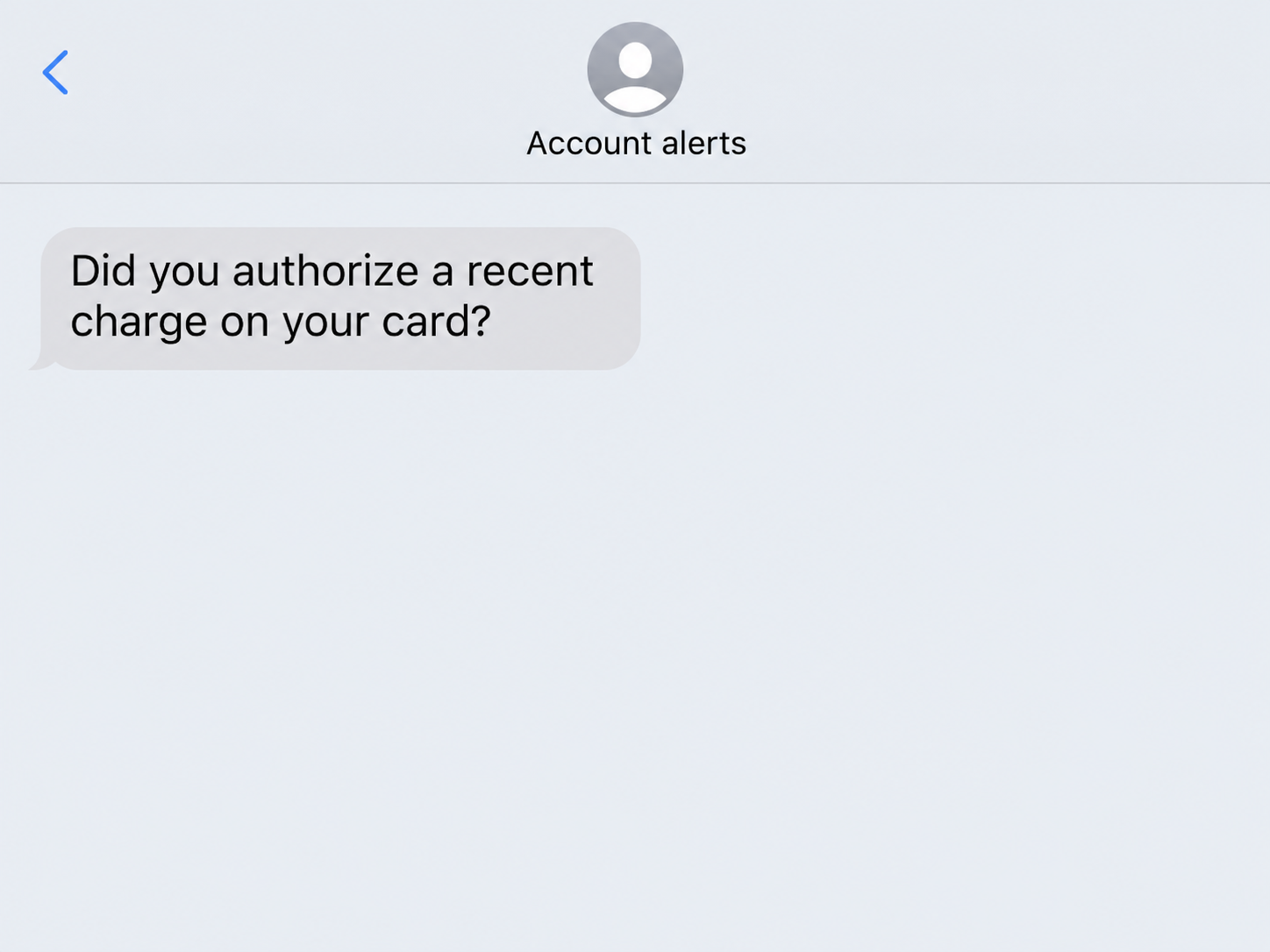
A text asks whether you recognize a debit card purchase. You answer that you did not make it, and someone calls before you can decide what to do next.
The caller sounds like a fraud specialist and knows details about the purchase. Then the conversation reaches a question the customer was not expecting.
Overview
The call started with a charge the customer recognized as wrong
A bank customer reported receiving a text about a purchase they had not authorized. After they responded, someone called claiming to work for their bank’s fraud department.
The caller knew the merchant and exact amount.
They said they could reverse the charge and cancel the card, then asked the customer to check whether it was still in their wallet.
Those details made the conversation feel useful. The next question was about the balance in the account, and the caller kept coming back to it after the customer asked why.
The image above reconstructs the opening text without identifying the customer or merchant. The public report does not name the bank or disclose the transaction amount.
The real bank gave a different account of the contact
The customer hung up and called the bank directly. According to their account, the bank confirmed that it had not contacted them about the charge.
The report describes a repeated request for the balance. Who made the original purchase and what the caller would have asked for next remain unknown.
That separation matters because a genuine unauthorized charge can make a fake fraud call sound credible. Each still needs to be verified through the bank’s own channels.
You can respond to the purchase without answering the caller
The fastest useful thing to do after a suspicious fraud alert is open the bank app on your own. Use what you find there to plan the next call.
- Locate the purchase in your own account and write down what the bank shows.
- End the incoming conversation before giving the caller any more information.
- Call through your app or the number printed on your card.
- Ask the bank whether it sent the alert and what it can do about the charge.
If the transaction is real, a verified fraud team can deal with it. There is no reason to give an unverified caller your balance to start that process.
What the Caller Knew and Why It Was Convincing
An accurate merchant name sounds like information the bank would have. In this case the impersonator also knew the amount, which made the caller seem like someone already investigating.
The question about the card being in the wallet was ordinary enough to lower the customer’s guard.
A real fraud representative might ask something along those lines during a verified call.
The caller then pretended to help the customer review other activity.
The customer asked which of two cards had been used for a second charge, and the caller could not say.
That answer was less decisive than the next exchange.
The supposed representative kept saying the full balance was necessary to make the customer whole, even after the customer questioned the connection.
When you call the real bank about a specific debit you did not authorize, have the amount, merchant and transaction date handy.
The Federal Trade Commission’s warning about bank fraud calls describes callers who use fraud claims to get account information or tell customers to move their money.
In the reported conversation, the caller asked for the balance and objected when the customer said they would call the bank directly. The conversation stopped before any later instructions.
How the Fake Bank Fraud Department Scam Works
Step 1: A text introduces a charge you want to stop
The first message asks about a card purchase. It feels like a question you should answer quickly, especially if the amount and merchant mean nothing to you.
Banks can send real alerts too. The question on a screen is why the customer went looking for the charge, but it cannot by itself tell them who sent it.
Step 2: A caller offers to carry out the reversal
A person calls after the reply and picks up the conversation as if they have the same case in front of them. The timing does much of the convincing.
In this instance the caller said they could cancel the card and reverse the debit. That gives the recipient a reassuring explanation for a conversation they may not have expected.
Step 3: The conversation turns to information about the whole account
After discussing the disputed purchase, the caller asked how much money was in the account. They claimed the number was needed in case there were other fraudulent charges.
The customer challenged that logic more than once. For the reader, the important part is the shift from sorting out a transaction to answering questions about money beyond that transaction.
Step 4: The caller tries to keep the customer on the line
When the customer proposed calling the bank directly, the caller objected.
Whatever the original story was, switching to the number the customer already trusted would have taken control away from them.
The customer ended the call anyway. Once they reached the bank through a known route, they could confirm whether the initial contact was authorized and discuss the actual purchase.
Some bank impostors go on to ask for transfer approvals or money moved to a supposedly protected account.
The source in this case did not stay on the line long enough for that.
How to Check a Fraud Alert When It Might Be Real
Compare the alert with transactions you can see yourself
Start in the app you normally use. Check the cards attached to the account, including any other cardholder’s activity you have permission to review.
Note what is pending and what has posted. A merchant may appear under a billing name you do not recognize, or a second cardholder might know about a purchase.
Use the bank to resolve a mismatch rather than debating it with the stranger.
The bank can tell you which card is involved once it verifies you through a trusted call.
If the alert mentions a transaction you cannot find, keep its timestamp and check again with the bank. A display delay is possible, so direct confirmation is still useful.
Make a fresh call through a channel you can verify
Open the contact section in your banking app, or dial the number on the back of the physical card. Call as if you were making the first report.
The person on the new call can tell you how their verification process works.
You can ask them to explain what information they need and how it relates to the dispute.
Treat caller ID as a label you can see, just like the name on a text.
The fact that it matches your statement is no substitute for starting the call yourself.
If you receive another call while you’re speaking to the real bank, let it go. A fraudulent operation depends on keeping your attention in the conversation it started.
Treat a request to move money as urgent in a different way
A follow-up caller may say that your money belongs in a separate account while the bank works on the fraud. Contact your issuer directly before approving any transfer.
The FTC’s guidance about calls claiming your money is at risk warns that moving money on someone else’s instructions can send it straight to the people behind the call.
A verification code or approval prompt can have its own description. Read what it authorizes, and decline anything you did not initiate through the bank.
When the Text Shows Up in a Familiar Conversation
Most messaging apps group texts by the sender information they receive. A message that sits beside old banking alerts may feel familiar before you finish reading it.
If the new message suddenly demands a callback or moves the conversation to another number, start again from your card.
The previous messages do not verify who made the new contact.
Real fraud teams may legitimately call customers. You can still say that you will call the bank yourself, then give the verified representative any case reference the first caller supplied.
If you have a joint account, tell the other cardholder what happened before they speak to anyone about it. Agree to check the cards together through the bank’s trusted channel.
Make sure you distinguish the transaction you originally disputed from any new money movement. A caller might use a genuine purchase to steer you toward approving something unrelated.
Write down whether you saw the disputed purchase in the bank app or only heard about it on the phone.
That helps support sort the confirmed activity from the caller’s claims.
You can also note any new funds transfer, device login or payee that appeared after the call. Those events may need a different response than replacing the original debit card.
What to do when the caller only obtained a balance
An account balance tells someone how much money is available to target. It does not serve the same function as a password or a code that authorizes an action.
Tell the bank you shared the balance, even if the call seemed to stop there. The details help the bank flag later contact that refers to the amount.
If the next caller claims to know an earlier answer, treat it as information that could have been passed along. Familiarity with the previous discussion cannot verify the new caller.
Open any banking approval notification independently and read what action it describes. An unexpected confirmation can refer to a sign-in, a payment or adding a device.
If an approval has already gone through, tell the bank what the notification said when you saw it. Keep a copy if you can retrieve it without accepting another prompt.
A second purchase can also be unrelated to the impersonation. Identify both by date and amount so the fraud team can review them individually.
What to Do if You Have Fallen Victim to This Scam
-
Write down the time and displayed number, save the text that started the conversation, then end the call and stop responding.
-
Call from your bank app or the number on your card to verify the alert and identify which account or card the transaction involves.
-
Tell the bank whether you disclosed a balance, card details or a code, and whether you approved a password reset or payment.
-
If you paid or approved a transfer, report the amount, time and recipient and ask whether your provider can stop or reverse it.
-
Follow the bank’s directions about locking your card, securing access or reviewing the details of a payee you did not add.
-
Keep the case number and transaction records so you can follow up through the same verified channel as the charge changes status.
If the caller learned only your balance, say that clearly. Ask what the bank recommends monitoring and tell it about any card number or approval code that was also disclosed.
If you approved a payment after getting a false explanation, explain the full sequence when you report it. That detail helps the bank understand why an approval may be present.
The FTC’s guide for people who paid a scammer explains how to approach banks and payment providers. Preserve the bank’s responses and the original message before deleting anything.
Even when you stopped the call in time, the disputed purchase still deserves a report. Verify with the bank whether the card is safe to use while it investigates.
Frequently Asked Questions
Is the text real if it correctly describes a purchase?
Matching information gives you a useful transaction to look up. You still need to contact the actual bank to confirm whether it sent the message and to dispute the purchase.
Why would a fake bank caller ask for my balance?
The question can reveal how much money is available and steer the next conversation. In this report, the caller claimed it was a condition for resolving other possible charges.
Can I trust the phone number displayed on the call?
Use your card or the official app to find a number independently. Displayed numbers can be spoofed, and a matching number does not tell you who is speaking.
What if I replied to the text but shared nothing else?
Tell the bank about the reply and confirm the disputed activity through its app. A reply by itself is different from disclosing a code, sending money or approving a transfer.
Should I freeze the card before talking to the bank?
If your app provides a temporary lock and you see unfamiliar activity, use it if appropriate. Then speak to the bank about how it handles the transaction and card replacement.
What if the person calls back while I am checking the charge?
Let it go to voicemail and keep speaking through the bank’s official channel. The real fraud team can tell you whether a callback was scheduled and what to do next.
The Bottom Line
End an incoming fraud call that turns into a request for your bank balance. Call the bank through your card or app to verify the alert and protect the account.
If you already shared information or approved a payment, tell the bank the sequence. It can address the transaction and secure any account access you exposed.

Join the discussion
0 commentsShare your experience or ask a question about this article.
Community experiences
Did this happen to you?
Your experience could help someone recognize the same scam. Submit a private report for our team to review.
I experienced this tooReports are reviewed before publication. Sharing publicly is always your choice.
Discussion
Start the conversation
Have a question or something useful to share? Add the first comment.