

Phytomem One greets visitors with a confident promise about protecting memory in a world filled with hidden environmental threats.
The presentation feels polished at first glance. A closer reading reveals several details worth checking before anyone accepts the explanation or the price.
Overview
What Phytomem One says it can do
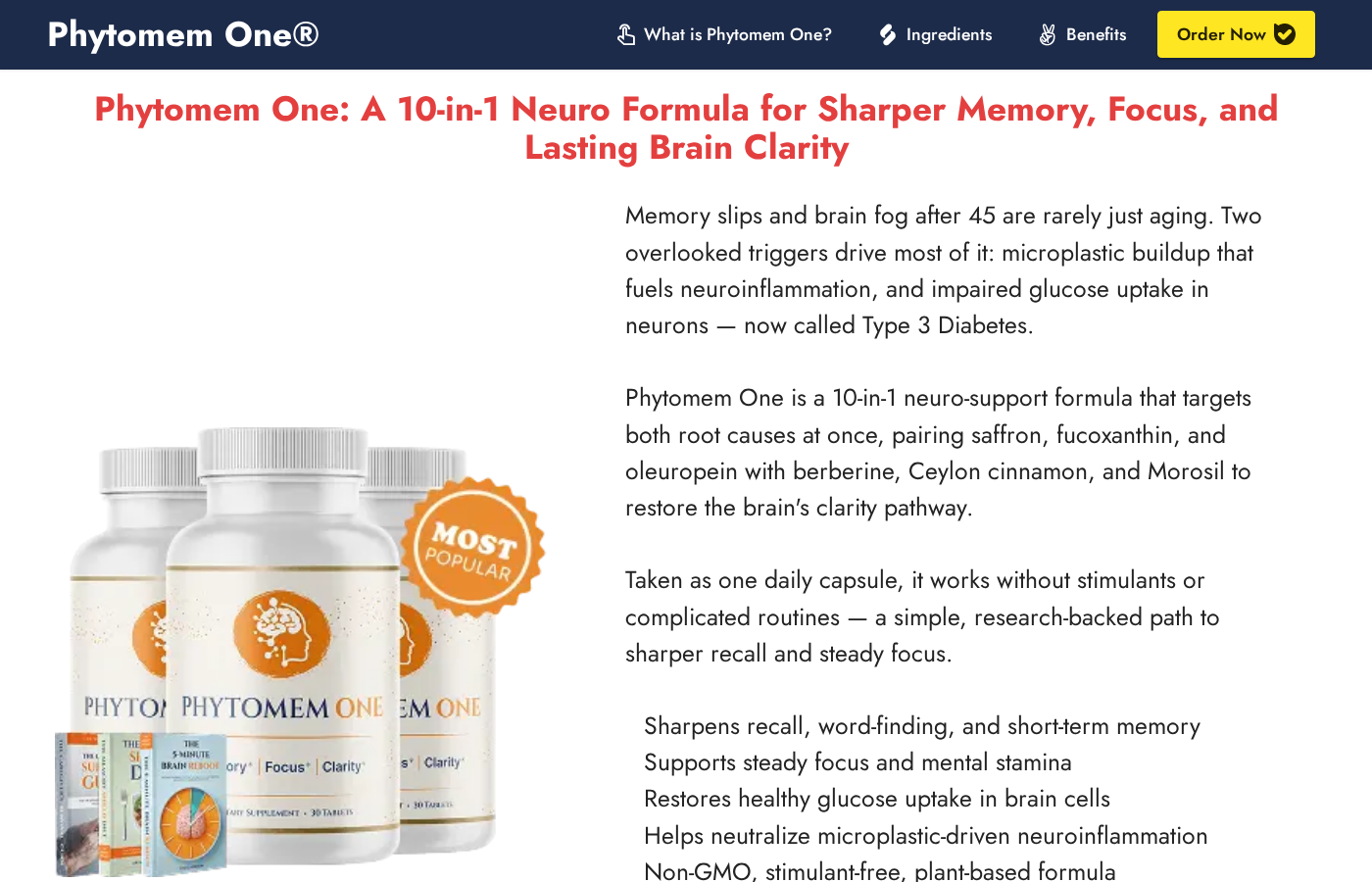
Phytomem One is sold as a daily memory supplement built around a ten-ingredient botanical formula.
The sales copy links forgetfulness to alleged microplastic buildup and a condition it calls Type 3 Diabetes.
It then promises support for glucose use, inflammation control, brain circulation, and long-term mental sharpness.
The offer presents those ideas as one connected explanation for ordinary memory complaints.
Why the sales story deserves a closer look
The formula lists recognizable ingredients, but the page moves quickly from preliminary science to confident product conclusions.
Research on a compound in a laboratory does not prove the finished capsule prevents memory loss in people.
The microplastic narrative is especially persuasive because it sounds modern and frightening.
Yet the website does not provide a clinical trial showing that Phytomem One removes microplastics or reverses cognitive disease.
What our review found
Our checks found a very recent main domain, several lookalike spellings, and a separate buying portal with different branding.
- Phytumemone.com was registered on July 12, 2026.
- Buyphytomemone.com was registered eight days later.
- Other domains use missing or rearranged letters around the product name.
- The homepage claims 14,600 verified customers without an independent review archive.
- The six-bottle package advertises $49 per bottle.
- The public terms and privacy links on the main site returned 404 pages.
- The buying portal names Wexford Botanical Group, LLC and gives a Michigan address.
That combination does not prove that every shipment is fake.
It does mean buyers should separate the sales narrative from the evidence supplied by the seller.
Is Phytomem One Legit or a Scam?
Phytomem One appears to be a real direct-response supplement offer, but its medical story is stronger than the proof shown.
The separate buying portal supplies more useful refund information than the main landing page.
That transparency is a positive detail, although it does not validate the claims about microplastics or Type 3 Diabetes.
The recent domains and typo variations make it difficult to know which page is official at any given time.
They also increase the chance that a buyer reaches an affiliate copy, an outdated checkout, or a cloned landing page.
We therefore rate the offer as high caution rather than a proven fraud.
The Microplastic Explanation Is Not Product Evidence
A frightening cause makes a simple capsule feel necessary
The page suggests that invisible plastic particles accumulate in the brain and trigger a chain of cognitive damage.
Environmental exposure is a legitimate research topic, but the product page treats an evolving field as a settled diagnosis.
It does not show testing of customers before and after Phytomem One.
It does not identify a validated method for measuring the claimed microplastic burden.
Type 3 Diabetes is used as a sales shortcut
Type 3 Diabetes is sometimes used informally in research discussions about insulin resistance in the brain.
It is not a diagnosis that lets a marketer identify a customer from a few forgotten names.
The website turns that loose phrase into a reason to buy a proprietary blend.
Readers should ask whether a claim describes a recognized medical condition, a research hypothesis, or an advertising label.
Ingredient research cannot be transferred automatically
Phytomem One lists saffron, fucoxanthin, fucoidan, oleuropein, berberine, cinnamon, kudzu, Morosil, corosolic acid, and xylitol.
Several ingredients have published research, but the research may involve food quantities, extracts, or different combinations.
The page does not publish a finished-product trial with participant numbers and measurable memory outcomes.
Without that bridge, the formula remains a supplement hypothesis rather than a proven treatment.
How the Phytomem One Offer Works
Step 1: A common memory worry opens the conversation
The advertorial starts with familiar experiences, such as losing a word, forgetting an appointment, or feeling mentally slower.
Those experiences are common and can have many explanations, including stress, sleep problems, medication effects, and aging.
The page quickly narrows that broad concern into one dramatic biological story.
Step 2: The story names an invisible enemy
Microplastics become the villain because readers cannot easily test or disprove the claim at home.
The language creates a feeling that everyday exposure is quietly damaging the brain.
That fear makes a bottle of capsules appear like a practical response.
Step 3: Scientific terms create authority
Words about glucose uptake, neuroinflammation, and cellular repair suggest that the marketer has solved a complex problem.
Scientific vocabulary can be informative, but it can also hide the absence of product-specific testing.
A reader should look for methods and data, not just impressive nouns.
Step 4: The ten-ingredient formula feels comprehensive
Many ingredients make the formula look carefully engineered rather than assembled for a marketing page.
The site does not explain how each ingredient is standardized, tested, or balanced against the others.
A long list can increase perceived value while making meaningful comparison harder.
Step 5: Social proof removes hesitation
The homepage claims 14,600 verified customers and says 93% select the largest bundle.
Visitors are not shown an independent review database, order dates, or a method for checking those figures.
That makes the numbers persuasive but difficult to audit.
Step 6: The offer rewards a larger order
The six-bottle package lowers the advertised price to $49 per bottle.
Six bottles also create a much larger financial commitment before the buyer knows whether the product is tolerated.
Calculate the final total, shipping, and return cost rather than focusing on the per-bottle headline.
Step 7: A rotating domain complicates verification
Some visitors see phytumemone.com, while other links point to buyphytomemone.com or misspelled versions.
Domain changes can reflect affiliates, but they also make it harder to preserve the correct policy and support address.
Pricing, Guarantees, and Checkout Details
The six-bottle figure is not the complete cost
Per-bottle pricing is designed to make a bulk purchase feel economical.
The checkout can still add shipping, tax, or a different quantity after an affiliate redirect.
Save the final order screen before entering card details.
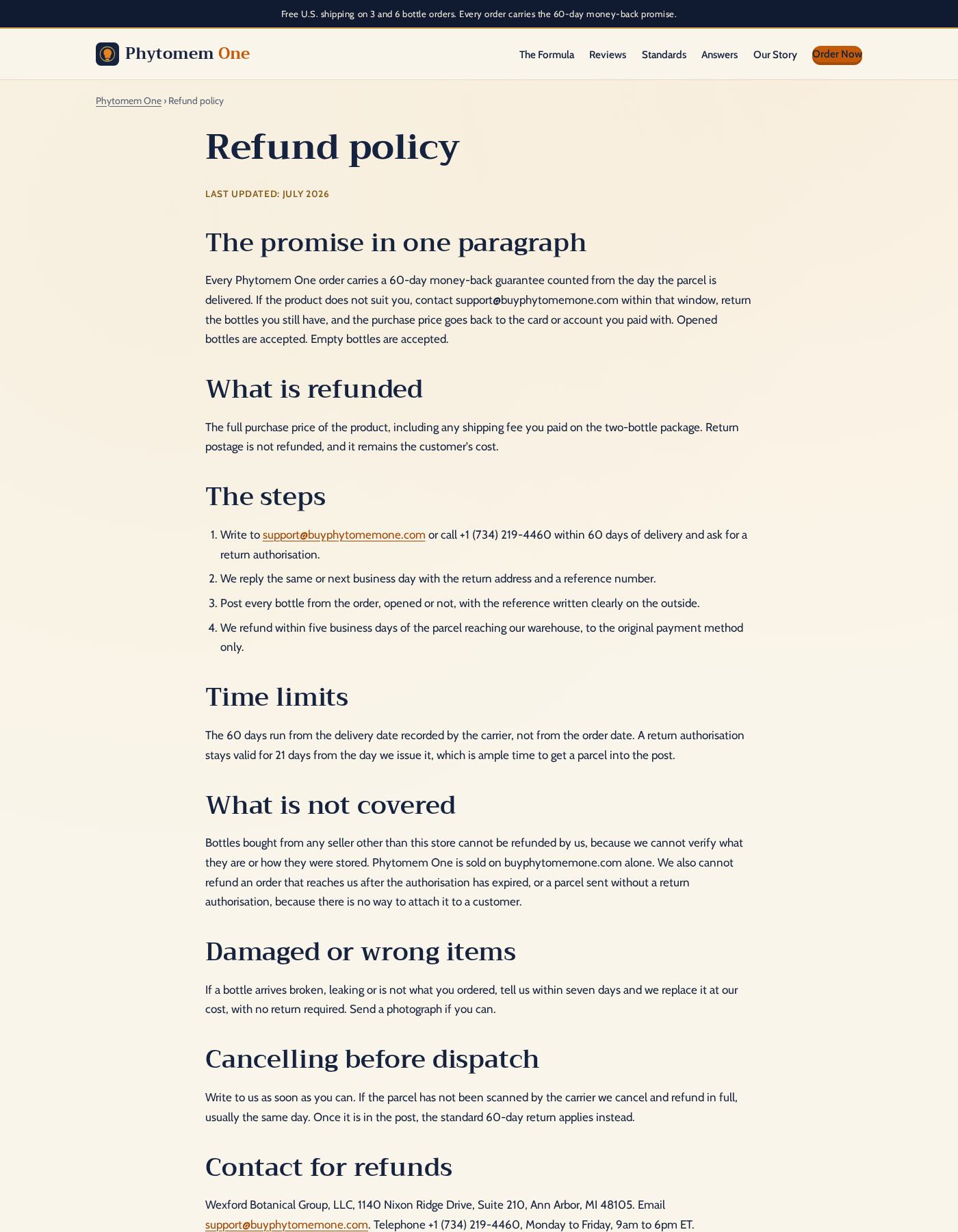
The buying portal gives a 60-day window
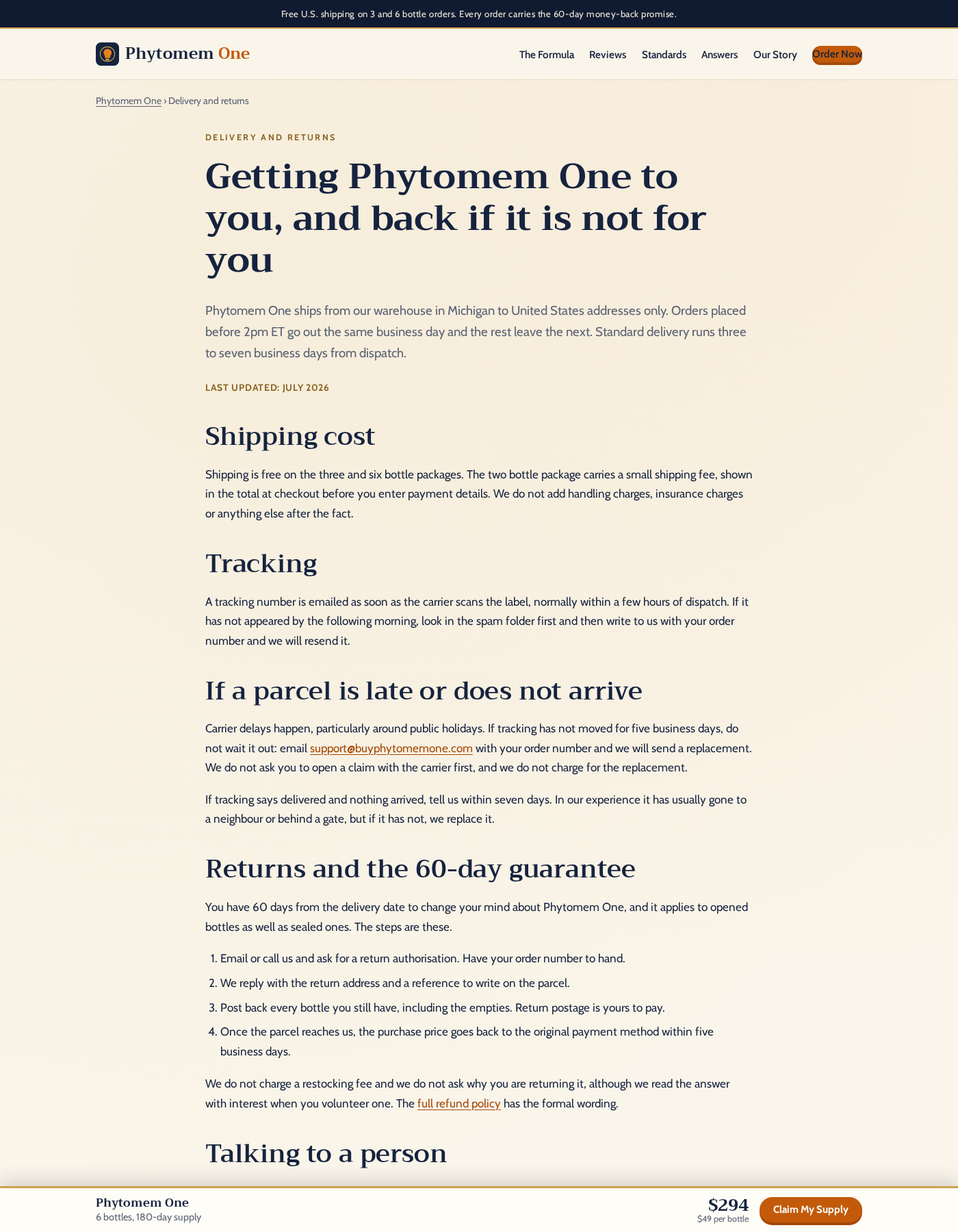
Buyphytomemone.com says customers have 60 days from delivery to request a refund.
It accepts opened or empty bottles, but authorization is required before sending anything back.
The customer pays return postage and must send every bottle to the stated warehouse.
A detailed policy still needs practical confirmation
The portal names Wexford Botanical Group, LLC and gives a suite address in Ann Arbor, Michigan.
That is more accountability than the main landing page provides, but buyers should confirm the entity on the receipt.
Keep the support email, phone number, and return authorization in writing.
“Natural” does not mean risk free
Berberine, cinnamon extracts, and other botanicals may interact with medicines or affect blood sugar.
People taking diabetes drugs, blood thinners, or multiple prescriptions should ask a clinician before using the formula.
Stop and seek advice if symptoms appear after starting any supplement.
Questions the Landing Page Leaves Open
The formula needs lot-level documentation
A supplement label tells you what the seller says is present, but it does not show whether every batch matches the label.
Ask for a certificate of analysis that identifies the lot number, test methods, and laboratory responsible for the result.
Generic certificates copied from another product do not answer that question.
Buyers should also check whether botanical names, extract ratios, and standardization details appear on the actual bottle.
“Verified customers” needs a definition
Verification can mean a completed order, an email confirmation, or simply a review collected by the seller.
The Phytomem One page does not explain which method produced the 14,600 figure.
It also does not show the date range or the number of negative reviews.
A buyer should not confuse a badge with an independently moderated review system.
Typo domains can change the transaction
A spelling variation may lead to a different affiliate, payment processor, or version of the guarantee.
Copy the address from the confirmation email and compare it with the page saved before payment.
If a new domain asks for the card again, stop and verify the order through the original support channel.
Never assume that a similar logo means the same legal business.
Health claims can encourage self-diagnosis
Memory changes deserve context, especially when they are sudden, worsening, or affecting safety.
A supplement page cannot distinguish sleep deprivation from depression, medication effects, thyroid disease, nutritional deficiency, or neurological illness.
People should discuss persistent changes with a clinician rather than treating the marketing story as a diagnosis.
Urgent symptoms require medical care, not an online checkout.
The return policy should be tested before purchase
Send a simple question asking for the legal seller, return authorization process, postage responsibility, and refund timeline.
Save the response in a local folder with the order page.
A refusal to answer basic commercial questions is useful information before money is committed.
Clear support should be able to explain which domain controls the purchase.
Before ordering, verify the complete evidence chain
Check the label against the landing page and note any missing amounts or warnings.
Search the named company rather than the bottle name because product branding can change faster than corporate records.
Ask who manufactured the finished capsules and where adverse reactions should be reported.
Confirm that the phone number handles Phytomem One rather than a general warehouse queue.
Read the card descriptor before authorizing payment so an unfamiliar statement entry does not create confusion.
Use a credit card with dispute rights instead of a debit transfer when possible.
Finally, remember that a 60-day guarantee addresses payment, not whether the medical explanation is accurate.
The safest decision is the one made after the urgency and novelty have been removed.
Company, Address, and Fulfillment Checks
The main domain hides basic policy pages
Phytumemone.com displayed links for terms and privacy, but both returned 404 responses during our review.
A missing legal page is not proof of bad intent, yet it leaves customers without the rules governing data and orders.
The buying portal names a legal entity
Buyphytomemone.com identifies Wexford Botanical Group, LLC as the business behind the offer.
The listed address is 1140 Nixon Ridge Drive, Suite 210, Ann Arbor, Michigan 48105.
Buyers should compare that name with their receipt and card statement.
A return warehouse is not necessarily the manufacturer
The portal says orders ship from Michigan and returns require a warehouse authorization.
That arrangement can be normal for a fulfillment operation.
It does not prove that the entity manufactures the capsules or performs independent quality testing.
Rotating spellings create an accountability problem
Typos such as phhytomem.com and phytmemone.com can confuse buyers after an advertisement disappears.
They can also make complaints and refund instructions harder to connect to one seller.
Always bookmark the exact domain shown on the order confirmation.
What to Do if You Bought Phytomem One
- Save the page you used. Record the domain, advertisement, checkout, price, bundle, and promises shown on the purchase date.
- Match the receipt to the selected quantity. Check whether the confirmation lists one bottle, a bundle, or an unexpected add-on.
- Ask support for the governing policy. Use the contact details printed on your receipt and request written return instructions.
- Do not mail products without authorization. The listed portal requires approval before a parcel is sent to the warehouse.
- Photograph every bottle and label. Keep lot numbers, packaging, tracking, and a copy of your request.
- Contact your card provider if the seller stalls. Explain missing disclosures, wrong quantities, or a refused eligible refund.
- Ask a clinician about interactions. This matters especially with blood-sugar medicine, anticoagulants, or pregnancy.
- Protect the browsing device. Check it with Malwarebytes after suspicious redirects, and use AdGuard to filter aggressive advertising exposure.
Frequently Asked Questions
Is Phytomem One approved to treat memory disease?
We found no product-level approval or clinical trial proving that Phytomem One treats dementia, Alzheimer’s disease, or another diagnosis.
Does the formula remove microplastics?
The sales page makes that implication, but it provides no validated test showing that the finished product removes microplastics from customers.
What does Type 3 Diabetes mean here?
The phrase is used as a marketing explanation for brain insulin resistance, not as a clear diagnosis that the supplement can identify or reverse.
Is the six-bottle bundle required?
No. It is promoted as the best value, but the larger bundle increases the amount paid before tolerability and refund handling are known.
Who handles Phytomem One returns?
The separate buy portal names Wexford Botanical Group, LLC and requires authorization before returns go to its Michigan address.
Should I trust the 14,600 customer figure?
It is a seller-controlled claim without a public independent archive, so treat it as advertising rather than verified proof of satisfaction.
The Bottom Line
Phytomem One packages a fascinating environmental story with a long ingredient list, strong review numbers, and a discounted bundle.
The recent domains, broken policy links, and unproven microplastic claims make careful verification essential.
The buying portal is more transparent than the main page, but no supplement should replace medical evaluation or evidence-based care.








