


A recruiter mentions Procore, offers an interview, and seems ready to move quickly. After weeks of applications, a straightforward conversation about work can feel welcome.
Then the interview becomes a text exchange, the offer arrives unusually fast, or the next step involves your money. That change deserves a closer look.
Overview
The real company is not the person using its name
A Procore job scam is a recruitment impersonation scheme, not evidence that Procore itself is fraudulent. Scammers borrow an employer’s identity to make their approach credible.
The real company has a careers website, employees, and a recruiting process. An impersonator can point to those genuine details without being part of that organization.
A familiar logo or job description therefore answers the wrong question. It shows that someone found the company’s public material, not that they can offer you employment.
Procore publishes its own interview warning signs
Procore’s recruiting guidance flags text-based interviews, mismatched email addresses, rushed offers, early requests for confidential information, and demands for money.
Those checks are useful because the scam can resemble ordinary recruitment at first. Social-media contact alone is not the deciding factor; refusing independent verification is more revealing.
Keep these practical questions beside the invitation before sending anything sensitive:
- Can a genuine company contact confirm this specific recruiter and opportunity?
- Does the proposed interview match a process the employer recognizes?
- Are you being asked for confidential information before a verified offer?
- Does accepting the supposed job require paying someone first?
The next request determines the immediate risk
Some fake job approaches seek identity information. Others try to extract an application payment, equipment purchase, or money sent onward after a check deposit.
These are known job-scam patterns, not a claim that every Procore impersonation includes every variation. Your response should match the information or funds actually exposed.
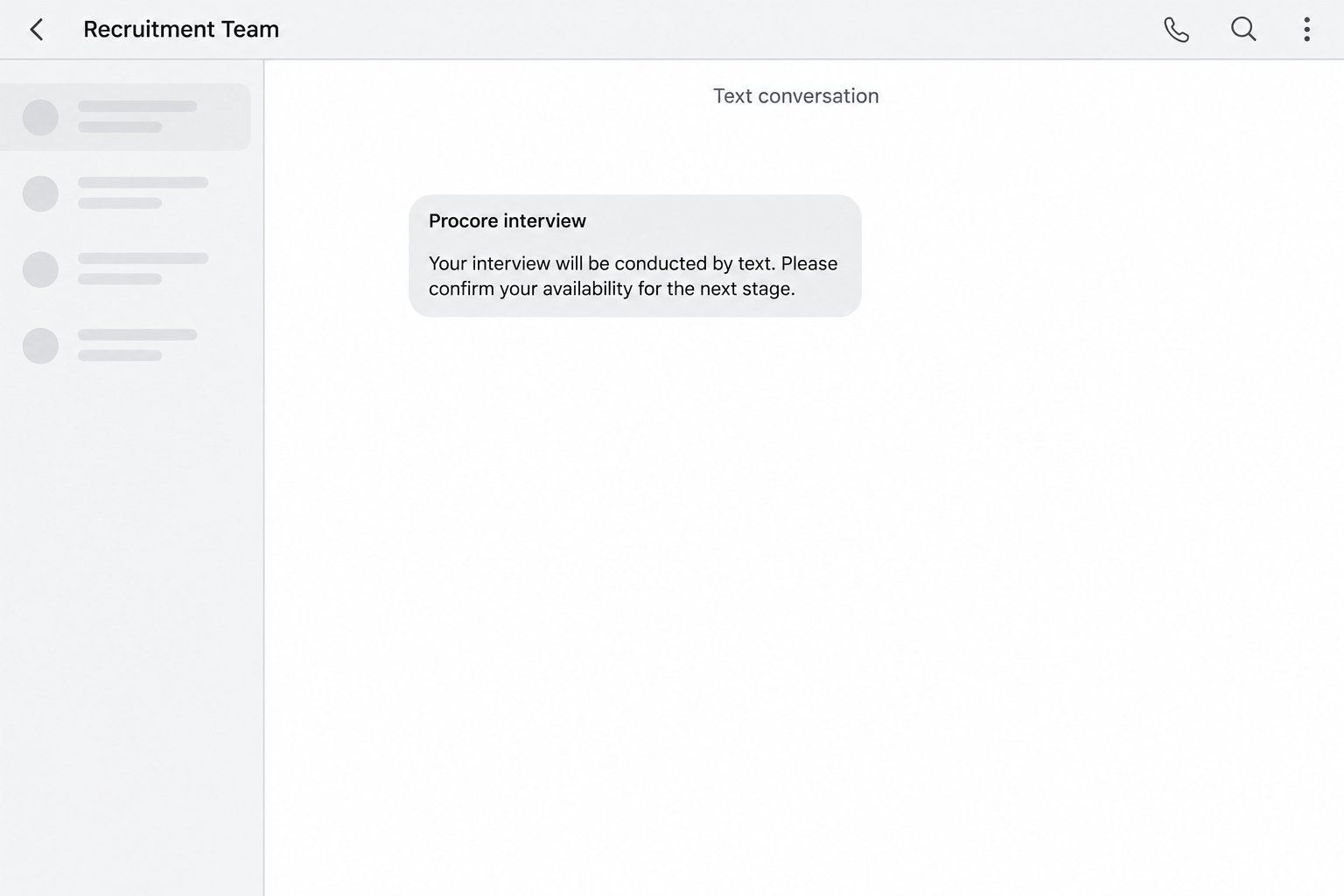
The conversation image is a simplified illustration of a text-interview lure. It is not an actual Procore conversation, offer, recruiter, or internal hiring screen.
What a Procore Email Address Does and Does Not Prove
A genuine product message is not automatically a job offer
An address such as team@customer.procore.com concerns a different question from whether an individual recruiter is genuine. Do not label all Procore-branded messages as scams.
A routine product notification may be legitimate. A job offer still needs its own verification, including the recruiter, role, communication route, and proposed next steps.
Receiving an unexpected message also does not prove that Procore exposed your information. An impersonator’s contact source cannot be established merely from the employer name they used.
Recruiter identity needs a separate check
Procore says its recruiters use Procore work email addresses. A similar-looking spelling or an address containing the company name somewhere else is not the same thing.
That is a useful comparison, not a reason to trust a display name blindly. An email application can emphasize a name while hiding the complete address underneath.
Find the company’s careers site independently and use a verified contact route to ask about the invitation. Do not use only the contact details supplied by the stranger.
A copied employee profile cannot authenticate a conversation
Someone can copy a real recruiter’s name or profile picture. Searching that name and finding a genuine employee does not connect the employee to your message.
The relevant check is whether the real organization confirms this approach. If a stranger keeps steering you away from that check, stop before providing more information.
You do not have to accuse anyone to pause. A legitimate opportunity should survive a reasonable request to establish whom you are speaking with.
How the Procore Job Scam Works
Step 1: A promising approach introduces the employer’s name
The first contact can arrive through email, a job platform, or a social profile. It may use a role that sounds compatible with your experience.
That makes the approach believable without requiring unusual promises. A person actively applying for jobs expects unfamiliar recruiters, scheduling messages, and requests to discuss their qualifications.
At this stage, keep your response limited to ordinary professional information. A conversation about availability should not require your bank details or identity documents.
Step 2: The contact tries to control the interview channel
The conversation may shift toward text or instant messaging. Procore specifically identifies text-based interviews as a warning sign and recommends checking the company’s process independently.
Messaging software is not inherently fraudulent. The concern is a person presenting an interview format that the real employer cannot confirm, while avoiding other ways of establishing identity.
Ask for a verified company contact and a normal discussion about the role. Do not treat a branded chat title as a substitute for that conversation.
Step 3: Easy agreement turns the conversation into an offer
An impersonator can accept your answers readily because filling a real position is not the objective. A quick offer creates the feeling that the difficult part is finished.
This can change how the next request feels. You may interpret a payment or document demand as routine onboarding rather than something requiring a fresh decision.
Speed alone does not prove fraud, but it must not remove verification. Check who issued the offer before relying on its salary, start date, or instructions.
Step 4: The supposed onboarding process requests something valuable
The request might involve an identification number, a document image, banking information, or an upfront charge. None becomes safe merely because an offer letter looks professional.
Real employers do collect necessary information through genuine onboarding processes. The distinction is whether you have verified the employer and the channel receiving that information.
Do not send a complete identity package to an unverified chat contact. Ask the genuine company how its onboarding works before deciding which information belongs where.
Step 5: An equipment or check story can turn employment into a payment demand
The FTC warns about fake job offers that leave applicants paying instead of earning. One established variation involves a check followed by instructions to send money onward.
The sender may frame the outgoing payment as purchasing work equipment. A supposed reimbursement can make spending your own funds seem less risky than it is.
This is a general fake-job variation to recognize, not a documented feature of every Procore approach. Treat any such instruction as a separate financial warning.
Step 6: A deadline discourages checking the offer
Pressure may concern a start date, an onboarding slot, or an opportunity that supposedly disappears if you ask more questions. The sender benefits when verification feels inconvenient.
Do not let an invented deadline decide what happens to your identity or money. Pause the exchange and confirm the opportunity away from the contact’s chosen channel.
If an account or payment is already involved, preserve the conversation before blocking the sender. The details may help your financial provider or identity-recovery process.
The Equipment Check Trap Deserves Its Own Warning
Money appearing in your account is not final confirmation
A bank balance can make a deposited check look settled before the bank identifies a problem. That is why a screenshot showing available funds can be misleading.
The FTC’s fake-check explanation warns that counterfeit or fraudulent checks can take weeks to uncover. Meanwhile, money you send away is real money.
If someone claiming to hire you sends a check and tells you to pay another party, explain the employment context to your bank before proceeding.
A designated supplier does not independently verify the employer
A seller selected by the supposed recruiter is part of the same unverified instruction. A receipt, invoice, or professional-looking checkout does not authenticate the job.
Do not make a small payment simply to test the arrangement. You can investigate an employment offer without purchasing equipment or transferring money to the contact’s supplier.
Ordinary remote-work arrangements are not all identical
Some jobs provide equipment, while other legitimate roles may use agreed personal devices. Do not decide solely from the presence of an equipment discussion.
The problem is an unverified employer requiring money or directing funds from a questionable check. Confirm the role and its real terms with the company itself.
What to Do If You Have Fallen Victim
-
Stop sending money, documents, or additional information to the supposed recruiter. Ask for time to verify the offer without following another link they supply.
Keep the original emails, offer documents, chat history, and payment instructions privately. Record the contact details actually used rather than only the copied employee name.
-
Find Procore’s careers website independently and verify the opportunity through a genuine company contact. Explain that someone may be impersonating its recruiting team.
Do not assume a missing or changed listing alone settles the matter. Ask about the specific invitation and process before relying on the contact again.
-
If you deposited a check connected with the offer, notify your bank’s fraud team immediately. Tell them about any instruction to buy equipment or send money onward.
Do not return a supposed overpayment yourself or spend funds merely because the account shows them available. Let the bank investigate the deposit.
-
For a payment already sent, contact the bank, card issuer, payment app, or transfer company involved. Ask whether the transaction can be stopped or disputed.
Provide receipts and a concise explanation of the fake hiring arrangement. Recovery options depend on the payment method and timing; nobody should promise a guaranteed refund.
-
If you shared an SSN or similar identity information, use IdentityTheft.gov for a recovery plan in the United States. Keep copies of reports and relevant correspondence.
Consider a free credit freeze at Equifax, Experian, and TransUnion. The FTC explains the differences between a freeze and a fraud alert.
A freeze helps restrict new-credit access, but it does not secure an existing bank account. Discuss any exposed banking information separately with your bank.
-
Change passwords entered through the contact’s forms, using genuine service addresses. If an exposed password was reused, replace it on the other affected accounts too.
Start with any email account used for password resets. Review recovery settings and sessions rather than assuming a new password resolves every kind of access.
-
If the contact persuaded you to install software, stop using that environment for private accounts until trusted support assesses it. Preserve the software name and instructions.
Do not install another remote-access tool offered by someone claiming to recover your money. A second unfamiliar helper can create another exposure.
-
Report the impersonating profile or listing to the platform where it appeared. In the U.S., submit the job-scam details through the FTC’s reporting service.
Use the official payment-recovery guidance for any money lost. Tell a trusted person what happened so further pressure does not leave you handling it alone.
Before You Continue With Another Recruiter
Keep an application record you can compare with new contacts
Record the employer, role, application date, and website used when applying. That gives you a starting point when an unfamiliar person claims to follow up.
An approach you did not expect is not automatically fraudulent. It should simply prompt independent checks before the conversation moves from qualifications to sensitive onboarding information.
Separate professional information from identity and payment information
A resume can be enough for an initial discussion. You do not need to attach financial statements, full identification documents, or banking credentials just to establish interest.
If a verified employer needs sensitive information later, confirm its official process and intended recipient. Keeping those stages separate gives you more than one chance to notice problems.
Use a simple explanation when you need to pause
Tell the contact that you will confirm the opportunity through the company’s established recruiting route before proceeding. Their reaction can help you decide whether to continue.
Do not argue about whether a logo looks genuine or a document contains correct office details. Public information can be copied; confirmed authorization is what matters.
Frequently Asked Questions
Is Procore itself a fake company?
Procore is a legitimate company, and its name can be misused by unrelated impersonators. A fake recruiter should not be confused with the employer being impersonated.
Verify the person and the particular opportunity. Finding the real company’s website does not establish that an outside contact is authorized to hire you.
Does team@customer.procore.com mean a message is fraudulent?
That address should not be condemned simply because an unsolicited message caused concern. Product notifications and recruitment invitations require different contextual checks.
Look at what the message requests and verify it through the appropriate genuine company route. Do not send sensitive details merely because the address looks familiar.
Is a text-only interview enough to stop the process?
It is a reason to pause and independently verify the format, particularly because Procore’s own recruiting advice flags text-based interviews. You can ask for confirmation without paying anything.
Do not let a chat contact approve their own legitimacy. Seek a verified company representative before treating the exchange as an authenticated interview.
What if the recruiter uses a real employee’s name?
A copied name can make an approach more convincing without connecting the real employee to it. A genuine profile is not proof of who controls your conversation.
Confirm the invitation through an independently established company contact. Avoid relying solely on links or introductions supplied by the person whose identity is in question.
Can I buy equipment after the bank makes a check available?
Available funds do not prove that a check is genuine. A fraudulent deposit can later be reversed, leaving you responsible for money already sent elsewhere.
Tell your bank if the check arrived through an unexpected job offer. Do not follow the supposed employer’s instructions to pay a supplier while that concern remains unresolved.
Is it too late to act if I already sent documents?
You can still limit further exposure and begin identity-protection steps. Keep a record of which documents you sent and report the impersonation through appropriate channels.
The response depends on the information involved, not just whether a payment occurred. Do not wait for a financial loss before addressing exposed identity or account details.
The Bottom Line
Do not pay or hand over sensitive information to an unverified Procore recruiter. A rushed text interview and a company logo are not authorization to hire you.
Confirm the opportunity with Procore independently. If you already responded, stop further contact, preserve the records, and address the specific identity, account, or payment exposure immediately.

Join the discussion
0 commentsShare your experience or ask a question about this article.
Community experiences
Did this happen to you?
Your experience could help someone recognize the same scam. Submit a private report for our team to review.
I experienced this tooReports are reviewed before publication. Sharing publicly is always your choice.
Discussion
Start the conversation
Have a question or something useful to share? Add the first comment.