

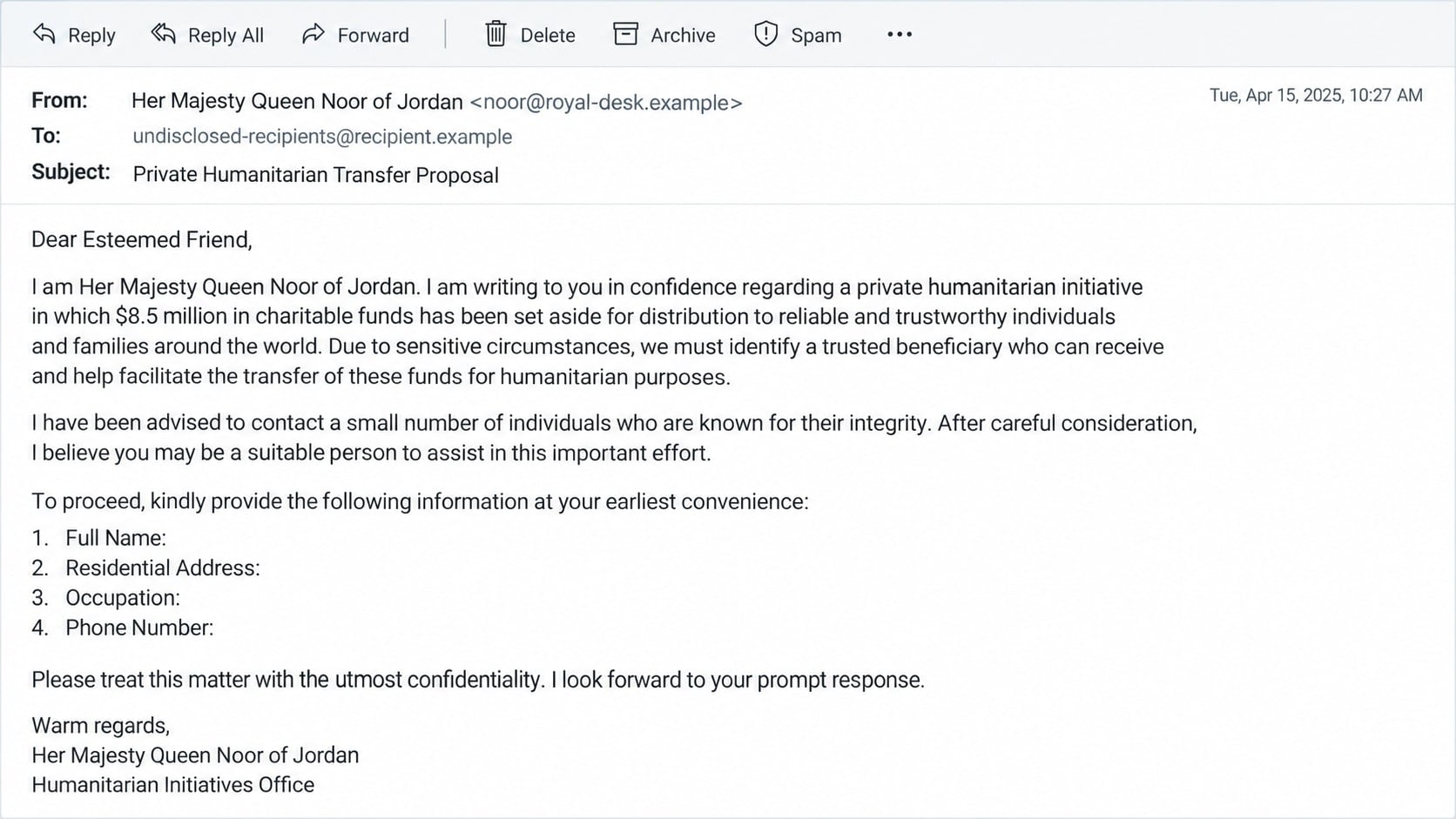
An unexpected email claims Queen Noor of Jordan has chosen you to help move millions in humanitarian funds. The sender sounds formal, asks for confidentiality, and promises a generous share for your cooperation.
Nothing in the message explains why a royal household would trust a stranger. That question is buried beneath titles, diplomatic language, and a life-changing amount that makes replying feel like a rare opportunity.
Overview
What the Queen Noor impersonation message claims
The sender pretends to be Queen Noor of Jordan, a private secretary, royal adviser, foundation representative, lawyer, or banker. The story may involve humanitarian funding, an inheritance, a dormant account, political restrictions, or a confidential donation.
You are described as trustworthy despite having no prior relationship with the supposed sender. In return for receiving or distributing the money, you may be promised a commission, personal grant, business investment, or charitable partnership.
Where the scam becomes costly
The first reply usually asks for personal information rather than payment. Once the victim is engaged, the operation introduces fees for diplomatic clearance, tax, insurance, anti-money-laundering certification, courier delivery, legal documents, or bank activation.
Each payment is presented as the final obstacle between the victim and a much larger transfer. The promised funds do not arrive because the royal identity, account, legal process, and release documents are part of an advance-fee fraud.
Warning signs in the story
Royal titles and official-looking attachments should not override basic checks. The message is fraudulent if an unverified stranger uses this identity to request secrecy, money, or sensitive information. Common signs include:
- An unsolicited royal or foundation contact offers you a share of millions.
- The sender cannot explain why you were chosen beyond fate, trust, or divine guidance.
- Communication uses a free mailbox or an unrelated domain.
- You are asked to keep the arrangement secret from relatives, banks, or authorities.
- Documents contain impressive seals, signatures, and reference numbers that cannot be verified.
- A fee must be paid before funds, grants, parcels, or certificates can be released.
- Payment is requested by wire, cryptocurrency, gift card, cash, or a money-transfer service.
The Real Person Is Not Behind These Messages
Queen Noor is a real public figure associated with established humanitarian work. That public visibility gives scammers biographical details, titles, speeches, photographs, and foundation names they can copy into a convincing profile.
The impersonation does not indicate involvement by Queen Noor, her family, or a legitimate foundation. A public figure’s identity is the bait, just as a bank name is used in phishing or a government seal is used in a fake-benefits letter.
Authentic charitable organizations select programs through documented processes. They do not recruit random email recipients to receive secret transfers valued at $1 million or more through personal accounts.
The King Hussein Foundation has an established public website and contact information. A message from an unrelated address that claims a private exception should be verified through those independently located channels, not through the sender’s lawyer or bank.
How the Queen Noor of Jordan Scam Works
Step 1: A royal identity creates instant authority
The first email uses a recognizable name and formal honorifics to make an extraordinary proposal feel possible. It may include a short biography, charitable themes, or references to Jordan to support the identity.
Some versions come from a supposed assistant because that explains why the address and writing style do not match a public figure. Others claim the contact is private and must avoid official channels for political or security reasons.
Step 2: The recipient is offered a confidential role
The sender says a trusted beneficiary is needed to hold funds, distribute donations, establish a charity, or receive an inheritance. The victim is promised a fixed payment or a share of the transfer.
The role flatters the recipient. Words such as honest, reliable, blessed, or specially selected replace due diligence. No real explanation is provided for choosing a stranger with no financial, legal, or charitable relationship.
Step 3: Personal details are collected gradually
The initial request may seem limited to full name, address, phone number, occupation, and nationality. A later form asks for identity documents, bank details, tax numbers, signatures, or proof of address.
Gradual collection lowers resistance. After sharing harmless-looking details, a victim may feel committed and become more willing to send sensitive records needed for identity theft or targeted follow-up scams.
Step 4: A second character confirms the story
A lawyer, bank officer, diplomat, courier, or compliance director joins the conversation. Different addresses and signatures create the impression that several independent organizations are processing the transfer.
They may all be controlled by the same operation. A new voice does not independently verify the claim when that contact was introduced by the original sender.
Step 5: Professional-looking documents show the money
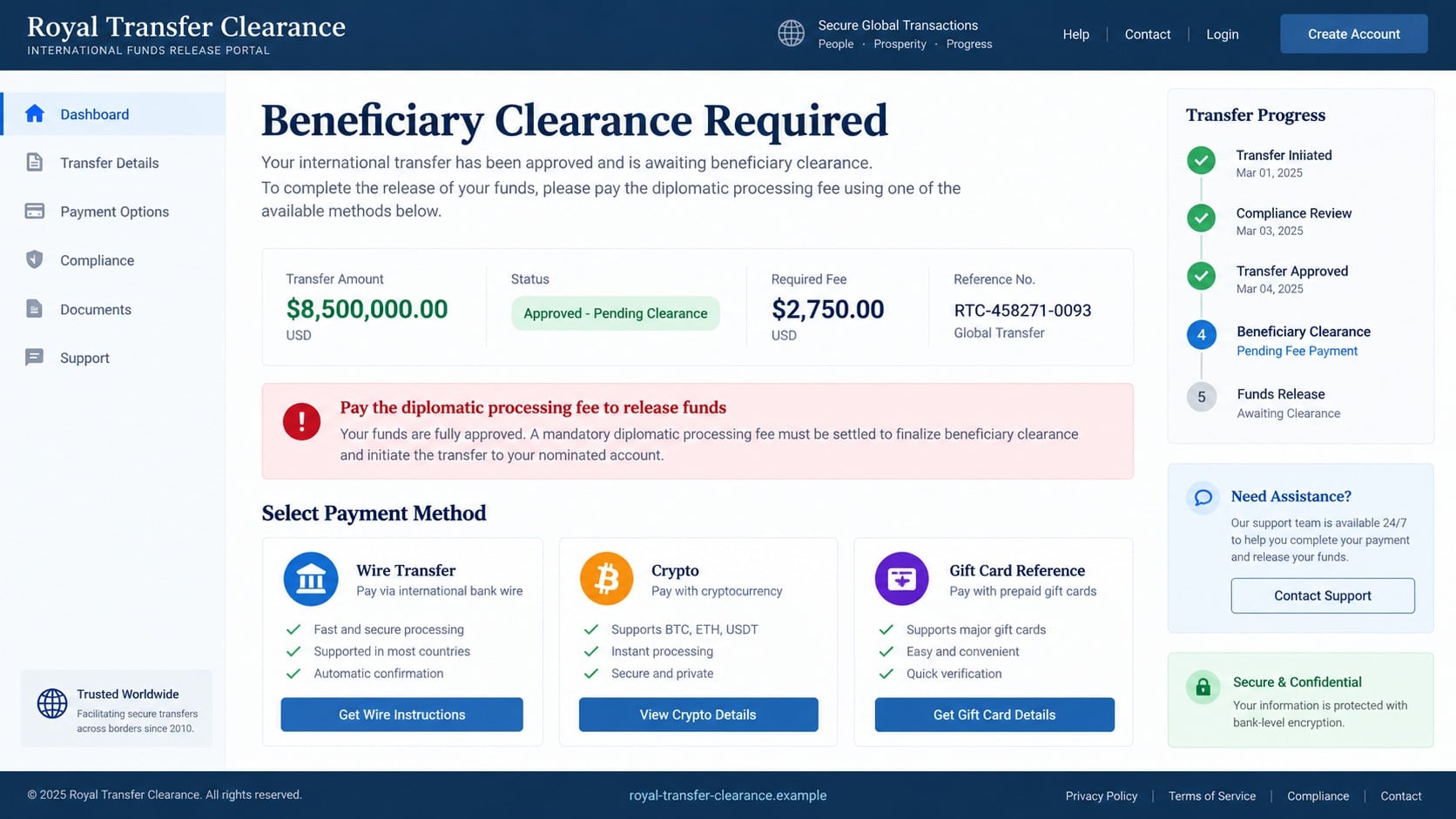
The victim receives certificates, transfer approvals, bank screenshots, identity cards, or letters with stamps and reference numbers. A fake portal may display the full promised balance and a progress tracker.
Those documents prove only that someone created an image or webpage. A number shown on a private portal is not a protected deposit, and a bank logo does not make the account accessible.
Step 6: A release fee becomes unavoidable
After the transfer appears approved, an unexpected charge is introduced. The sender may call it a diplomatic processing fee, beneficiary certificate, insurance bond, tax code, customs payment, or anti-terrorism clearance.
The fee seems small beside the promised millions. The operator insists it cannot be deducted from the transfer because of banking rules, frozen funds, or international law. That explanation exists to make the victim supply new money.
Step 7: Every payment creates another obstacle
If the first fee is paid, a new document or official appears with an additional requirement. The amount may increase because the operators now know the victim can pay and wants to recover what has already been sent.
Eventually the contacts disappear, or they continue as long as another payment seems possible. A recovery agent may later claim the funds were found and begin a second advance-fee scheme.
Why Intelligent People Can Be Drawn In
The proposal is not always written carelessly. A patient operator may answer questions, provide plausible explanations, and avoid asking for money until trust has developed over days or weeks.
Authority also changes how details are interpreted. A royal title, international bank, or diplomatic office makes unusual secrecy feel important rather than suspicious. Copied news articles and public photographs add facts without proving identity.
The promised amount creates a powerful comparison. A $2,750 fee feels manageable beside $8.5 million, even though the smaller number is the only real money in the entire exchange.
Finally, earlier participation can create commitment. After forms, calls, and documents, walking away feels like abandoning both the reward and the money already spent. Scammers exploit that feeling by describing each new fee as the last.
Company, Address, and Fulfillment Checks
Verify the organization independently
Find the foundation or royal office through a trusted search result, government reference, or established public record. Contact it through details you located yourself and ask whether the message, representative, and program exist.
The King Hussein Foundation’s official website publishes its own programs and contact information. An unrelated sender cannot replace that verification by forwarding another certificate.
Examine every email and website address
A display name can contain any royal title. Expand the sender details and check the registered domain, reply address, and any link destination. Free mailboxes, recently created domains, and spelling variations deserve immediate caution.
HTTPS does not prove royal, government, charitable, or banking affiliation. It encrypts the connection to the site selected by the sender.
Check the professionals outside the provided chain
Search for the named lawyer, bank, courier, and office using independent directories. Contact the real institution at its published number. Do not call a number printed only on the letter or supplied by the supposed royal aide.
Even a real professional’s name may be copied. Verification must establish that the person sent the message and is involved in the claimed matter, not merely that the name exists.
Test whether anything can genuinely be fulfilled
Ask why the recipient was selected, why funds cannot be transferred through established charities, and why fees cannot be deducted. Advance-fee stories rely on vague legal barriers rather than a verifiable agreement and independent custody of funds.
Never use your personal bank account to receive or forward money for a stranger. Even if money arrives, it could come from another victim or a compromised account, creating financial and legal risk.
What Scammers Can Do With the Information
A name, address, occupation, and phone number can support more convincing phishing. The operator may mention the victim’s employer, family area, or bank in later calls and appear to know private facts.
Identity documents and signatures can be used for account applications, verification attempts, or fabricated paperwork. Bank details can lead to fraudulent debit attempts or targeted bank impersonation.
An email password is especially valuable because the inbox contains receipts, contacts, and reset messages. Never send login credentials or a multifactor code to a person who claims to process a grant.
If the victim agrees to receive and forward funds, the account may be used as a money mule. Moving money for strangers can involve stolen proceeds, frozen accounts, and investigation even when the intermediary believed the humanitarian story.
How to Respond to the Message Safely
Do not reply to challenge the sender or request proof. A response confirms that the address reaches a person and begins a conversation designed to overcome objections.
Preserve the original message if you intend to report it, including full email headers. Then mark it as phishing and block the sender. Avoid opening unexpected attachments or signing in through included links.
If you want to alert the impersonated organization, use contact information from its official website. Send only the material needed for investigation and remove unrelated personal information.
The FTC’s guidance on celebrity impersonators recommends slowing down, researching the public figure’s name with the word scam, and verifying a charitable cause before sending money.
What to Do if You Have Fallen Victim to This Scam
- Stop sending money and end contact. Do not pay a final clearance, tax, refund, or recovery fee. A larger promised transfer does not become more real because earlier fees were paid.
- Contact the payment provider immediately. Tell the bank, wire service, crypto exchange, card issuer, or gift-card company that the payment resulted from impersonation fraud. Ask whether a transfer can be stopped, traced, flagged, or documented.
- Preserve the complete evidence. Save messages, headers, phone numbers, profiles, websites, wallet addresses, transfer receipts, documents, and names used by every supposed official. Keep the files even if you now know their contents are false.
- Protect identity and financial accounts. Change exposed passwords from a trusted device, enable multifactor authentication, and notify banks about shared details. Consider a credit freeze or fraud alert where available if identity documents or national identification numbers were sent.
- Scan devices that opened files or installed software. Disconnect any device given remote access. Run a full security scan, then use a second-opinion scanner such as Malwarebytes to check for information stealers, remote tools, and unwanted changes.
- Remove malicious browser permissions. Delete unfamiliar extensions and revoke site notifications. AdGuard can reduce exposure to malicious advertisements and phishing pages after cleanup, but it cannot verify a royal identity or recover a transfer.
- Report the fraud. In the US, report to ReportFraud.ftc.gov and the FBI Internet Crime Complaint Center when appropriate. Report to the relevant national authority elsewhere and include transaction details.
- Reject recovery promises. Anyone who guarantees the millions or your fees can be recovered for an upfront payment may be targeting you again. Work only with verified financial institutions, authorities, and qualified counsel you select independently.
Frequently Asked Questions
Is Queen Noor of Jordan sending private humanitarian transfer emails?
An unsolicited message offering millions, requesting secrecy, or demanding fees should be treated as impersonation. Verify any claimed foundation activity through its established official channels.
Why did the message know real facts about Queen Noor?
Public biographies, foundation pages, interviews, and photographs are easy to copy. Accurate background information proves research, not control of the claimed identity.
Could the bank documents be genuine?
A convincing document can be fabricated or altered. Contact the institution through independently verified information and ask it to confirm both the document and the employee who supposedly issued it.
Can the clearance fee be deducted from the transfer?
The argument about deducting fees is part of the story. In an advance-fee scam, no legitimate transfer waits behind the payment, regardless of how the operator explains the restriction.
What if I shared information but sent no money?
End contact, secure reused passwords, watch for targeted follow-ups, and consider identity protections based on what you disclosed. Report the account and keep the evidence.
Can a real charity ask for donations online?
Yes, but donors should reach the charity independently and verify its registration, website, program, and payment route. A secret personal transfer or gift-card request is not normal charitable fundraising.
The Bottom Line
The Queen Noor of Jordan scam is an advance-fee scheme built around an impersonated public identity. The royal title and humanitarian language give emotional weight to a transfer that cannot be independently verified.
A stranger will not select you to move millions and then require your money to release it. Stop at the first request for secrecy, personal records, or fees, and verify every claimed organization outside the contact chain.








