


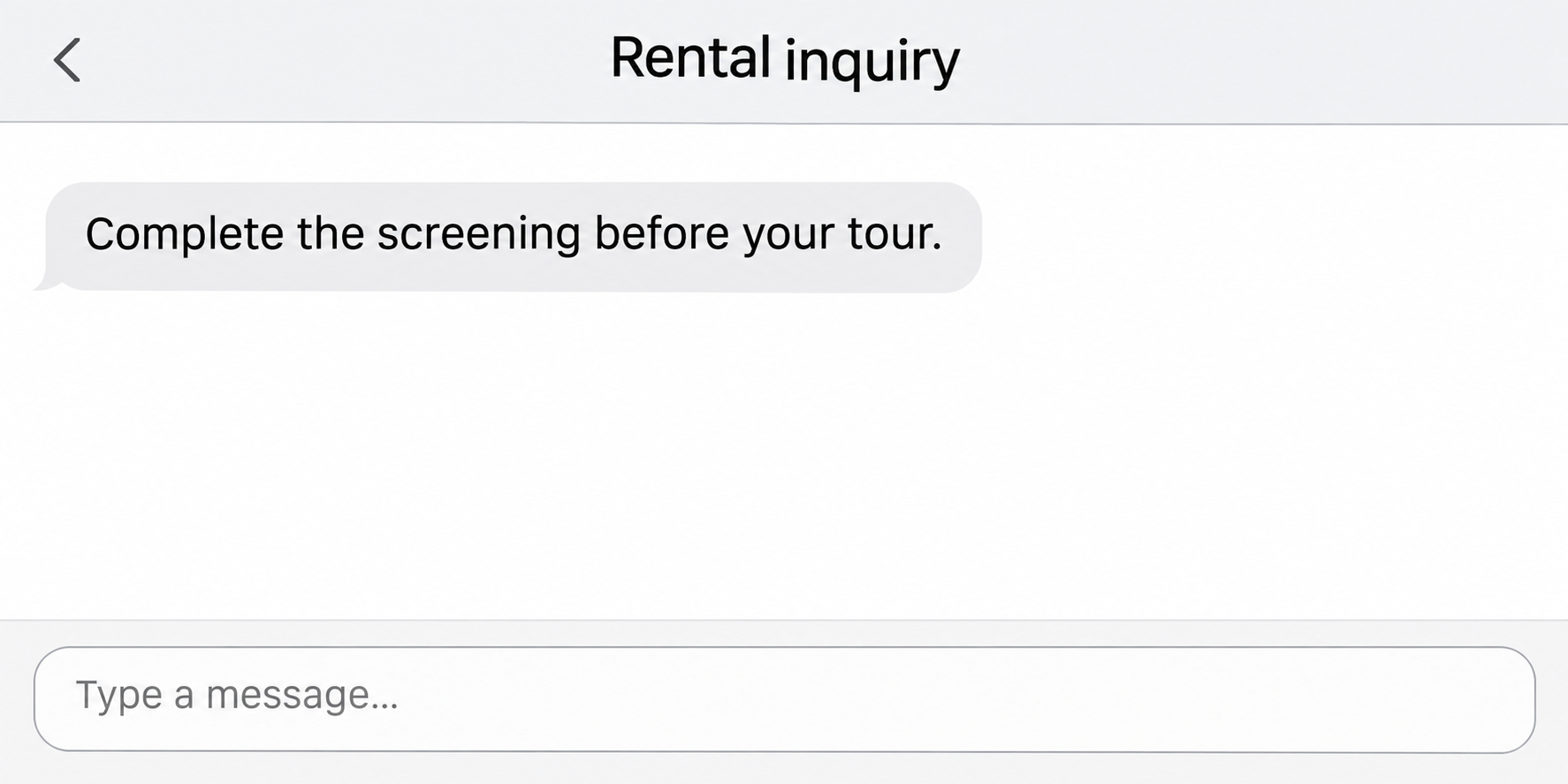
You found a rental on Zillow, and the person handling it wants you to complete a credit check before they will schedule a tour.
A rental application can legitimately involve fees and sensitive information. The first question is whether this particular person and form belong to the rental you found.
Overview
A Zillow listing does not authenticate a separate screening link
The person sending the Zillow rental application link might be managing the unit, or might have copied the listing. You need to check the relationship independently.
The FTC warns that rental scammers use both copied and invented listings to demand application fees, deposits or rent before they disappear.
A real address and attractive photos can’t establish who controls a rental. Even if a fee resembles Zillow’s price, it doesn’t tell you who will receive the money.
Two decisions matter before you enter private information
First, confirm the unit is actually available and that the person has authority to rent it. Then confirm which application system that verified person uses.
If either check fails, stop before entering your Social Security number, identity documents or card details. You can ask for clarification without submitting the form.
Know what official Zillow screening does and doesn’t buy
- Zillow’s current renter page lists a one-time $40 fee for applications to participating properties within 30 days.
- Generating screening reports is not the same as submitting a rental application to a landlord.
- Neither payment nor submission holds the apartment or means that the landlord has approved you.
Verify the Unit and the Person Before Checking the Form
Save the address, unit number, asking rent and management name from the listing. An apartment building can have multiple units and more than one genuine listing.
Look for the address through the property manager’s public website. Use its own contact information to ask whether the apartment is available and the person contacting you works there.
If a person claims to be the owner, public property records may help. A name mismatch can have an ordinary explanation, such as a property manager representing the owner.
Ask for a way to verify that relationship without using the phone number supplied in the suspicious message. A document with someone’s name on it isn’t enough by itself.
Compare independent listings for the exact unit. A copied photo can be a clue, but legitimate brokers also share photos and list the same unit in several places.
Try to see the rental before paying. If you’re moving from far away, ask someone you trust to tour it or confirm the viewing through the management office.
Being shown a property isn’t final proof of authority either. A tour may be available through a separate manager, and the person collecting a fee might not be connected.
The useful test is whether the known owner or manager can confirm the current offer, agent, application process and precise unit. Get those answers before you share screening information.
In one fake Zillow listing case, a real home was used to solicit fees. Check authority to rent the property rather than treating its existence as proof.
What a Real Zillow Application Looks Like From Your Side
Some properties accept Zillow’s portable application and others don’t. Look for the options on the property page you reached yourself, and ask the verified manager which process they use.
Zillow’s renter guide separates filling out the application, activating it with a fee, and using it for participating properties. Confirm the charge on the genuine checkout before paying.
Some older help material lists $35, while the current renter page lists $40. A fraudster can quote either number, so don’t rely on price alone.
Zillow’s renter dashboard guidance lets you track each application. Generating reports or getting a payment confirmation alone doesn’t mean you submitted an application for that property.
Check the Application Hub and confirm whether the application was actually submitted. If the status is unclear, ask Zillow from its Help Center rather than paying a second request.
Zillow’s Rental Manager FAQ says the fee covers applications to participating properties for 30 days. It doesn’t pay for a different screening service.
A verified manager can also send a genuine Zillow invitation. Receiving an invitation is not itself suspicious, but confirm it independently before using it.
Don’t treat an invitation to apply as proof the unit is yours. Zillow provides the application service, while the verified landlord or manager makes the rental decision.
Ask what you are paying for before you agree. An application fee funds screening through the stated service; a holding payment or security deposit is a different obligation.
How the Fake Rental Screening Request Works
Step 1: Start with a place the renter wants
The advertised location, price and photos may be real because they were taken from a legitimate listing. What changed is the contact or the promised process.
The existence of a building doesn’t mean your proposed unit is available. Check the unit, current dates and terms against the manager’s own record.
Step 2: Make screening the price of getting a tour
The person says that only screened renters can see the property, or that other applicants are waiting. The pressure pushes you to pay before checking their authority.
A demand sent over private chat can be framed as a precheck or tiny verification fee. Ask why it isn’t part of the verified application process before doing anything.
Don’t pay someone just to prove you’re a serious renter. A verified manager should be able to describe the viewing process and the application costs without taking your card details.
Step 3: Collect money or information away from the verified application
Some schemes seek a fee, while others ask for a copy of your ID, pay stubs or a Social Security number. The same request can expose both money and data.
A page that markets a separate credit or monitoring product isn’t automatically your rental application. Read what you are signing up for and who receives it before authorizing payment.
The safest way to check a referral is to start again with the independently verified manager. The sender doesn’t need access to a credit bureau account to explain the process.
What If the Manager Uses a Different Screening Service?
It’s possible to see a genuine Zillow listing for a manager that takes applications elsewhere. The platform’s presence is not a rule that every fee must be paid to Zillow.
Have that verified office confirm the screening service’s name and route. Ask what information it collects, who can view it, and what fee the manager expects you to pay.
If a paid credit-monitoring product is presented as a mandatory screening fee, don’t assume the names are interchangeable. Check whether it will submit anything to the manager at all.
Review any recurring charge separately from the price shown at the top of the page. A subscription for credit monitoring isn’t a one-time Zillow screening charge.
A legitimate process may require identity verification, but don’t send sensitive documents directly to a stranger because they say the form is broken. Contact the verified provider for alternatives.
Zillow says its application does not supply applicants’ raw Social Security numbers to landlords. That doesn’t mean a landlord receives no sensitive information after you submit an application.
For a background or credit report problem, use the provider’s official support. Missing information, an unavailable report and a demand for a separate fee are not the same event.
The FTC’s tenant screening guidance explains what to ask before paying and how to handle a negative decision based on a report. That’s a different problem than a fake link.
Read the Application Status Before Paying for Screening Again
A payment receipt means you should check what it purchased. In Zillow’s process, it can mean the reports were generated while the application still needs to be submitted.
If your application shows as a draft, don’t accept a second link merely because somebody says nothing arrived. Use the official dashboard to check which action remains.
If the application is already submitted but the manager says they don’t see it, verify the exact rental and unit on the receipt and compare it with their records.
You can follow up using the property contact shown on the submitted application. Avoid a new payment request from a different number while that check is unresolved.
A landlord viewing an application is not an agreement to rent. Get the lease terms and any deposit request through the relationship you verified before moving more money.
A report that’s unavailable is also not a demand for new money. Zillow says some screening reports can’t be completed, so ask its support what applies to your account.
If your report is incomplete, speak to the verified manager about what is required. Never assume a person in private chat can fix the report by collecting sensitive data.
Check whether the process asks you to pay for a report or reserve the unit. The two actions have different consequences even when the amounts happen to be similar.
Separate an Application Fee From a Deposit and From a Subscription
An application charge pays for processing or screening. A holding deposit has a different purpose and should have clearly stated conditions before you agree to send it.
Ask whether a deposit is credited toward rent, refundable, or forfeited under stated terms. Local rules vary, so don’t infer the answer from the word deposit alone.
A monthly credit service may advertise a cheap trial that becomes a different charge later. Check the merchant, renewal amount and cancellation terms before entering payment details.
If the manager can’t explain how the proposed service submits an application, hold off on buying anything and ask that verified office for an alternative.
That distinction helps if you already paid. Report a mislabeled subscription as what it is, rather than assuming a charge called screening paid the actual landlord.
If you accepted a trial on a real service, use its verified cancellation route and keep written confirmation. For an unrecognized or deceptive charge, contact the payment provider promptly.
Look at the receipt and the payment descriptor together. They can tell you which provider to contact even if the advertisement disappears before you can check it again.
Don’t share full statements with the advertiser to ask about a refund. A verified provider can tell you what limited payment information it needs to locate the transaction.
What to Do If You Paid or Shared Information
- Identify exactly what happened: Keep the listing, invitation, payment receipt and timestamp. Record which site or recipient received the payment or data.
- Check the application in your own account: If this was supposed to be a Zillow application, open your dashboard directly and check for the relevant submission.
- Contact the payment provider promptly: Explain the transaction and whether you authorized it. Ask about cancellation, recall or a dispute appropriate to that payment method.
- Act on the sensitive information exposed: For identity documents or a Social Security number entered on a suspicious form, use IdentityTheft.gov for U.S. recovery guidance.
- Report the actual posting or message: Use the listing’s report control if it’s on Zillow. Report a copied ad on the service where it appeared.
A card dispute does not remove a Social Security number from someone else’s records. Handle the financial charge and identity exposure as separate problems.
If you gave a password to the form, secure that account through its genuine sign-in page. Change it on other accounts if you reused the same password there.
You don’t need to send a second fee to reclaim the first one. If a payment provider offers help, get the instructions from its own app or website.
If the real property manager confirms the listing was copied, tell them where it was posted. The real business may need that information to get the copy removed.
Keep your notes about the verified listing separate from the suspicious invitation. A real manager shouldn’t be accused of taking money that went to an unrelated recipient.
Frequently Asked Questions
Can I identify a fake Zillow fee by its amount?
No, real prices can change and scammers can copy them. Verify the form through the genuine service and confirm the manager and property before you pay.
Does a receipt mean the manager can see my Zillow application?
Not necessarily, because payment can generate reports before you submit. Open your dashboard and check the record for that property rather than sending another fee.
Do I have to use the screening link someone texted?
Ask the independently verified manager which service they use. Start from that service’s genuine route and don’t enter anything into an unverified copy.
Can a property be real if the rental listing is fake?
Yes, a scammer can copy a real home and replace the contact details. Confirm the exact unit and the authority of the person offering it.
Does Zillow accept applications for every rental it lists?
No, the portable application works with participating properties. A different provider can be legitimate, but its identity and the manager’s authority still need verification.
Should I pay a separate fee to correct a screening report?
Find out what is wrong through the screening company or tenant guidance. Do not pay an unknown caller or advertiser who promises to fix your report.
The Bottom Line
Don’t pay or enter private information just because someone sent a Zillow rental application link. Confirm the property, manager and screening route independently before you apply.
If you already paid or submitted private data, preserve the records and contact the provider that can address that exposure. Don’t send another payment to the original contact.

Join the discussion
0 commentsShare your experience or ask a question about this article.
Community experiences
Did this happen to you?
Your experience could help someone recognize the same scam. Submit a private report for our team to review.
I experienced this tooReports are reviewed before publication. Sharing publicly is always your choice.
Discussion
Start the conversation
Have a question or something useful to share? Add the first comment.