


The MalwareTips app
Your community, one tap away.
Open MalwareTips from your Home Screen or desktop. Follow discussions, find answers and pick up where you left off.
- Home Screen access
- Optional push alerts
- Your community
You're ready to explore.Explore what's new
Installation instructions
iPhone & iPad
- Open MalwareTips in Safari and tap Share. You may need to open the Page Menu first.
- Choose Add to Home Screen. If it is not listed, use Edit Actions to add it.
- Keep Open as Web App enabled if shown, then tap Add.
Android
- Open MalwareTips in Chrome or another browser that supports app installation.
- Open the browser menu and look for Install app, Install and create shortcut, or Add to Home screen.
- Choose Install and confirm. Wording varies by browser.
Desktop
- Chrome: use the install icon in the address bar, or the menu under Cast, save and share.
- Edge: open the menu, then More tools, Apps and Install this site as an app.
- Safari on Mac: choose Share or File, then Add to Dock. Firefox on Windows: look for the web apps button in the address bar.
If you cannot find an install option, update your browser or use its bookmark option to keep MalwareTips close.
Keep up with your conversations
After installation, open the app and sign in. Enable push notifications in Preferences if you want alerts. On iPhone and iPad, push requires a Home Screen web app and iOS or iPadOS 16.4 or later.
Sign in to manage notificationsInstallation is optional. Your notification settings stay under your control.
You are using an out of date browser. It may not display this or other websites correctly.
You should upgrade or use an alternative browser.
You should upgrade or use an alternative browser.
Question Wise Care 365 Blocked and Deleted by Microsoft Defender and after trying to reinstall Autorun Organizer show it as malware
- Thread starter lokamoka820
- Start date
System utilities
18 Replies
4,222 Views
Help answer the author's question with clear explanations and useful steps.

It seems like your security software identifies these programs as potential threats. This could be due to false positives. Try adding them to the whitelist/exclusion list in your antivirus software. However, always ensure that the software you're installing is from a trusted source.

It is common for some security vendors to classify these apps as unwanted. Over the years, optimisers reputation has been less than flawless. If you have downloaded the app from its official website, you can create an exclusion and ignore these messages.
If you’ve downloaded through other sources, something may have been bundled with the app. Use only the official website.
If you’ve downloaded through other sources, something may have been bundled with the app. Use only the official website.


Enable or Disable Microsoft Defender PUA Protection in Windows 11 Tutorial
This tutorial will show you how to enable or disable Microsoft Defender Antivirus Potentially unwanted applications (PUA) protection in Windows 11. Potentially unwanted apps (PUA) aren't malware, but they might display advertising, use your PC for cryptomining, or do other things you'd prefer...
 www.elevenforum.com
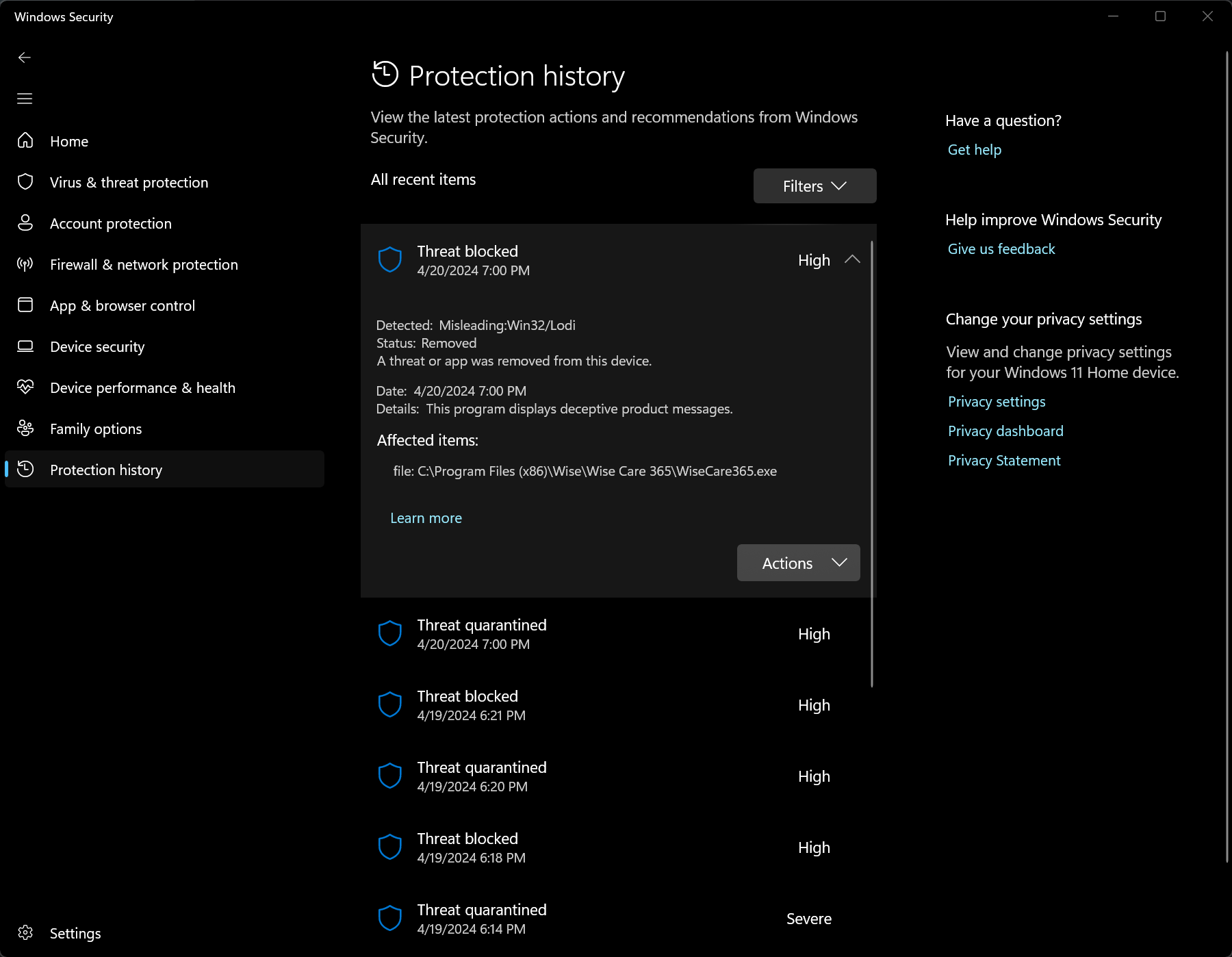
Here is the Windows Security details about the block.

ALBERTSVOICE TECH
New Member
I've been using this program for years this is the first time I seen this and I know for a fact it does have the adware inside but it seems it can send information back to them but what type of info. When I installed this app I block the main exe inbound and outbound but now windows defender on 4/20 told me it detected win32/lodi and remove the program. I tried to install it back it but it removed the entire app and downloaded. I get the app directly from their download servers.
Wise Care 365 website back to older version on the download page Version Wise Care 365 v6.6.5 which is released in Feb to avoid more detection on the Current Version Wsie Care 365 V6.6.6, but if you download the portable version it will still get the malware.
More antiviruses detect it now including Avast.
More antiviruses detect it now including Avast.

Also using wise disk cleaner for years here, no issue right now with MS defender.
The issue is just with Wsie Care 365 V6.6.6, older versions have no issue.Also using wise disk cleaner for years here, no issue right now with MS defender.

SpectraShadow83
Level 2
Version 6.7.1 is also detected on Virustotal by various security vendors... I have always used this software without any problems... My question is, aren't they boycotting it because it's Chinese?
SpectraShadow83
Level 2
No the problem only with wise Care 365, but Wise Disk Cleaner and Wise Registry Cleaner have no problems at all.Version 6.7.1 is also detected on Virustotal by various security vendors... I have always used this software without any problems... My question is, aren't they boycotting it because it's Chinese?
I guess that because of the Bootup Booster Service included in Wise Care 365.
SpectraShadow83
Level 2
Here we go again, MS Defender blocks Wise Care 365 again as PUA, but this time it asks about the action instead of remove by default, awesome.
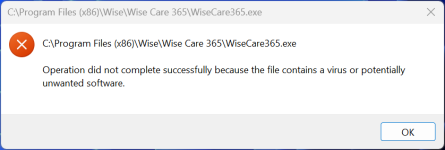
The most resent detection is: PUA:Win32/PCCleanNo. Microsoft and other AV block or delete based upon the product reputation as scareware (misleading product messages). That is why the recent detection is:
Misleading:Win32/Lodi
F
ForgottenSeer 114717
It can be any of them:The most resent detection is: PUA:Win32/PCClean
- PUA: Win32/WiseCare (2017)
- Misleading: Win32/Lodi (2024)
- PUA: Win32/PCClean (2024)
These detections (signatures) are all still in Microsoft's active Defender signatures database. Sometimes you can get different detection signatures for the same file. There can be variations between Windows 10 and 11 and even between different build numbers of Windows or the Defender detection engine.
No matter what it is as a dedicated user of WiseCleaner it will be a PITA for you. Best just to create an Allow exception in Defender.
Microsoft Security is going to keep generating new signatures for programs such as Wise until the publisher joins their Partnership program and pays all the money and jumps through all the hoops to get Microsoft to leave them alone. Essentially that is an accurate characterization of it. Otherwise the development teams has contact Microsoft and submit infos every single time a new signature is created.
Most, if not all, of these detections are based upon Microsoft categorizing the product's reputation as "suspicious."
Last edited by a moderator:
If I understand you well, is Microsoft use MS Defender to get money by doing this?It can be any of them:
- PUA: Win32/WiseCare (2017)
- Misleading: Win32/Lodi (2024)
- PUA: Win32/PCClean (2024)
These detections (signatures) are all still in Microsoft's active Defender signatures database. Sometimes you can get different detection signatures for the same file. There can be variations between Windows 10 and 11 and even between different build numbers of Windows or the Defender detection engine.
No matter what it is as a dedicated user of WiseCleaner it will be a PITA for you. Best just to create an Allow exception in Defender.
Microsoft Security is going to keep generating new signatures for programs such as Wise until the publisher joins their Partnership program and pays all the money and jumps through all the hoops to get Microsoft to leave them alone. Essentially that is an accurate characterization of it. Otherwise the development teams has contact Microsoft and submit infos every single time a new signature is created.
Most, if not all, of these detections are based upon Microsoft categorizing the product's reputation as "suspicious."
F
ForgottenSeer 114717
Not directly. Some software publishers pay the money and go through the process of extended validation to obtain a permanent whitelisting by Microsoft of the Authenticode digital signature. Others join one of the various Microsoft industry initiatives.If I understand you well, is Microsoft use MS Defender to get money by doing this?
Microsoft is average in its fight against PUA whereas Kaspersky essentially allows most any PUA to be installed. Each security software publisher has differences based upon those making the decisions to block PUAs. Some decision makers want to crack-down on software they think are not good for end users while others leave it to the end user to figure out a software is a problem.
Last edited by a moderator:
Recently browsing
Members who viewed this thread in the last 5 minutes
You may also like...
-

-
-
 Serious Discussion Did Microsoft Defender change the way it responds to file downloads?
 -
-
