

The Arterial Flush Ritual Scam begins with a frightening story about clogged arteries and a familiar television-style interview. A spoonful of honey supposedly becomes the missing answer, but the story does not end in a kitchen. It ends at a supplement order page.
We followed the claims to BloodPril, compared the active sales pages, checked the formula, prices, refund language, address, and billing terms, then separated what the websites actually say from what the dramatic advertising tries to make viewers believe.
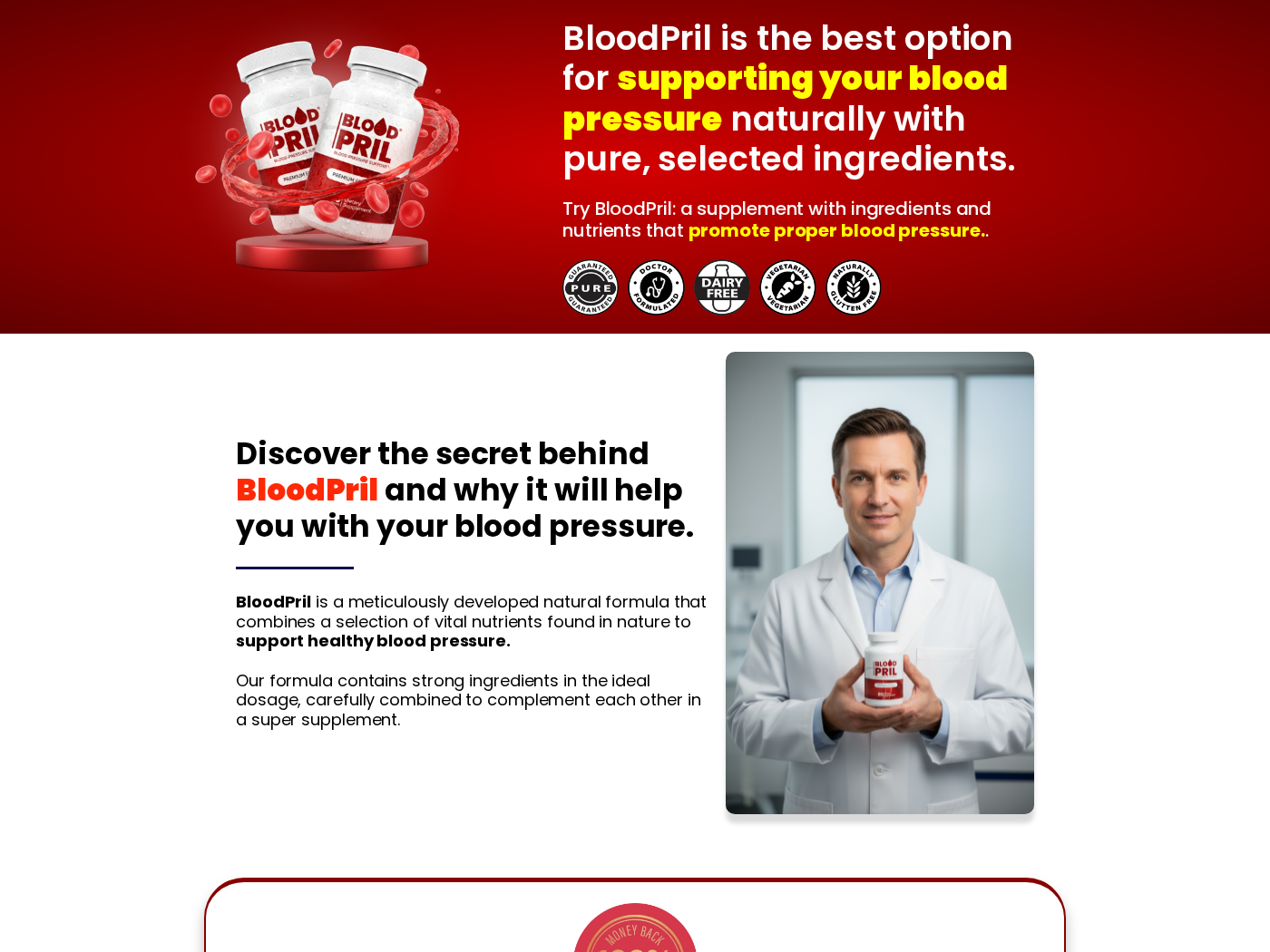
One BloodPril page presents the capsules as a natural way to support blood pressure. It places two bottles beside a polished doctor image and surrounds the offer with badges for purity, vegetarian ingredients, and a dairy-free formula.
That presentation looks far more ordinary than the story used to attract attention. The ad campaign reportedly invokes a supposed medical crisis, famous broadcasters, physicians, actors, and a secret honey ritual that powerful interests allegedly do not want discussed.
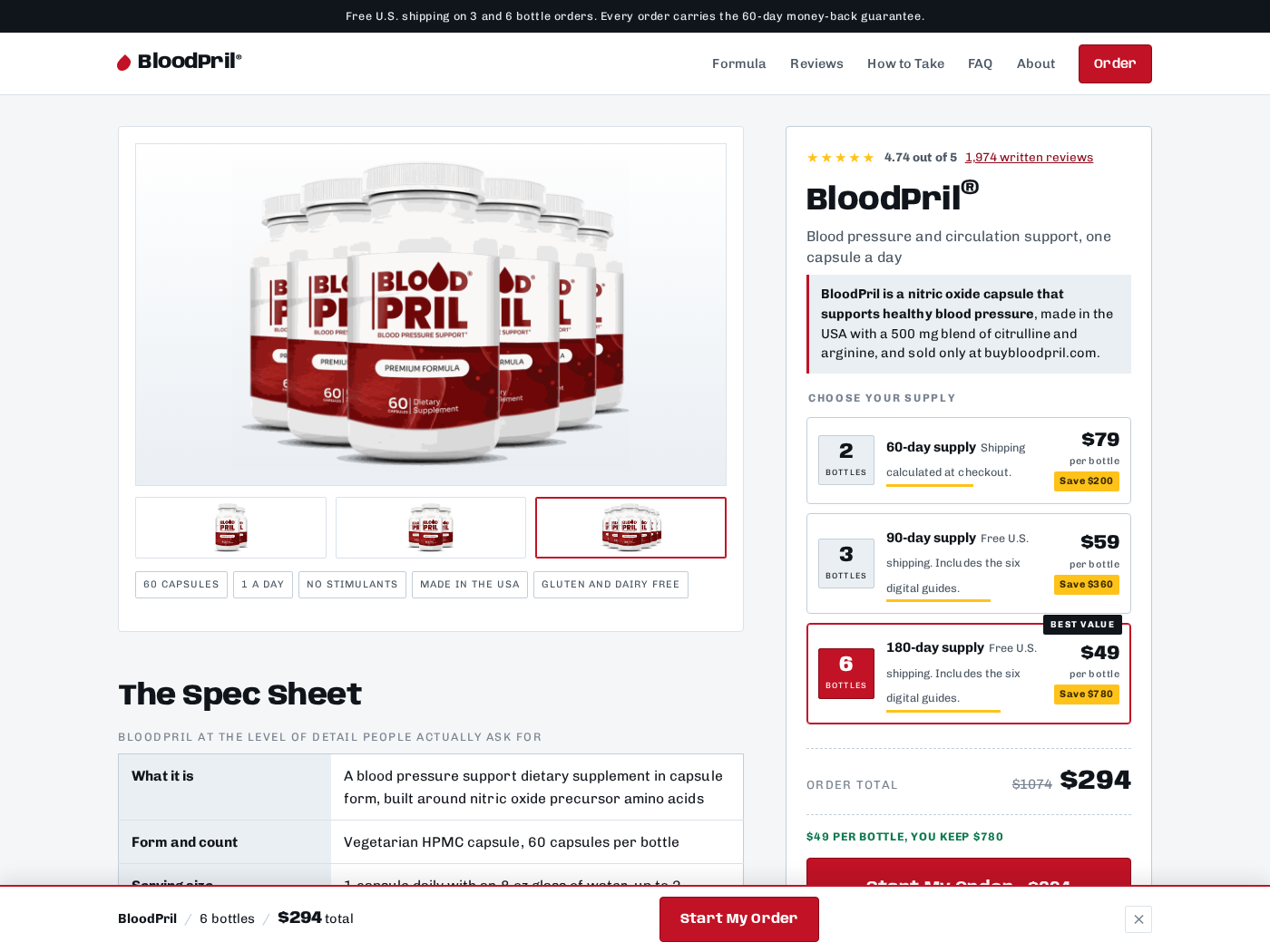
The current store then focuses on nitric oxide support, citrulline, arginine, multi-bottle discounts, and a 60-day guarantee. This gap between the sensational hook and the retail product is central to understanding the funnel.
Overview
The viral story and the retail offer are two different things
The so-called ritual is promoted through unauthorized television-style clips and celebrity imagery. Viewers may be led to think a major news program or respected doctor confirmed a way to clear arteries with honey. We found no reliable evidence that those public figures endorsed BloodPril or this remedy.
BloodPril is a dietary supplement sold through active websites. A real checkout page does not make the surrounding broadcast, endorsement, cure story, or medical promise authentic. Each claim needs its own evidence, and the advertising story provides very little that can be independently verified.
The BloodPril websites do not describe one consistent purpose
The store at buybloodpril.com describes blood pressure and circulation support. Yet other near-match domains found during the review use the BloodPril or BloodSpril name for blood sugar, metabolism, or weight-related claims. Similar names do not prove common ownership, but they create a confusing search environment.
A customer must therefore record the exact domain, product label, ingredient panel, receipt, and card descriptor. Searching only the bottle name could lead to a different seller, a different formula, or a page making a completely different health promise.
The current store says one charge and no subscription
The visible buybloodpril.com offer states that the purchase is a single charge and says there is no subscription. That is important evidence. The current storefront should not be called a confirmed automatic-refill trap unless a checkout screen, receipt, or later card statement shows different terms.
The advertising funnel still raises serious concerns because it uses an extreme health story to sell a supplement. Buyers should save the final checkout and monitor their statements, but our warning is about deceptive promotion and unsupported medical framing, not a recurring charge we could prove on this page.
- The ad story imitates a television investigation and borrows recognizable faces.
- A honey arterial flush is used as curiosity bait before capsules appear.
- No verified celebrity or physician endorsement connects the story to BloodPril.
- The current store lists a 500 mg proprietary blend based on citrulline and arginine.
- Package totals shown during review were $158, $177, and $294.
- The store promises a 60-day refund but makes the buyer pay return shipping.
- The visible offer explicitly says no subscription, so hidden refills are not confirmed.
What the Arterial Flush Ritual Story Is Designed to Do
The pitch begins with fear. Arteries are described as dangerously blocked, a loved one supposedly suffers a stroke, or a doctor seems alarmed that ordinary treatment missed a simple cause. The viewer is pushed toward an emotional decision before the product name is even revealed.
Honey then makes the story feel harmless and familiar. Because most people recognize it as food, the claim can sound less like an untested medical intervention. The ad implies that a special timing, mixture, or hidden companion ingredient transforms it into an arterial cleanse.
The campaign reportedly uses fabricated broadcast-style segments and unauthorized depictions of well-known journalists, doctors, and entertainers. A long list of recognizable people creates social proof, even though the viewer is not shown authentic interviews, original program links, or verifiable endorsement statements.
After curiosity and fear have done their work, the free ritual becomes incomplete. The viewer is told that the real benefit requires a concentrated ingredient combination. This is the moment the story pivots from household advice to a commercial bottle.
That pivot matters because there is no credible medical shortcut that literally flushes arterial plaque at home. Anyone with chest pain, stroke symptoms, severe blood pressure readings, or concerns about cardiovascular disease needs qualified medical care, not a video funnel promising rapid repair.
What Our BloodPril Investigation Found
The active store describes BloodPril as one capsule per day for blood pressure and circulation support. It lists a 500 mg proprietary blend containing L-citrulline dl-malate, L-arginine AKG, and L-arginine HCl. A proprietary total does not reveal the amount of each component.
The package math is aggressive. At the time checked, two bottles cost $158, three cost $177, and six cost $294. Large crossed-out savings and a best-value label encourage the customer to buy months of product before knowing how it affects them.
The refund promise lasts 60 days, but the customer is responsible for return shipping. The store identifies a BloodPril distributor in Lakeland, Florida, and provides a support number. It does not clearly identify a named manufacturing company on the visible product page.
A distributor or returns location is not automatically a headquarters or factory. The Lakeland listing should be treated as a contact point until company registration, manufacturing documentation, and batch records connect it to a specific legal entity and finished product.
Near-match sites add another layer of uncertainty. One describes a blood sugar supplement, another emphasizes weight management, while buybloodpril.com focuses on blood pressure. We cannot assume every similar domain belongs to the same operator, and that uncertainty is exactly why the full URL matters.
The FDA explains that dietary supplements are not approved before sale. A website may discuss general support, but claims to cure cardiovascular disease, clear plaque, or replace prescribed treatment require a very different level of evidence and regulatory review.
How the Arterial Flush Ritual Scam Works
Step 1: A frightening social ad interrupts the feed
The first contact is usually a short video or sponsored headline about a stroke, clogged arteries, or a medical discovery. It is written to feel urgent enough that scrolling past seems irresponsible.
The advertiser may use a generic wellness account or a page unrelated to the people shown. The identity of the ad buyer is much less prominent than the famous face and medical emergency placed in the creative.
Step 2: Fake television authority lowers skepticism
The viewer sees a set, logo, presenter, transcript, or editing style that resembles a respected news program. Synthetic audio and clipped footage can make unrelated people appear to discuss the same product story.
The crucial verification step is missing. There is no full broadcast on the network’s official site, no statement from the alleged speaker, and no trustworthy record tying the segment to the supplement being sold.
Step 3: The honey ritual creates an open loop
The ad promises a simple honey recipe but delays the exact explanation. Each minute adds another testimonial, mechanism, or warning about people who supposedly want the discovery hidden.
This delay is deliberate sales psychology. A viewer who has watched for several minutes becomes more likely to continue, even when the original household remedy keeps changing into something more complicated.
Step 4: A fake editorial page continues the story
The click may open an advertorial that resembles a health article, news transcript, or independent investigation. Its design creates distance between the dramatic video and the eventual sales checkout.
The page is not neutral reporting. Buttons lead toward one commercial offer, objections are answered with seller-controlled claims, and meaningful criticism is absent or framed as proof that the discovery is being suppressed.
Step 5: BloodPril becomes the packaged solution
Only after trust and fear are established does the capsule appear. The customer is encouraged to transfer belief in the honey story, celebrity image, and supposed medical mechanism directly onto BloodPril.
The current product page uses softer support language than an artery-clearing promise. That contrast helps the seller market dramatically in the funnel while displaying more cautious wording near the actual bottle.
Step 6: Bundle pricing turns concern into a large order
The checkout emphasizes cost per bottle, crossed-out reference prices, free shipping thresholds, and the package labeled best value. The total charge can be much larger than the headline unit price.
Customers should ignore the claimed savings and read the order total. A six-bottle package is still a $294 decision, and returning unused bottles may involve deadlines, authorization steps, and customer-paid postage.
Step 7: The buyer must navigate support and refund rules
If the product disappoints, the customer has to contact the correct seller, obtain instructions, preserve the bottles, and ship them back within the stated window. Confusing near-match domains can make that process harder.
The visible page says there are no automatic refills. Buyers should nevertheless keep the receipt and watch the exact card descriptor, because those records identify the merchant more reliably than a bottle name shared across unrelated pages.
Company, Address, and Fulfillment Checks
The bottle name is not the company
BloodPril is a product label. The active store refers to a distributor but does not prominently present a full legal-company identity beside the main offer. Without that entity, checking registration, owners, litigation, and operating history becomes difficult.
Before paying, match the legal name in the terms, privacy policy, checkout, receipt, and card statement. If those records show different names, save every version and ask the seller to explain the relationship in writing.
A Lakeland address does not prove where it is made
The visible contact points to Lakeland, Florida. That may be a distributor, mailbox, office, or returns operation. It is not evidence that the capsules are manufactured, tested, or quality-controlled at that address.
A serious seller should identify the manufacturer or responsible company, provide a complete Supplement Facts label, and answer where finished-product testing occurs. A map pin and a USA badge cannot answer those questions.
The phone should survive a basic reality check
Call the published number before ordering. Ask the representative to name the exact product, legal seller, return address, refund procedure, and whether the checkout creates any future charges. Record the date and the answer.
If support does not answer, cannot identify the bottle, or refuses to send terms by email, do not assume help will improve after the charge. An unanswered sales problem often becomes a much harder refund problem.
Unknown sourcing means unknown risk, not proven origin
We did not find reliable evidence proving that BloodPril is mass-produced in China, so that claim should not be stated as fact. What can be said is that the visible storefront leaves important manufacturing and batch-testing details unclear.
Any supplement can be risky if the contents, dosage, contamination controls, or interactions are uncertain. People using blood pressure drugs, nitrates, diabetes medicines, anticoagulants, or other prescriptions should show the exact label to a clinician before taking it.
Why the Medical Claims Deserve More Scrutiny Than the Bottle
L-citrulline and L-arginine participate in nitric oxide pathways, but an ingredient having a biological role does not validate a particular finished supplement or prove that it clears arterial plaque. Dose, purity, formulation, health status, and clinical endpoints all matter.
The store provides one 500 mg proprietary blend for several ingredients. Without individual amounts, customers and clinicians cannot compare the formula with research doses or assess how much of each substance a daily capsule provides.
Blood pressure can change for many reasons, and uncontrolled hypertension often has no obvious symptoms. Replacing monitoring or prescribed treatment with a supplement because an ad promised a honey cure can delay care and create a preventable emergency.
The strongest red flag is therefore not the existence of a capsule. It is the attempt to make viewers believe that a fabricated broadcast and dramatic celebrity story already settled the medical question before they reached the sales page.
A fair conclusion separates the evidence. BloodPril is visibly offered for sale, the current store says no subscription, and some listed ingredients are real dietary compounds. The celebrity endorsement, artery-flushing narrative, and rapid cure implication remain unverified and misleading.
Warning Signs to Watch For
- A secret cure appears inside a television-style clip that cannot be found on the network's official site.
- Several famous people seem to support the same supplement without direct statements on their verified channels.
- A honey recipe is promised, delayed, and finally replaced by a paid capsule.
- The product purpose changes across near-match domains.
- The formula is presented as one proprietary total instead of individual ingredient amounts.
- A large package is labeled the obvious choice before the buyer has tried one bottle.
- The address identifies distribution but does not clearly establish manufacturing or testing.
- Disease-treatment language appears in advertising while the store retreats to general support wording.
One warning sign can have an innocent explanation. In this funnel, however, borrowed authority, a delayed household secret, medical fear, opaque sourcing, and bundle pressure reinforce one another. That combination is a reason to stop and verify before paying.
What to Do if You Have Fallen Victim to This Scam
- Save the entire order trail. Keep the ad, URL, screenshots, checkout, receipt, shipping label, bottle, Supplement Facts panel, emails, and card descriptor. These records show which seller and terms applied to your purchase.
- Do not stop prescribed treatment. Contact your clinician if you changed medication or used the product for blood pressure, circulation, or heart concerns. Seek emergency care for chest pain, stroke symptoms, fainting, or severe readings.
- Contact the merchant in writing. Request cancellation or a refund under the 60-day policy. Ask for the required return authorization, exact return address, deadline, and confirmation that no further orders will be processed.
- Use tracked return shipping. If you send bottles back, photograph the package and label, retain the tracking number, and keep delivery proof. Do not rely on an untracked parcel when the refund depends on receipt.
- Dispute an unresolved charge. If the merchant does not honor written terms, contact the card issuer promptly. Explain the misleading promotion, product mismatch, or refund failure and submit your saved evidence.
- Watch for unexpected transactions. The visible store says no subscription, but monitor statements for the merchant descriptor and any unfamiliar repeat charge. Report unauthorized billing immediately rather than waiting for another cycle.
- Secure the device used to order. Run a Malwarebytes scan if the funnel triggered downloads, alerts, or redirects. Use AdGuard to reduce malicious ad and tracker exposure.
- Report the deceptive advertisement. Report the ad to the platform, the FTC, and the FDA when a supplement is marketed with disease-cure claims or causes an adverse event.
Frequently Asked Questions
Is the Arterial Flush Ritual real?
We found no reliable evidence that a honey ritual can rapidly flush arterial plaque. The story functions as a sales hook and should not replace cardiovascular evaluation, blood pressure monitoring, or prescribed care.
Did the television personalities endorse BloodPril?
We found no verified endorsement connecting the recognizable broadcasters, physicians, or entertainers used in the campaign to BloodPril. A clip is not proof unless it can be confirmed through the person’s or network’s official channels.
Is BloodPril a real product?
BloodPril is offered on active sales pages with bottles, package prices, ingredients, and refund terms. That proves an offer exists, not that the sensational artery-clearing story or every health claim is accurate.
Does BloodPril create an automatic subscription?
The current buybloodpril.com page explicitly says the order is a single charge with no subscription. We did not find checkout evidence proving automatic refills, so recurring billing should not be presented as confirmed.
Why do BloodPril search results describe different benefits?
Several near-match domains use similar names while discussing blood pressure, blood sugar, metabolism, or weight. They may not share an operator. Confirm the exact URL and label instead of assuming every result concerns the same product.
Can BloodPril replace blood pressure medicine?
No supplement should replace prescribed medicine based on an online ad. Discuss the exact ingredients with your clinician because nitric oxide-related compounds can affect blood pressure and may interact with other treatment.
The Bottom Line
The Arterial Flush Ritual Scam uses fear, borrowed television authority, a delayed honey secret, and celebrity imagery to make a supplement sale feel like the conclusion of a medical investigation. That conclusion is not supported by verifiable endorsements or evidence that the ritual clears arteries.
BloodPril is sold through real pages, and the current store says the transaction is one-time rather than an automatic refill. Even so, the inconsistent online branding, proprietary formula, unclear manufacturing trail, and exaggerated funnel are strong reasons to avoid impulse purchases and consult a qualified clinician instead.








