


A contract notification can feel unusually important, especially when it carries a settlement number and asks for a signature. The formal wording makes hesitation seem costly.
Yet a polished document request can conceal more than it reveals. A few careful checks can separate genuine business paperwork from a dangerous imitation.
Overview
A Settlement Contract That Was Never Sent
The Contract Document To Review And Sign email scam impersonates an electronic signature service and claims a business agreement awaits the recipient.
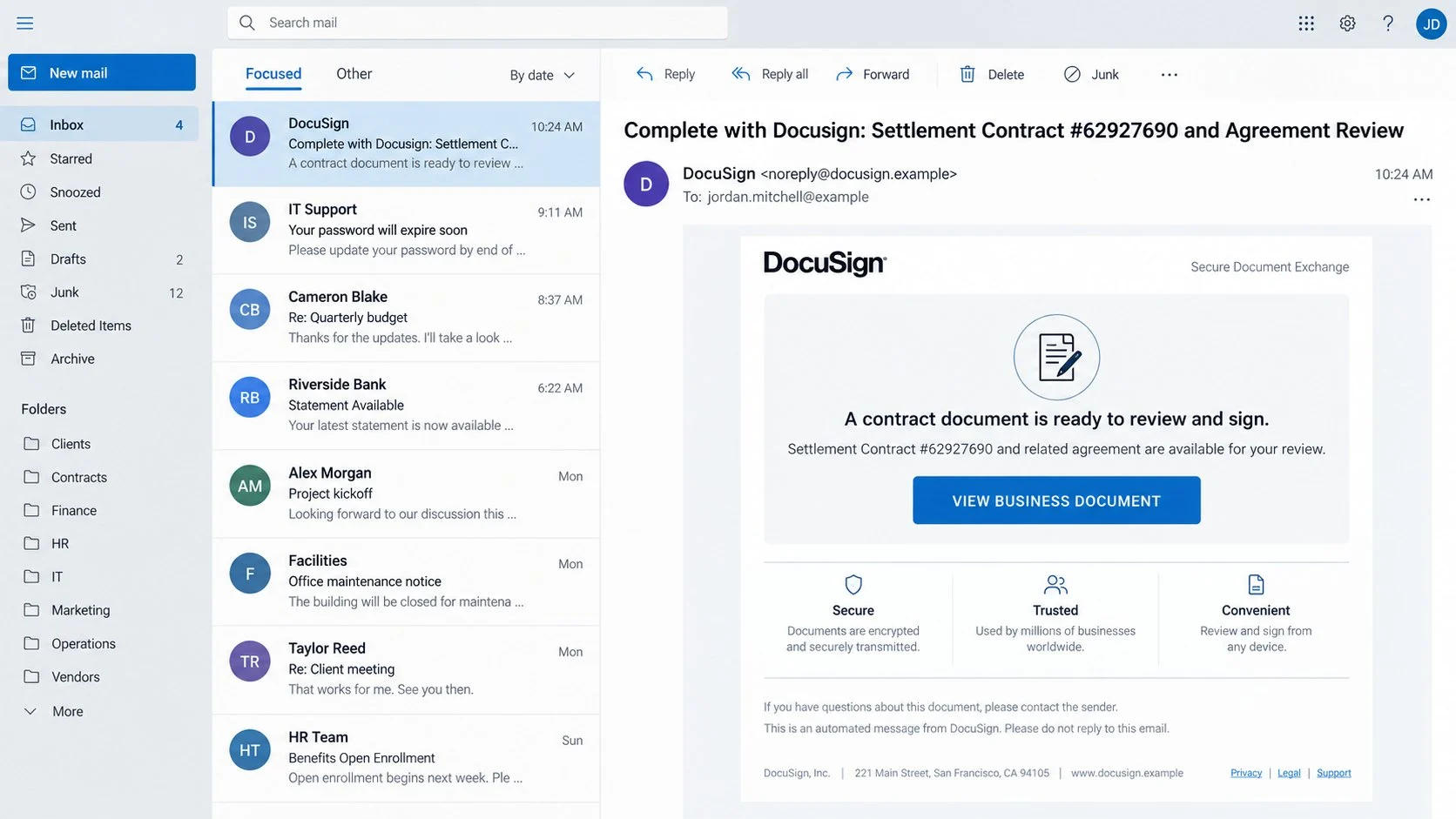
The examined subject read “Complete with Docusign: Settlement Contract #62927690 and Agreement Review.” That precise number makes the notice look tied to a real transaction.
Inside, a large “VIEW BUSINESS DOCUMENT” button promises access to the agreement. The message also refers to parties completing a purchase order for equipment.
Those details are invented. The button does not open a legitimate envelope, verified contract, or authentic signing session.
The Button Leads to a Password Trap
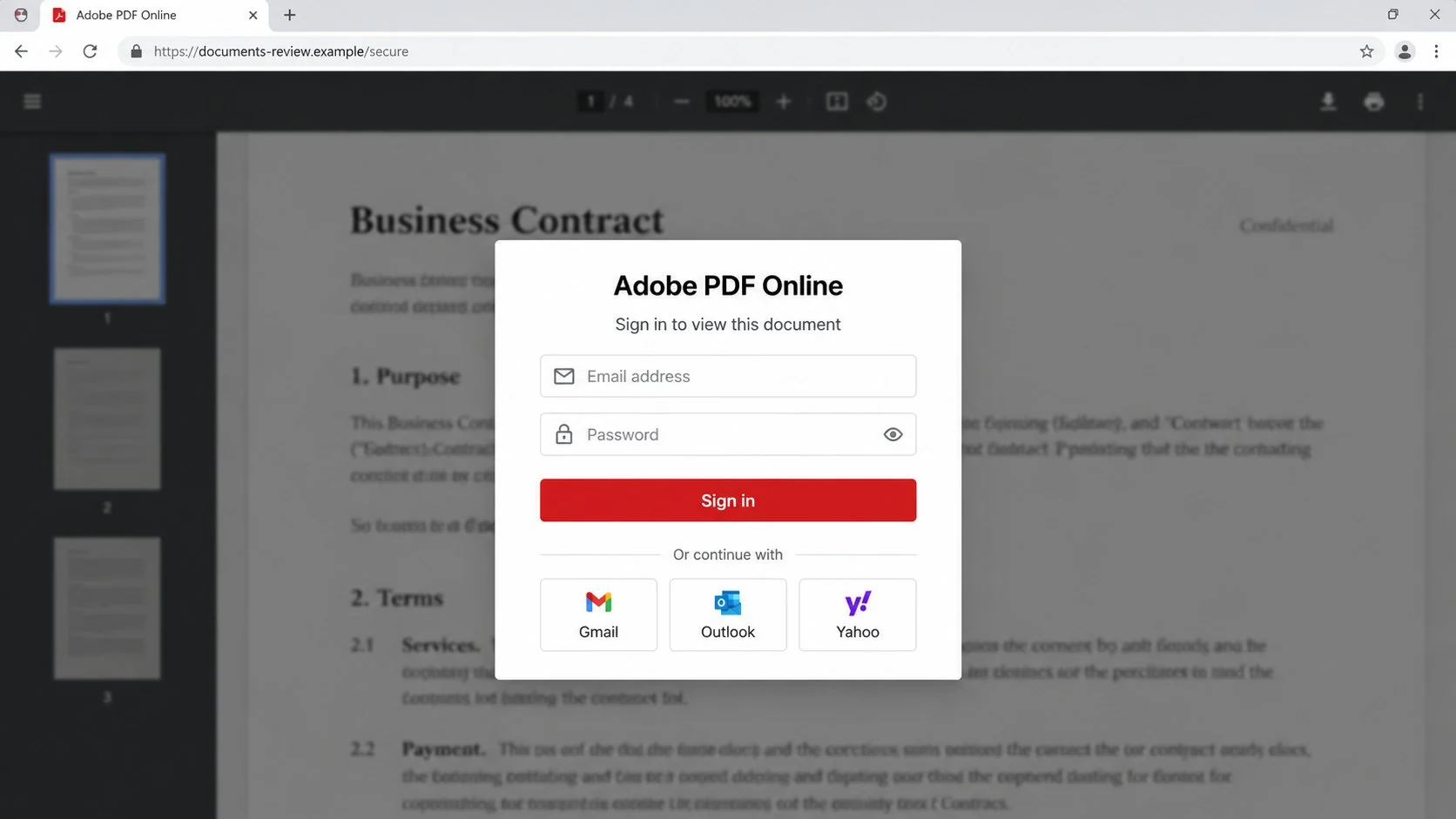
The email first directs visitors through an unrelated web address. Its path eventually displays a counterfeit “Adobe PDF Online” page.
A blurred contract appears behind a login box. The design suggests the document already exists and will become readable after authentication.
- The email arrives without a recognized sender or prior negotiation.
- The visible signing brand differs from the supposed PDF service.
- The action button points to an unrelated website.
- The page requests an email password before showing anything.
- Provider logos are used to make the form feel compatible and safe.
- The contract description supplies urgency but no verifiable business context.
Submitting the form gives criminals a mailbox credential. It does not unlock a protected PDF or confirm a signature.
Why a Stolen Mailbox Matters
Email accounts hold far more than conversations. They receive password resets, invoices, cloud invitations, identity records, and private business discussions.
An attacker can search for valuable exchanges, impersonate the owner, or quietly monitor future messages through hidden forwarding rules.
Work accounts are especially attractive. A compromised mailbox can support payment diversion, supplier impersonation, payroll fraud, and convincing attacks against colleagues.
This campaign is credential phishing. Simply viewing the email is not the central danger. Clicking and entering a password creates the immediate exposure.
How the Contract Document To Review And Sign Email Scam Works
Step 1: A Formal Contract Notice Arrives Unexpectedly
The campaign begins with an email designed to resemble an automated electronic signature notification. Its tone is restrained, professional, and deliberately ordinary.
A settlement reference gives the impression that a legal or commercial process is already underway. Recipients may worry that ignoring it could delay business.
The message does not establish who negotiated the agreement. Instead, it uses broad language that could fit a customer, vendor, employer, or unfamiliar partner.
That ambiguity is useful to the sender. The recipient is encouraged to open the document to discover why it supposedly concerns them.
Step 2: Equipment and Purchase-Order Details Add Credibility
The sample mentioned a mid-rise scissor lift purchase order. Specific industrial wording makes a random email resemble paperwork from a real procurement chain.
Scammers do not need to know whether the target buys that equipment. They only need the description to feel plausible to some percentage of recipients.
Employees who process invoices, facilities requests, legal documents, or purchasing records face constant paperwork. Routine volume can weaken careful inspection.
A genuine contract should connect to known negotiations, named parties, and an expected sender. Technical product language cannot replace that history.
Step 3: The Review Button Opens an Unrelated Website
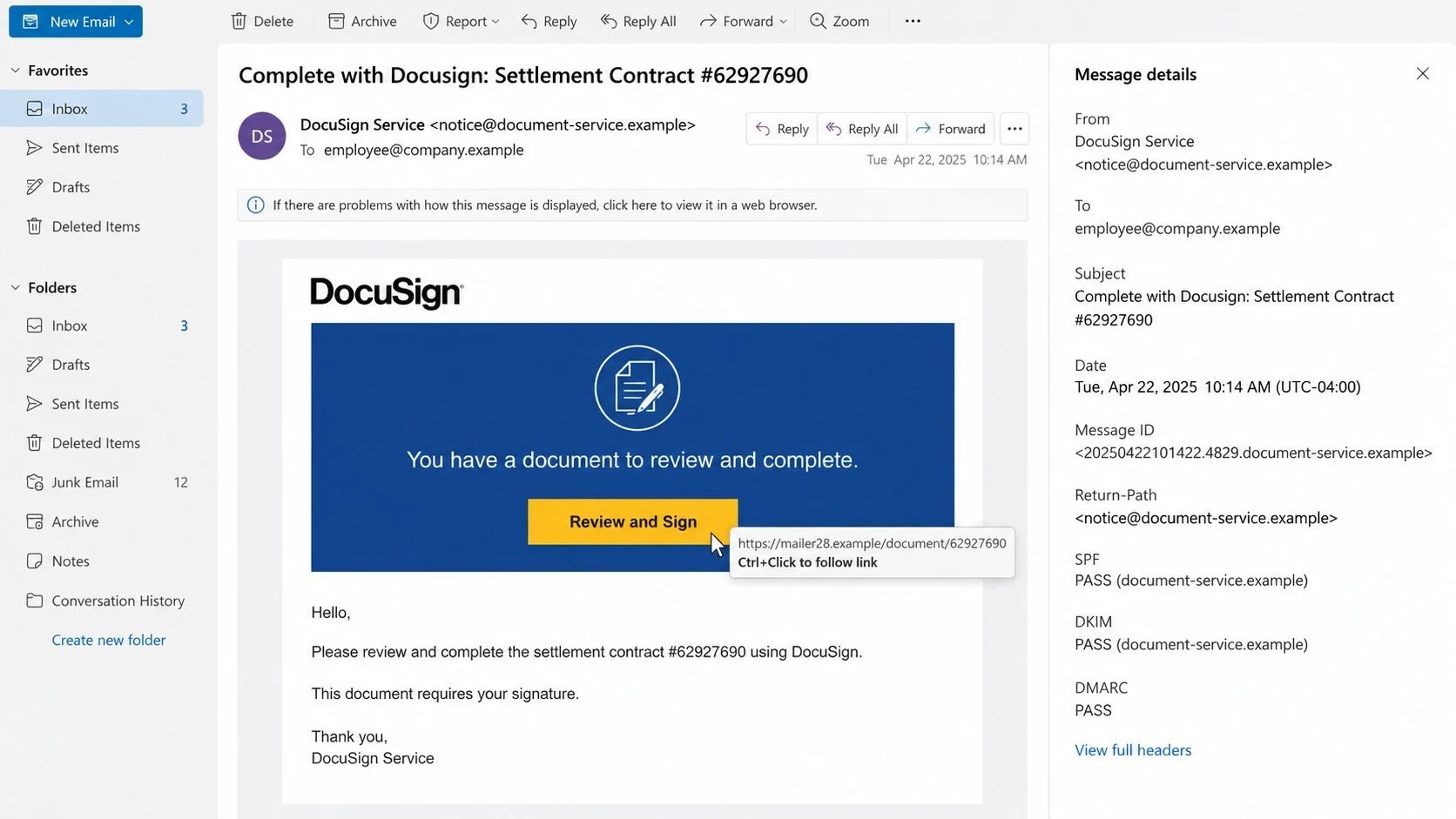
The “VIEW BUSINESS DOCUMENT” button looks like the normal next step. Its visible label reveals nothing about the actual destination.
In the analyzed path, the link used infrastructure unrelated to the signing service or the alleged parties. That mismatch is a decisive warning.
A familiar logo inside an email does not control where a button travels. The destination address is stronger evidence than the artwork surrounding it.
Redirects can also hide the final page from basic mail filters. Each intermediate site makes the route harder for recipients to understand.
Step 4: A Blurred PDF Creates an Authentication Excuse
The destination displays what appears to be a business contract, but its contents remain deliberately blurred. A centered form blocks the supposed document.
This visual arrangement is psychologically effective. It suggests the promised file is real, loaded, and only one familiar login away.
The page may offer Gmail, Outlook, or Yahoo choices. Those options are decorative cues, not proof that any provider authorized the site.
A document sender never needs the password to someone else’s email account. Authentication should occur only on the recipient’s established provider domain.
Step 5: The Counterfeit Form Records the Password
When a visitor enters an address and password, the page can transmit both values to the operator. It does not verify them safely.
Some phishing kits ask twice, claiming the first password was incorrect. That tactic captures alternate passwords from people who assume they mistyped.
Afterward, the site may show an error, display a harmless PDF, or redirect to a genuine service. None of those outcomes reverses the theft.
The criminal can test the credential quickly. Automated attempts may occur before the victim realizes that no meaningful contract appeared.
Step 6: The Compromised Account Supports a Second Attack
Successful access lets an intruder examine contacts, recent projects, payment conversations, and the language normally used by the account owner.
That information improves later impersonation. A fraudulent invoice sent within an existing thread can be much harder to recognize than the original lure.
Attackers may add inbox rules that hide security alerts or forward selected messages. Password changes alone may not remove those settings.
The original fake contract can also be sent from the compromised address to colleagues. A trusted internal sender makes the next recipient less suspicious.
How to Verify a Contract Notification Safely
Confirm the Agreement Through Existing Business Records
Search your calendar, contract system, procurement platform, and previous correspondence for the settlement number. Do not begin with the email button.
A legitimate signature request should follow some recognizable discussion. The parties, project, and purpose should not be mysteries resolved only after login.
If you work for an organization, ask the responsible legal or purchasing contact whether the envelope is expected. Share the message according to internal policy.
Inspect the Complete Sender and Destination
Expand the sender details instead of trusting the display name. Compare the address with earlier verified notices from the same signing platform.
Preview the button destination without opening it. A misspelled, newly introduced, or unrelated domain should stop the process immediately.
HTTPS does not prove ownership. A fraudulent site can encrypt traffic while collecting information for the person who operates it.
Reach the Signing Service Independently
Open the service through a saved bookmark, its official application, or an address already used by your organization. Check for the envelope there.
Do not paste an email password into a document viewer. Legitimate access may use a dedicated account, secure link, or company identity system.
If the contract is absent, contact the purported sender through a known number or established email thread. Avoid reply details supplied by the suspicious message.
Evaluate the Document Story, Not Just the Design
Ask whether the described purchase belongs to your role or company. An unfamiliar scissor lift order deserves verification before any digital action.
Check whether names, dates, reference numbers, and organizations agree with one another. Scammers often combine realistic fragments that lack a coherent relationship.
A genuine sender can explain the agreement without demanding your mailbox password. Pressure to authenticate before receiving basic context is not normal.
What to Do If You Fell Victim to the Contract Document Email Scam
Stay calm and respond according to what you entered or opened. Fast containment can greatly reduce the value of a stolen credential.
- Close the phishing page and preserve the email.
Do not retry the form or experiment with another password. Save the original message, headers, destination, and approximate time of interaction.
Workplace users should notify their security team immediately. Administrators may need those details to find related messages across the organization.
- Change the exposed password from a trusted route.
Open the genuine mail service directly and create a unique replacement. Never use a recovery link supplied by the suspicious message.
If that password protected other accounts, replace every reuse. Prioritize financial services, cloud storage, business systems, and social accounts.
- Terminate sessions and strengthen authentication.
Review active devices, recent logins, recovery addresses, application passwords, and connected applications. Remove anything you do not recognize.
Enable multifactor authentication with a passkey, authenticator application, or security key when available. Save recovery codes somewhere protected.
- Check the mailbox for hidden changes.
Inspect forwarding addresses, filters, inbox rules, delegates, sent mail, and deleted folders. Undo unauthorized settings before normal use resumes.
Look for security notifications that may have been hidden. A rule targeting words like “password” or “invoice” can reveal deliberate persistence.
- Warn people exposed through the account.
Tell colleagues or contacts if suspicious messages were sent. Include the subject and timing, but do not forward a live phishing button.
Ask finance teams to verify bank-detail changes independently. An intruder may use known conversations to redirect legitimate payments.
- Scan any downloaded content.
This documented path focused on password theft, but related campaigns can deliver harmful files. Run a complete Malwarebytes scan after opening an unexpected download.
AdGuard can block many known phishing and advertising domains. Keep it enabled as an added layer, while still verifying every unexpected contract.
- Report losses and suspicious access.
Use the mail provider’s phishing report feature and follow workplace incident procedures. Record dates, actions, and support case numbers.
If money or identity documents were exposed, contact the relevant bank and fraud-reporting authority promptly. Ask what protective measures apply locally.
Is Your Device Infected? Run a Free Malware Scan
Slow performance, constant pop-ups, or strange behavior? These are classic signs of a malware infection. A quick way to check is to scan your device with Malwarebytes Free, one of the most trusted malware removal tools available. If you only visited a scam page and didn’t download or install anything, this scan is optional.
The free version detects and removes the most common threats, including:
- Adware — the cause of those annoying pop-ups
- Browser hijackers — unwanted redirects and changed homepages
- Trojans and spyware — hidden programs stealing your data
- Potentially unwanted programs (PUPs) — software you never asked for
👉 Select your device below — Windows, Mac, or Android — then follow the simple steps to download Malwarebytes, scan your system, and remove any threats it finds. The scan usually takes 5 to 20 minutes.
Run a Malware Scan with Malwarebytes for Windows
Malwarebytes is one of the most popular and trusted anti-malware tools for Windows — and it’s completely free for removing infections. It catches threats that many antivirus programs miss, including adware, browser hijackers, and trojans. Follow the steps below to scan your PC and remove what Malwarebytes finds.
Download Malwarebytes
Click the button below to download the latest version of Malwarebytes for Windows from the official source. The free version is all you need — it will scan your computer and remove adware, browser hijackers, and other malicious software at no cost.
Download MalwarebytesOfficial installer for Windows 11 and 10. Your download starts right away.Want real-time protection? See Malwarebytes Premium Malwarebytes Free for WindowsScans and removes malware at no cost
-
Install Malwarebytes
When the download finishes, open your Downloads folder and double-click the MBSetup file. If Windows shows a User Account Control pop-up, click “Yes” to allow the installation.

Follow the On-Screen Prompts to Install Malwarebytes
The setup wizard will walk you through a few quick screens:
-
Choose where you’re installing the program — “Personal Computer” or “Work Computer” — then click Next.

-
Malwarebytes will now install on your device. This usually takes under a minute.

-
When installation is complete, the “Welcome to Malwarebytes” screen will open automatically.

-
On the final screen, click Open Malwarebytes to launch the program.

-
Optional: Check for rootkits with a Custom Scan
You don’t need to change any settings for a normal scan. The standard Threat Scan in the next step is enough for most problems, so you can go straight to it.
If you also want to check for rootkits, use a Custom Scan. In current versions of Malwarebytes, rootkit scanning is only available there:
- On the Scanner tile, click the three-dot menu and select Advanced Scan.
- Choose Custom Scan. In its options, check Scan for rootkits.
- Select your system drive (usually C:\) as the location to scan, then start the scan. It takes longer than a Threat Scan.
- When it finishes, review and quarantine the results as described in the steps below.
Rootkit scanning isn’t available on Windows devices with ARM processors.
Start the Scan
Click the blue Scan button. Malwarebytes will automatically update its virus database and start checking your computer for malware.

-
Wait for the Scan to Finish
The scan checks your entire system for browser hijackers and other malicious programs, so it can take 5 to 20 minutes depending on your computer. Feel free to do something else — just check back occasionally to see the progress.

-
Quarantine the Detected Threats
When the scan is done, you’ll see a list of everything Malwarebytes found — malware, adware, and potentially unwanted programs. Click the “Quarantine” button to remove all of them at once.

Malwarebytes will now remove the malicious files and registry entries and move them safely into quarantine.

-
Restart Your Computer
Some threats can only be fully removed after a reboot. If Malwarebytes asks you to restart, click Yes. Once you’re logged back in, Malwarebytes has finished removing the threats it found.

When the scan is done, check whether the problems you noticed have stopped. If they continue, see the options below.
If you are still having problems with your computer after completing these instructions, then please follow one of the steps:
- Run a computer scan with ESET Online Scanner
- Ask for help in our Windows Malware Removal Help & Support forum.
Run a Malware Scan with Malwarebytes for Mac
Malwarebytes for Mac is a free on-demand scanner that removes the malware other security software tends to miss — adware, browser hijackers, and unwanted programs included. Cleaning an infected Mac with Malwarebytes has always been completely free, and it’s our go-to recommendation. Follow the steps below to scan your Mac and remove what Malwarebytes finds.
-
Download Malwarebytes for Mac
Click the button below to download the latest version of Malwarebytes for Mac.
Download MalwarebytesOfficial installer for macOS. Your download starts right away.Want real-time protection? See Malwarebytes PremiumMalwarebytes Free for MacScans and removes malware at no cost -
Open the Malwarebytes setup file
When the download finishes, open your Downloads folder and double-click the setup file to begin the installation.

-
Follow the On-Screen Prompts to Install Malwarebytes
The Malwarebytes for Mac Installer will guide you through a few quick screens. Click “Continue” and keep following the prompts until the installation completes.



When the installation is complete, Malwarebytes opens to the Welcome to Malwarebytes screen. Click “Get started“.
Malwarebytes needs Full Disk Access to check your whole Mac. When it asks, open System Settings > Privacy & Security > Full Disk Access, turn on Malwarebytes (it may be listed as Malwarebytes Protection), and confirm with your password or Touch ID. Then return to Malwarebytes. On macOS Monterey and earlier, this setting is in System Preferences > Security & Privacy > Privacy.
-
Select “Personal Computer” or “Work Computer”
Malwarebytes will ask what type of computer you’re installing it on. Click either Personal Computer or Work Computer, whichever applies.

-
Start the Scan
Click the “Scan” button. Malwarebytes will automatically update its detection database and begin checking your Mac for malware.

-
Wait for the Scan to Finish
Malwarebytes will scan your Mac for adware, browser hijackers, and other malicious programs. This can take a few minutes, so feel free to do something else — just check back occasionally to see the progress.

-
Quarantine the Detected Threats
When the scan is done, you’ll see a list of everything Malwarebytes found. Click the “Quarantine” button to remove all the threats at once.

-
Restart Your Mac
Malwarebytes will now remove all the malicious files it found. Some threats can only be fully removed after a reboot — if Malwarebytes asks you to restart, allow it. Once you’re logged back in, check whether the problems you noticed have stopped. If they come back, save the scan report and ask for help in our forum.

If the problems you noticed continue after the scan, see the options below.
If you are still experiencing problems while trying to remove a malicious program from your computer, please ask for help in our Mac Malware Removal Help & Support forum.
Run a Malware Scan with Malwarebytes for Android
Malwarebytes for Android scans your phone or tablet for malware, adware, and potentially unwanted apps. The free version scans only when you start a scan. Real-time protection, which checks apps automatically, is part of the paid Premium version.
-
Download Malwarebytes for Android.
You can download Malwarebytes for Android by clicking the link below.
Get Malwarebytes for AndroidOpens Google Play in a new tab.Want real-time protection? See Malwarebytes Premium for AndroidMalwarebytes for AndroidScans your phone and removes malware at no cost -
Install Malwarebytes for Android on your phone.
In the Google Play Store, tap “Install” to install Malwarebytes for Android on your device.

When the installation process has finished, tap “Open” to begin using Malwarebytes for Android. You can also open Malwarebytes by tapping on its icon in your phone menu or home screen.

-
Follow the on-screen prompts to complete the setup process
When Malwarebytes opens, it walks you through a short setup. Tap Get started and follow the prompts. If you see an offer for a trial or a paid plan, read it before you accept. You can skip it and keep using the free scanner.
Malwarebytes will ask for permission to access the files on your phone so it can scan them. Tap Allow, or turn on the permission in the Android screen that opens, then return to Malwarebytes.
-
Run a scan with Malwarebytes for Android
On the main screen, tap Scan now. In some versions, you open the menu, tap Scanner, and then tap Run a scan.
-
Wait for the Malwarebytes scan to complete.
Malwarebytes will now start scanning your phone for adware and other malicious apps. This process can take a few minutes, so we suggest you do something else and periodically check on the status of the scan to see when it is finished.

-
Remove the detected apps.
When the scan has been completed, you will see a list of the threats that Malwarebytes for Android has detected. Next to each detected item, tap the menu icon (three dots), then choose to uninstall the app or delete the file. Android then asks you to confirm. Tap OK or Uninstall to remove the app.
-
Restart your phone.
When the detected apps are removed, restart your phone if Malwarebytes asks you to. Then check whether the problems you noticed have stopped.
If the problems you noticed continue after the scan, see the options below.
If you are still having problems with your phone after completing these instructions, then please follow one of the steps:
- Ask for help in our Mobile Malware Removal Help & Support forum.
- Only as a last resort, reset your phone to factory settings. Read the warning below first.
- Back up your photos, videos, files, and messages, for example to your Google account or a computer.
- Make sure you know your Google account email and password. The phone asks for them after the reset. If you changed the password recently, Google recommends waiting 24 hours before you reset.
- On a Samsung phone, also make sure you know your Samsung account password.
- If you use an authenticator app for two-step verification, move your accounts to another device or save your backup codes first.
Stay Protected: Block Ads and Malicious Sites
No scan can prove a device is completely clean, so it helps to block threats before they reach you. Most infections start with a malicious ad or a fake download button — so blocking them at the source is your best defense.
We recommend AdGuard, which blocks malicious ads, phishing pages, and dangerous redirects before they can reach you.
👉 Download AdGuard and browse safely
Why Contract Lures Catch Careful People
Contracts carry natural authority. They imply deadlines, obligations, and decisions that may involve managers, customers, or legal teams.
The scam exploits uncertainty rather than making an outrageous promise. A recipient clicks because they want context, not because they expect a reward.
Electronic signature notices are also common. Familiarity trains people to move from inbox to browser with little conscious inspection.
A long reference number reinforces the appearance of an established workflow. Random digits feel administrative even when they match no internal record.
The blurred document completes the illusion. The visitor sees enough structure to believe a file exists but not enough information to verify it.
Teams can reduce this risk by establishing predictable contract channels. Employees should know which platforms, domains, and internal contacts handle signatures.
Business Protections That Limit the Damage
Mail filtering helps, but business procedures matter just as much. A single stolen account should not authorize a payment or contractual change.
Require secondary confirmation for new bank details, unusual purchases, and sensitive documents. Use a known telephone number, not contact data inside the request.
Restrict automatic forwarding where practical. Alerts for new rules, unfamiliar logins, and impossible travel can expose compromised mailboxes sooner.
Modern authentication reduces password-only attacks. Passkeys and security keys are harder for a counterfeit form to capture and reuse.
Employees need a quick reporting method. A suspicious email should be easy to submit without fear that asking for help will cause delay or criticism.
Security teams can search for the same subject, sender infrastructure, and button destination. Removing copies protects people who have not opened them.
Legal and procurement staff should publish the expected signature process. Consistency gives employees concrete details to compare with unexpected notices.
External partners should be told how changes are communicated. A verified onboarding message prevents a surprise domain from appearing legitimate later.
Organizations should also monitor compromised-account indicators. Outbound contract lures, unusual forwarding, and repeated login failures deserve prompt investigation.
These controls turn one employee’s moment of uncertainty into a manageable event. They also stop credential theft from becoming payment fraud.
Frequently Asked Questions
Is the Settlement Contract #62927690 real?
The number appeared in a phishing campaign and did not identify a verified agreement. Confirm any similarly numbered contract through your own business records.
Are DocuSign or Adobe responsible for this email?
No. Criminals copied familiar document language and branding. The legitimate companies do not control the unrelated phishing websites used in the campaign.
Can opening the message alone steal my password?
The primary documented risk begins after following the button and submitting credentials. Reading the email does not automatically reveal your password.
Why does the fake page offer several email providers?
Provider choices make the trap appear universal and trustworthy. They route visitors into counterfeit forms rather than protected provider authentication.
What if I clicked but entered nothing?
Close the page and clear any downloaded files. A password change is generally unnecessary unless credentials were entered or another suspicious event occurred.
Should I reply and ask whether the contract is genuine?
Do not reply to the questionable message. Contact the alleged sender through an established conversation, known telephone number, or verified business directory.
The Bottom Line
The Contract Document To Review And Sign email is a credential trap disguised as routine electronic paperwork. Its button leads to a counterfeit password form.
Verify the agreement outside the email, inspect the destination, and never give a document viewer your mailbox password. That pause prevents the entire chain.

Join the discussion
0 commentsShare your experience or ask a question about this article.
Community experiences
Did this happen to you?
Your experience could help someone recognize the same scam. Submit a private report for our team to review.
I experienced this tooReports are reviewed before publication. Sharing publicly is always your choice.
Discussion
Start the conversation
Have a question or something useful to share? Add the first comment.