


Mizu Kappa invites you to buy a frog-themed token on BNB Smart Chain, stake it for up to 30% a year and earn BNB from 15 levels of referrals.
We read the site, its whitepaper and its staking pages, then checked the token and staking contracts directly on the public blockchain to see whether the numbers add up.
Overview
What Mizu Kappa offers
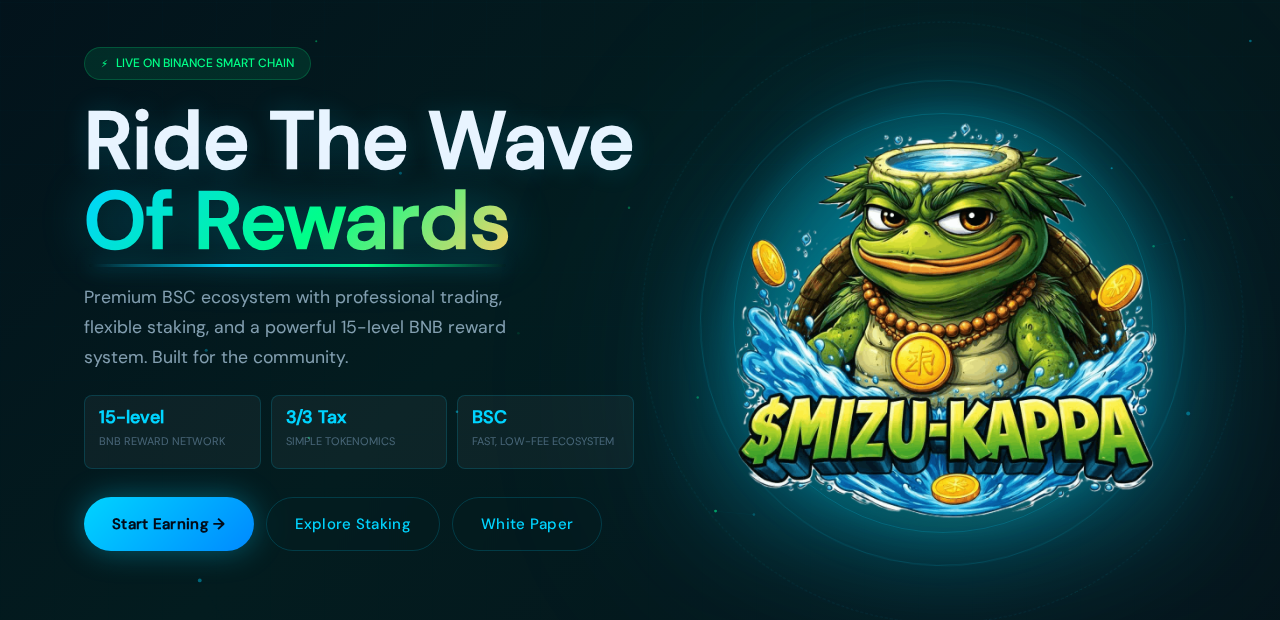
The site, mizukappa.io, promotes MIZU, a token launched in July 2026 on BNB Smart Chain, plus a trading terminal, five staking pools, betting games and bill payments.
The trade page stays locked until a buyer names a sponsor, and a 3% tax on purchases is said to fund referral rewards across 15 levels.
The staking pools advertise 0.25% to 30% APY, with fixed terms from 30 to 360 days and exit fees that rise with the advertised rate.
What we found behind the pitch
The token contract routes 100% of its 3% buy and sell tax to a single founder address, and we found no function in it that pays referrers.
The staking contract’s owner can pause withdrawals and change pool rates, and its reward balances hold about 0.6% of the rewards the current stakes would earn over a full term.
The site, the whitepaper and the blockchain disagree on the tax, the referral split, the staking plans and the holder count, and the audit link goes nowhere.
What we could and could not verify
Here is where the evidence stands after our checks:
- Verified by us: the pool rates, the tax figures, the burned liquidity, the renounced token owner, the staking code and the staked totals.
- Not found: a company, a team, an audit report, a compensation plan or any written risk warning on the main site.
- Not verified: who controls the wallets, whether the bill payments work, how referral rewards are really paid and whether any member has been paid.
Our advice is not to buy or stake MIZU because of the referral pitch, and to read the response section below if you already did.
How the Mizu Kappa Pitch Works
Step 1: A sponsor before the first trade
The trade terminal at trade.mizukappa.io opens with a swap box that is dimmed and labeled Trade Locked, under a notice that a referral code is required.
The code is a sponsor’s wallet address, and the page marks the visitor as Unverified until one is applied.
The token also trades on a public PancakeSwap pool, so the gate decides who earns commission on a purchase, not who is able to buy.
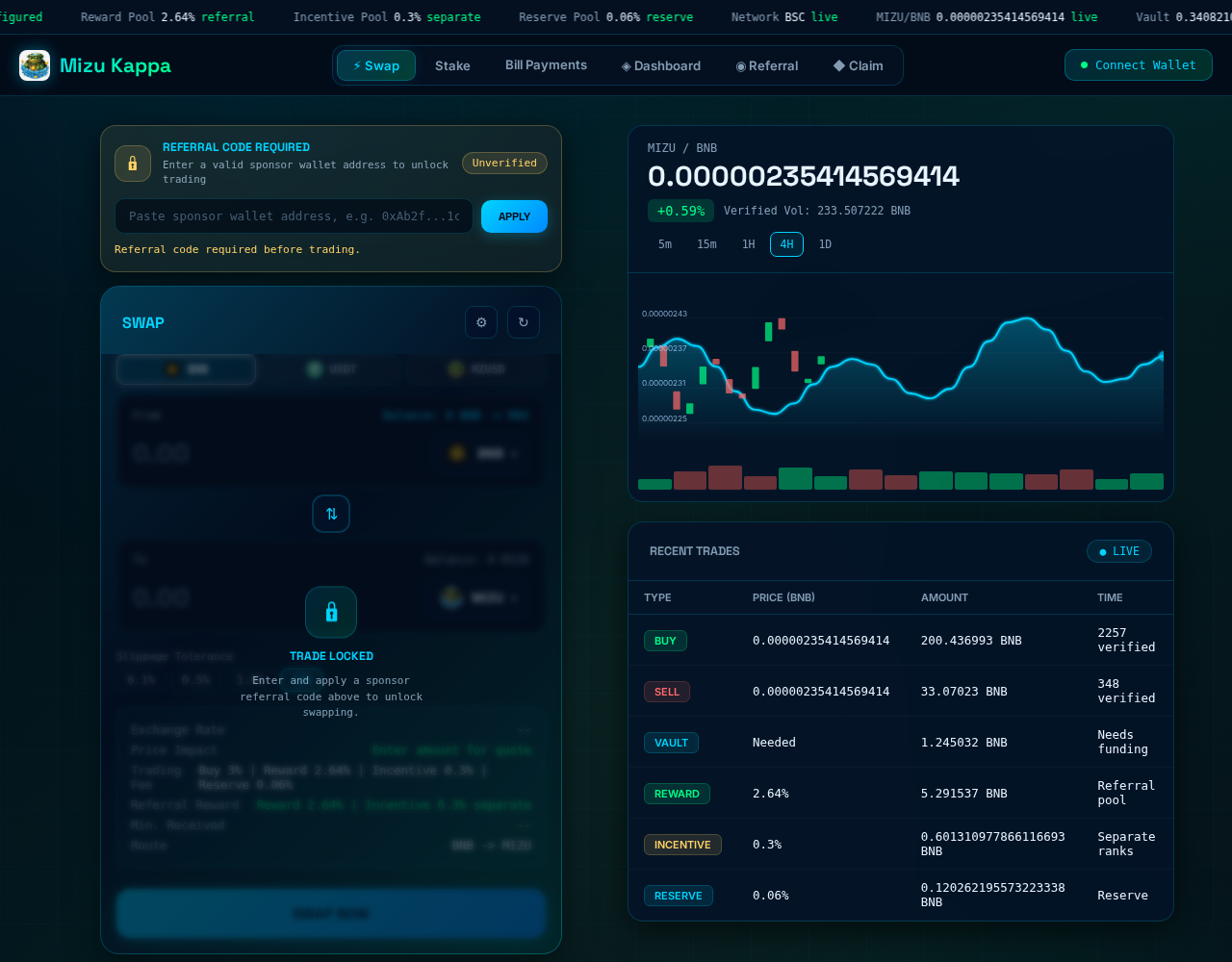
We did not connect a wallet or press any button, so everything above comes from what the terminal shows before anyone signs in.
Step 2: A 3% tax split into pools
A ticker across the top of the terminal lists the buy tax as 3%, divided into a 2.64% referral pool, a 0.3% incentive pool and a 0.06% reserve.
The home page tells it differently: the whole 3% buy tax goes to the 15-level reward pool, and the 3% sell tax goes to a marketing wallet.
The whitepaper offers a third version, calling the final sell-tax structure 100% ecosystem development and incentives, with 88% for rewards and 12% for leader incentives.
The FAQ lists the 15 levels as 20%, 15%, 10%, 9%, 8%, 7%, 6%, 5%, 4%, 3%, 3%, 3%, 3%, 2.5% and 1.5%.
Those shares add up to exactly 100% of the reward pool, so a Level 1 sponsor earns 20% of 2.64%, or 0.528% of what the buyer spends.
That is 0.00528 BNB on a 1 BNB purchase, while Level 15 earns 0.0396%, or 0.000396 BNB, so the deep levels the site advertises pay almost nothing per trade.
The whitepaper’s table differs from the site’s: its weights run 20, 15, 10, 8, 7, 6, 5, 4, 3, 2, 2, 2, 2, 1 and 1.
It says those weights total 90 units when they actually total 88, so its own conversion to an 88% reward pool yields shares that add up to 86.04%.
The whitepaper also warns that lower trading activity means a smaller reward pool, which matters because DexScreener shows only $594 of trading over the last 24 hours.
Even if all of that volume were purchases, the 2.64% pool would hold about $16 for the entire network that day.
Step 3: Ranks, volume and prizes
A second layer sits on the dashboard: members earn ranks from complete-team buy volume, under a 40/40/20 leg limit that the page mentions but never explains.
Achiever needs $50,000 of team volume and wins a three-day local trip or a $150 cash prize outside Africa, while Executive needs $250,000 for a $600 award.
Diamond needs $1.5 million for $4,000, and Star Diamond needs $5 million for a car worth $10,000.
The 0.3% incentive pool would collect $15,000 from $5 million of purchases, yet the page says qualified ranks are sent to an admin who reviews each award request.
Commissions down a long line plus prizes for team volume resemble the multi-level plans in our MLM scam guide, except that the product sold is the project’s own token.
Step 4: Staking rates that look generous
The staking page, on the arcade subdomain bet.mizukappa.io, says rewards equal the amount staked times the APY times the duration divided by 365.
Applied to the five pools, a full term returns 0.02% over 30 days, 0.74% over 90, 3.95% over 180, 13.32% over 270 and 29.59% over 360, all paid in MIZU.
Those returns arrive in the same token you stake, so what they are worth depends entirely on a MIZU price that is set by a pool holding about $127,000.
Leaving early costs a fee equal to the pool’s APY, charged on your principal: 3%, 8%, 18% or 30%, with only the 30-day pool exempt.
A 360-day staker who leaves at day 180 has earned about 14.8% in rewards but pays 30% to exit, a net loss of roughly 15% of the original stake.
The same holds at every point before maturity, because in every pool that charges one, the fee is larger than the rewards earned so far.
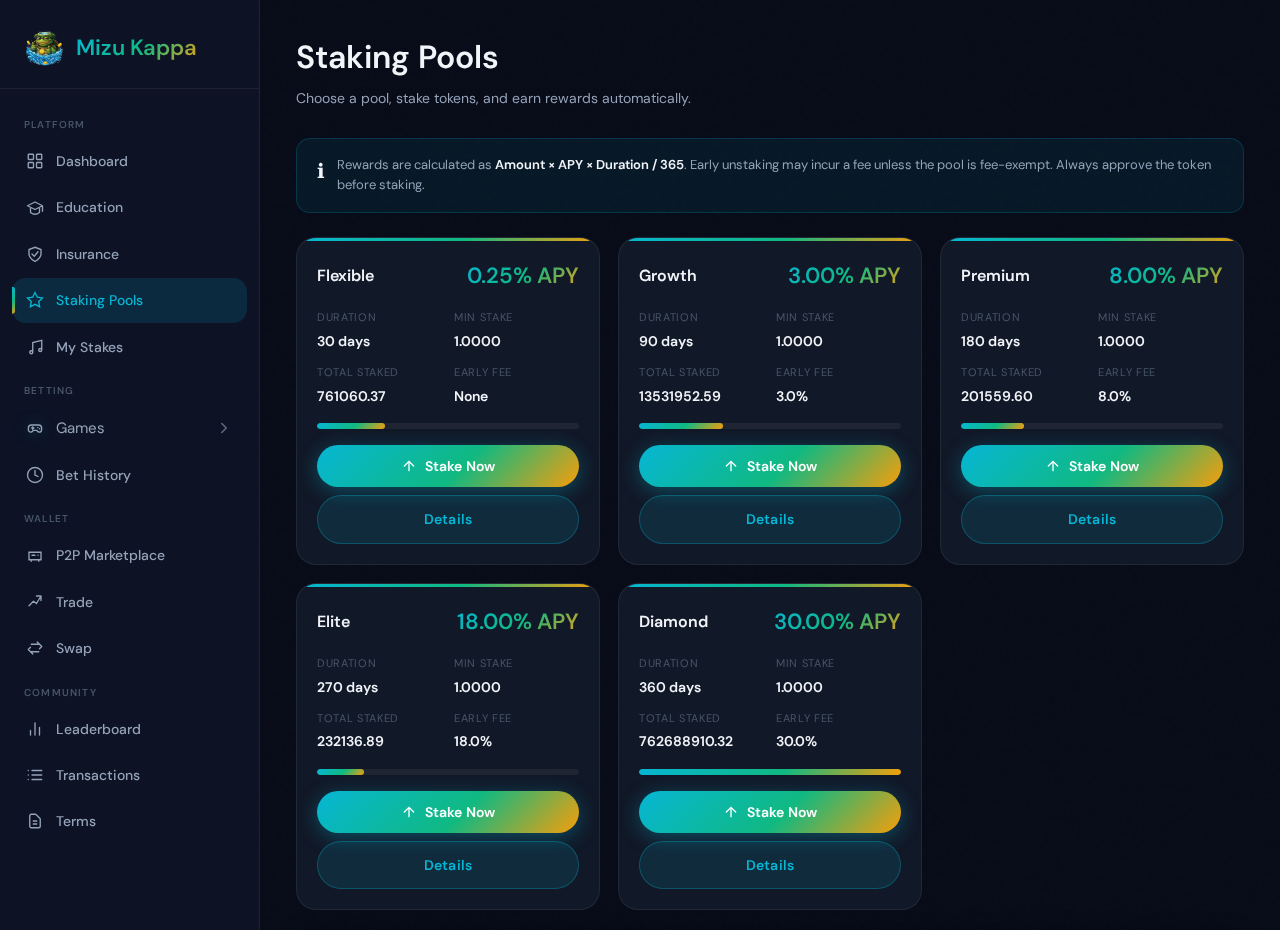
The whitepaper lists only four plans and omits the 8% pool, although it confirms that early unstaking costs the same share as the plan’s APY.
The totals shown on the staking page, such as 762,688,910.32 MIZU in the Diamond pool, match the figures the contract itself reports.
Step 5: Games, balances and utilities
The home page promises a prediction market that pays up to 2x, but the prediction page offers only 1.1x on BTC and ETH and 1.2x on BNB and SOL.
If those multipliers are the total payout, a trader must be right about 91% of the time on BTC, or 83% on BNB, merely to break even.
The same arcade lists crash, horse race and dice games, and says winnings are paid automatically from a System Balance that the platform holds.
That sits uneasily with the home page’s claim that the team never holds your tokens.
Other menu items cover insurance and exam PINs priced in naira, and the whitepaper says airtime, data, electricity and cable TV payments are live; we tested none of them.
What the Public Contracts Show
BscScan answered with a bot check that we did not try to bypass, so we made read-only calls to a public BNB Chain node, with no wallet involved.
The token contract, 0xb1D1F602034F7c4b242169b818200d07C117FfFF, reports the name MIZU KAPPA, a supply of 1,000,000,000 and an owner of the zero address, which means ownership was renounced.
The PancakeSwap pair holds 39.2 million MIZU and 92 BNB, and effectively all 59,396.97 of its liquidity tokens sit at the burn address, which locks that liquidity in place.
That is a real point in the project’s favor, and the whitepaper’s claims of renounced ownership and burned liquidity hold up, though neither protects what you stake or earn.
The tax is where the contract departs from the site: it charges 3% on buys and sells, and its settings route 100% of the fee to one founder address.
That address has received 36.7 BNB in fees, roughly $25,000 at DexScreener’s implied BNB price, and no function we could decode in the token pays referrers.
The trade terminal’s code calls the project’s own server for registration, trades, claims and award requests, and the dashboard says it lists only verified backend reward rows.
That suggests the operators track and pay referral rewards, which is our inference, and it conflicts with the home page’s claim that all reward logic is on-chain and immutable.
The staking contract, 0xD8ACDCeBfc70A8F4Ee821D28a25E9DE689CB50d7, has verified source code in the public Sourcify registry, which let us read exactly what it does.
It holds 784.9 million MIZU, or 78.49% of the supply, and its Diamond pool alone records 762.7 million MIZU staked, which is 76.27% of every token that exists.
Its owner is an ordinary wallet rather than a burned address, and the code lets that owner pause staking, claims and unstaking, and change any pool’s rate or exit fee.
Rates and fees are read when you claim or leave, not when you stake, so a change would apply to stakes that already exist.
The owner can also withdraw the early-exit fees, and owner wallets can withdraw a pool’s reward balance or create stakes from it. We found no function that takes principal directly.
Rewards come only from a per-pool reward balance, and the code reverts any unstake or claim whose reward exceeds it, so exits depend on the owner funding it.
The reward balances total 1.39 million MIZU, while a full term on current stakes would owe 225.8 million, so the contract holds 0.6% of what it promises.
The Diamond pool is the starkest case: its reward balance is about 546,000 MIZU, and one 360-day stake above roughly 1.85 million MIZU would earn more than that.
The owner can add funds, and we cannot see any plan to do so, but the pool as it stands cannot pay what the staking page advertises.
The vault has collected 6.05 million MIZU in early-exit fees, mostly from the 360-day pool, which at a 30% fee implies about 19.5 million MIZU left early.
DexScreener shows a price near $0.0016, a market cap of about $1.6 million, liquidity of about $127,000 and, over 24 hours, 5 buys and 13 sells.
GeckoTerminal counts about 1,853 holders, and its data says the ten largest hold 93.97% while everyone beyond the 50 largest holds 1.68% in total.
At the quoted price, the staked tokens are worth roughly ten times the liquidity that backs them, so a rush to exit would meet a thin pool.
Claims That Do Not Match the Evidence
The FAQ claims a full security audit and the roadmap marks one complete, but the Audit Report link goes nowhere and the whitepaper names no auditor.
The footer links for the whitepaper, BscScan and How to Buy go nowhere either, although a button in the hero section does open a 32-page whitepaper PDF.
The roadmap lists a 10K holder milestone in a phase marked complete, while GeckoTerminal counts about 1,853 holders and the Telegram group has about 1,500 members.
The home page says rewards are paid instantly with no manual claiming, then the FAQ says claiming is required, and the terminal has a Claim Rewards tab.
Its tokenomics list a liquidity pool of 100%, staking of 5%, CEX listings of 5% and charity of 1%, which add up to 111% of the supply.
The whitepaper reports that more than 70% of supply was staked, which the vault confirms at 77.7%, yet the site describes staking as a 5% allocation.
The home page’s trade preview carries a Live label and shows a MIZU price of 0.00042 BNB, about 178 times the real price of roughly 0.0000024 BNB.
The page’s code calls this panel a trade mockup, so the figures are samples, yet the visible label says Live and nothing on the page says otherwise.
The whitepaper is more careful than the site. It says nothing guarantees profit, treats renunciation and burned liquidity as claims to verify, and notes that reward capacity follows trading activity.
Nothing on the main site names a company, an address, a refund route, an age limit or a risk warning.
The arcade’s ten-clause terms add only that features may be paused or removed, and that continued use means you accept the latest version.
Who Runs Mizu Kappa?
The company named in the documents
No company is named anywhere we read: the home page footer says only © 2026 MIZU-KAPPA, and the arcade terms never identify who operates the platform.
The whitepaper names no team either, and says it was prepared from project information supplied for that edition, with the technical claims left for readers to verify independently.
We found no named person or company in the site, the whitepaper or the public description of the project’s Telegram channel.
Where the address and registration lead
There is no postal address or registration number to check, so the only addresses available are wallet addresses, and the public contracts point to at least three of them.
The token’s fee settings name a founder contract, 0x43c2fca5106771fdf2ddb9b3aaf25a5241b08849, while the staking vault’s owner is 0x7515c2e58253fdbf1b54e6615e9cea7d00d00f95.
A third wallet, 0xCcFc115D2868b47A92e3317324ba8D3544fa3e97, owns the MZUSD token and the four contracts listed in the arcade pages’ code.
Nothing we read ties any of these wallets to a named person or company, so they show separate roles on the blockchain and not an identity.
The domain, platform and reviews
The domain mizukappa.io was registered on May 31, 2026 through Namecheap behind a privacy service, about five weeks before the PancakeSwap pair appeared on July 6.
The main site, the trade terminal and the arcade all resolve to one hosting address, which shows a shared setup and says nothing about who owns it.
The token has CoinGecko and GeckoTerminal listings, a Telegram group of about 1,500 members and social pages, but our searches found no independent audit or review.
What we could not confirm
We did not connect a wallet, buy, stake or place a bet, so we cannot rate the swap, the claim flow or the withdrawals in practice.
We could not read the token contract’s source, so we do not know who may call the blacklist and trading-mode functions that appear in its code.
We also did not test the bill-payment services or read the X, Facebook and YouTube pages, so any identity clue they hold is missing here.
What to Do Before You Buy or After You Staked
-
Hold off on buying. A sponsor’s invitation is not evidence that the rewards are paid, so wait until the operators are named.
-
Ask who is responsible. Request the legal entity, the audit report and the written compensation plan before you spend anything, and keep the replies.
-
Check the contracts yourself. Open the token and the staking vault on a block explorer, then look at the owner, the holder list and the reward balances.
-
Approve only what you stake. If you do connect a wallet, set a spending approval for the exact amount and remove it afterwards.
-
Skip the games. On the prediction page, break-even can take 83% to 91% accuracy, and gambling rules differ by country.
-
Keep your own records. Save screenshots, wallet addresses, transaction hashes and every message from your sponsor, because a pause or a rate change can leave you with no other proof.
-
Do not recruit yet. Share your link only once you can show where rewards come from, and read the FTC’s guidance on multi-level marketing first.
-
Report it. File at ReportFraud.ftc.gov, and note that crypto payments cannot usually be reversed the way card payments can.
Frequently Asked Questions
Is Mizu Kappa a scam?
We cannot say: its contracts are public and its liquidity is burned, but its operators are anonymous, no audit report is published and its reward promises exceed its funding.
How much does the 15-level referral actually pay?
Each purchase feeds a 2.64% pool, so Level 1 earns 0.528% of a buyer’s spend and Level 15 earns 0.0396%, if the site pays as described.
Can I really earn 30% by staking?
Only if you hold 360 days and the reward balance can pay you, and the Diamond pool’s balance covers about 0.24% of what its current stakes would earn.
Is the liquidity locked and the contract renounced?
The liquidity tokens sit at the burn address and the token’s owner is the zero address, but the staking contract keeps an active owner who can pause it.
Who owns Mizu Kappa?
Nobody is named: the domain uses a privacy service, no company appears in the documents, and the contracts show only wallet addresses that we cannot tie to a person.
What happens if I unstake early?
You pay a fee equal to the pool’s APY, from 3% to 30% of your principal, and the Flexible 30-day pool is the only one exempt.
The Bottom Line
Do not buy or stake MIZU because of the Mizu Kappa referral offer: the vault owner can pause withdrawals, and the reward balances cover under 1% of promised payouts.
If you want to follow the project, wait for named operators, a published audit and a compensation plan, and treat the token as a high-risk speculation whatever the site says.
If you already bought or staked, save your records, weigh any exit fee against the risk of waiting, add nothing because a sponsor asks, and report problems at ReportFraud.ftc.gov.

Join the discussion
0 commentsShare your experience or ask a question about this article.
Discussion
Start the conversation
Have a question or something useful to share? Add the first comment.