

A stranger texts or contacts you on WhatsApp claiming to recruit for WBD Global Streaming, Warner Bros. Discovery or a media promotion team. The job supposedly pays between $200 and $500 a day for watching, rating or promoting online content.
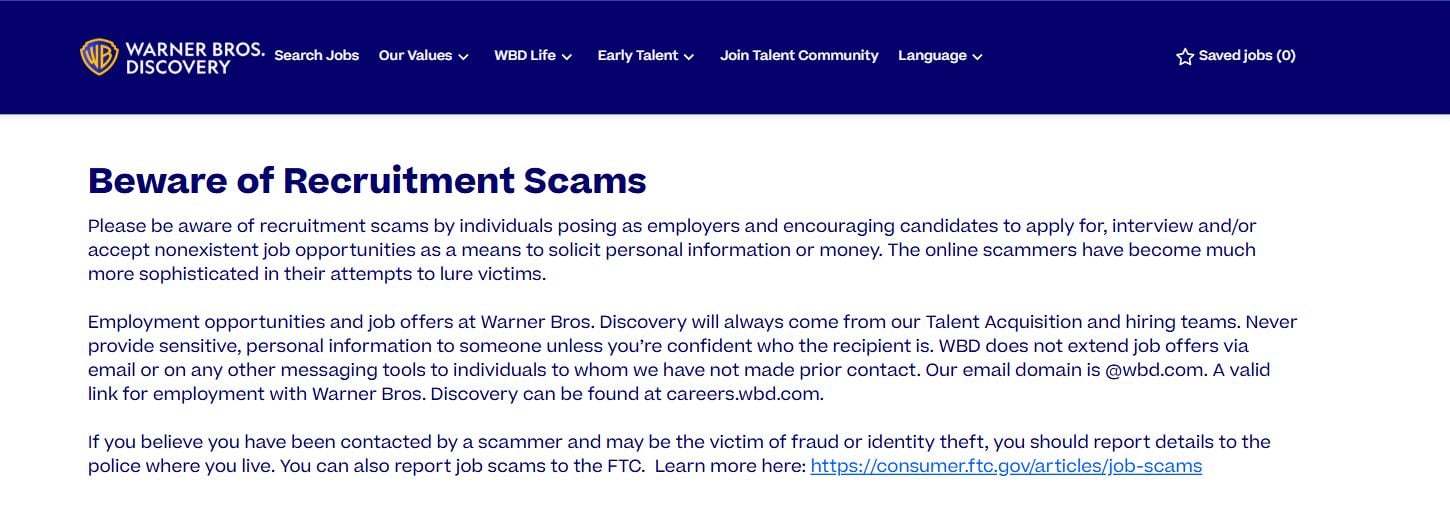
The offer is fake. It is an employment task scam that borrows a recognized entertainment brand to make a money-deposit scheme look like remote work. The real Warner Bros. Discovery warns that it does not extend job offers through messaging tools to people it has not previously contacted.
WBD Global Streaming Job Scam Overview
The message sells income before discussing a real job
The approach often arrives without an application, interview or prior contact. A recruiter says a flexible Content Promotion Assistant role is available. The work may require only 30 to 60 minutes a day, yet the promised daily income and joining bonus are far above what such simple activity could reasonably produce.
The stranger moves the conversation to WhatsApp or Telegram and introduces a private platform that displays tasks, commissions and a growing account balance. Early actions may involve clicking titles, submitting ratings or pressing an optimize button. The dashboard creates the appearance of productive work even though the numbers are controlled entirely by the operators.
The fake earnings become leverage for real deposits
Victims may receive a small first withdrawal so the platform feels legitimate. Later, a task produces a negative balance, a premium order or a combination task that must be completed before money can be released. The worker is told to deposit personal funds, commonly through cryptocurrency, to restore the account and continue.
Each payment creates another condition. A larger balance may require a tax, verification charge, anti-money-laundering deposit or credit-score repair fee. The displayed earnings are not withdrawable wages; they are screen numbers used to persuade the victim to send increasingly large amounts.
- The bait: a random remote-job message promising unusually high daily pay and a joining bonus.
- The routine: simple clicks, ratings or content-promotion tasks inside a private platform.
- The turn: a negative balance or locked commission requires the worker to deposit money.
- The loss: repeated crypto payments continue until the victim refuses or runs out of funds.
Warner Bros. Discovery states that legitimate opportunities come through its Talent Acquisition and hiring teams, that its email domain is @wbd.com and that valid openings are published through careers.wbd.com. A random messaging account cannot be validated by a logo, employee photo or copied company description.
Warning Signs of the WBD Global Streaming Job Scam
The recruiter removes every normal hiring checkpoint
A real employer needs to know who it is hiring, what skills the person has and how employment will be documented. The scam treats those steps as unnecessary because it is not filling a position.
The central warning is simple: workers are paid by employers. A platform that requires employees to deposit personal money to complete routine tasks is reversing the employment relationship.
Red Flags at a Glance
- You never applied. The recruiter selected your telephone number without explaining how or why.
- The interview is only a chat. There is no verified company email, video interview, manager or formal hiring process.
- The pay is disconnected from the work. Simple clicks supposedly earn between $200 and $500 per day.
- A large joining bonus appears immediately. Amounts such as $688 or $1,000 are promised before any real employment begins.
- The job runs through a private dashboard. The web address is unrelated to wbd.com or careers.wbd.com.
- You must add money to work. A negative task balance can be cleared only with a deposit, often in crypto.
- Withdrawals need more fees. Taxes, verification charges or credit repairs are invented after the victim pays.
Why the Fake WBD Job Feels Convincing
Brand recognition replaces verification
Warner Bros. Discovery owns familiar entertainment brands and streaming properties. Scammers use that recognition so recipients focus on an exciting opportunity rather than the absence of a legitimate hiring trail.
Profiles may display corporate logos, polished recruiter photos and job descriptions copied from public webpages. None of those materials proves that the sender controls a company email account or represents the organization.
A small withdrawal acts as manufactured proof
Some task operations allow the victim to withdraw a small commission at the beginning. The payment is a calculated acquisition cost, not evidence of a sustainable job. It trains the victim to believe the dashboard balance can become real money.
After that success, a request to deposit $100 can feel like a temporary step toward recovering $500. The next request may be $800 or $2,000 because the earlier payment increases the pressure to rescue everything already committed.
Group chats create false social confirmation
Victims may be added to a chat where other members celebrate withdrawals, post screenshots and encourage new workers to finish combination tasks. Those accounts can belong to the same operation or to participants who have not yet reached the withdrawal block.
A crowded chat is not independent evidence. The platform owner controls membership, removes complaints and can manufacture payment screenshots in seconds.
Cryptocurrency makes recovery harder
Task scammers prefer cryptocurrency because transfers are fast, international and difficult to reverse. A recruiter may guide a beginner through purchasing stablecoins and sending them to a wallet described as a work account.
No legitimate streaming company needs an employee to buy crypto in order to watch trailers, rate content or process a commission. Once a wallet address replaces payroll, the job story has collapsed.
How the WBD Global Streaming Job Scam Works
Step 1: A random recruiter sends a remote-work message
The victim receives a text or WhatsApp message offering flexible work connected to WBD, streaming promotion or digital media.
The recruiter claims that a staffing database, recommendation or public profile produced the telephone number, but provides no verifiable referral.
Step 2: High pay is promised for simple activity
The job supposedly requires rating content, clicking promotional items or completing a small number of daily tasks. Pay may be described as a daily salary plus commission.
A large joining bonus makes immediate participation feel more valuable than pausing to investigate.
Step 3: The victim enters a controlled task platform
A link opens a website unrelated to official WBD domains. The victim creates an account and sees task buttons, customer-service chat and a commission balance.
The interface may work smoothly because its purpose is to simulate employment, not to deliver a real business service.
Step 4: Early tasks produce visible earnings
Each click increases the on-screen balance. A small withdrawal may be approved so the victim associates the platform with real income.
The recruiter praises progress and encourages a larger task set that promises better commissions.
Step 5: A negative balance requires a personal deposit
A premium or combination task pushes the account below zero. The worker is told that platform rules require the full task sequence to be completed.
The recruiter supplies a crypto wallet and promises that the deposit plus commission will be returned after the final click.
Step 6: New barriers appear after every payment
The withdrawal is blocked by another combination task, tax, verification fee or claimed account error. Each barrier is framed as the last one.
The on-screen balance grows while the victim’s real money leaves through irreversible transfers.
Step 7: The operation disappears or demands more
When the victim refuses, the recruiter threatens account closure, claims the balance will be forfeited or stops responding. The website may later move to another domain.
A recovery scammer may then promise to trace the crypto for an upfront fee, creating a second loss.
How To Verify a Warner Bros. Discovery Job Offer
Check the hiring trail, not the recruiter profile
Do not use links, telephone numbers or email addresses supplied by the unexpected recruiter. Open careers.wbd.com independently and search for the exact position, location and requisition details.
Warner Bros. Discovery says its employment communication comes through its hiring teams and that its email domain is @wbd.com. A lookalike address, free email account or messaging-only interview does not meet that standard.
A Safer Verification Sequence
- Search careers.wbd.com. Confirm that the exact role exists and matches the description.
- Inspect the complete email domain. Extra words, hyphens and free mailboxes are not @wbd.com.
- Request a formal interview. A chat-only recruiter who avoids company systems is not credible.
- Check the platform domain. A random task dashboard is not made official by WBD logos.
- Reject every deposit request. Employment does not require crypto payments to unlock tasks or wages.
- Contact WBD through its published career site. Ask about the role without replying to the stranger.
What To Do If You Paid the WBD Task Platform
Stop depositing even if the dashboard shows a large balance
Do not send the final fee. Task scams are structured so every final payment reveals another requirement. The displayed balance is controlled by the same people requesting the money and does not create a recoverable debt.
Preserve the initial text, recruiter profile, group-chat messages, platform URL, wallet addresses, transaction hashes and screenshots of withdrawal demands. Do this before blocking accounts or before the website disappears.
Contact the cryptocurrency exchange or payment provider immediately. Explain that the transfer funded an employment task scam and ask whether the receiving account can be flagged or frozen. Blockchain transfers may not be reversible, but rapid reporting still matters.
Recovery Checklist
- Stop all payments and do not borrow money to finish a task sequence.
- Save wallet addresses, transaction IDs, payment receipts, messages and platform screenshots.
- Notify the exchange or payment service and request a fraud review of the destination account.
- Change passwords reused on the platform, beginning with email and financial accounts.
- Enable two-factor authentication and review active sessions for unknown devices.
- Contact the bank or card issuer if purchases of cryptocurrency were funded by card or transfer.
- Report the fake recruiter to the messaging service, the FTC and local law enforcement.
- Ignore recovery firms that demand upfront crypto, tax or tracing fees.
Expect another approach using the same personal details
The operation may know your name, telephone number, occupation, exchange account and approximate loss. Later callers can use those details while pretending to be investigators, lawyers or blockchain recovery agents.
Tell close family members about the incident if you may be pressured to borrow money. A second person can help evaluate future messages without the emotional weight of the trapped balance.
Frequently Asked Questions
Is Warner Bros. Discovery a real company?
Yes. Warner Bros. Discovery is a legitimate media company. The scam consists of criminals impersonating its recruiters and inventing a task platform.
Does WBD recruit through WhatsApp or random text messages?
WBD states that it does not extend job offers through email or messaging tools to people it has not previously contacted. Verify openings through careers.wbd.com.
Why was I allowed to withdraw money at first?
A small payment can be used to build trust and encourage a much larger deposit. It does not prove that later dashboard earnings can be withdrawn.
Can I unlock my balance by paying the tax fee?
No. The operator controls the balance and can invent unlimited fees. Stop paying and report the wallet and platform instead.
The Bottom Line
The WBD Global Streaming text is not a shortcut into the entertainment industry. It is a task scam that converts fake commissions into real deposits from the victim.
Verify jobs at careers.wbd.com, insist on a normal hiring process and never pay cryptocurrency to unlock work or wages.








