

Ordering a denture online sounds easier than scheduling several appointments. EasyDenture promises a self-fitting option at a price far below conventional treatment.
The offer deserves a careful look before anyone heats the appliance, breaks its seal, or assumes that a familiar regulatory phrase settles the safety question.
Overview
The product is real, but it is not a dental appointment
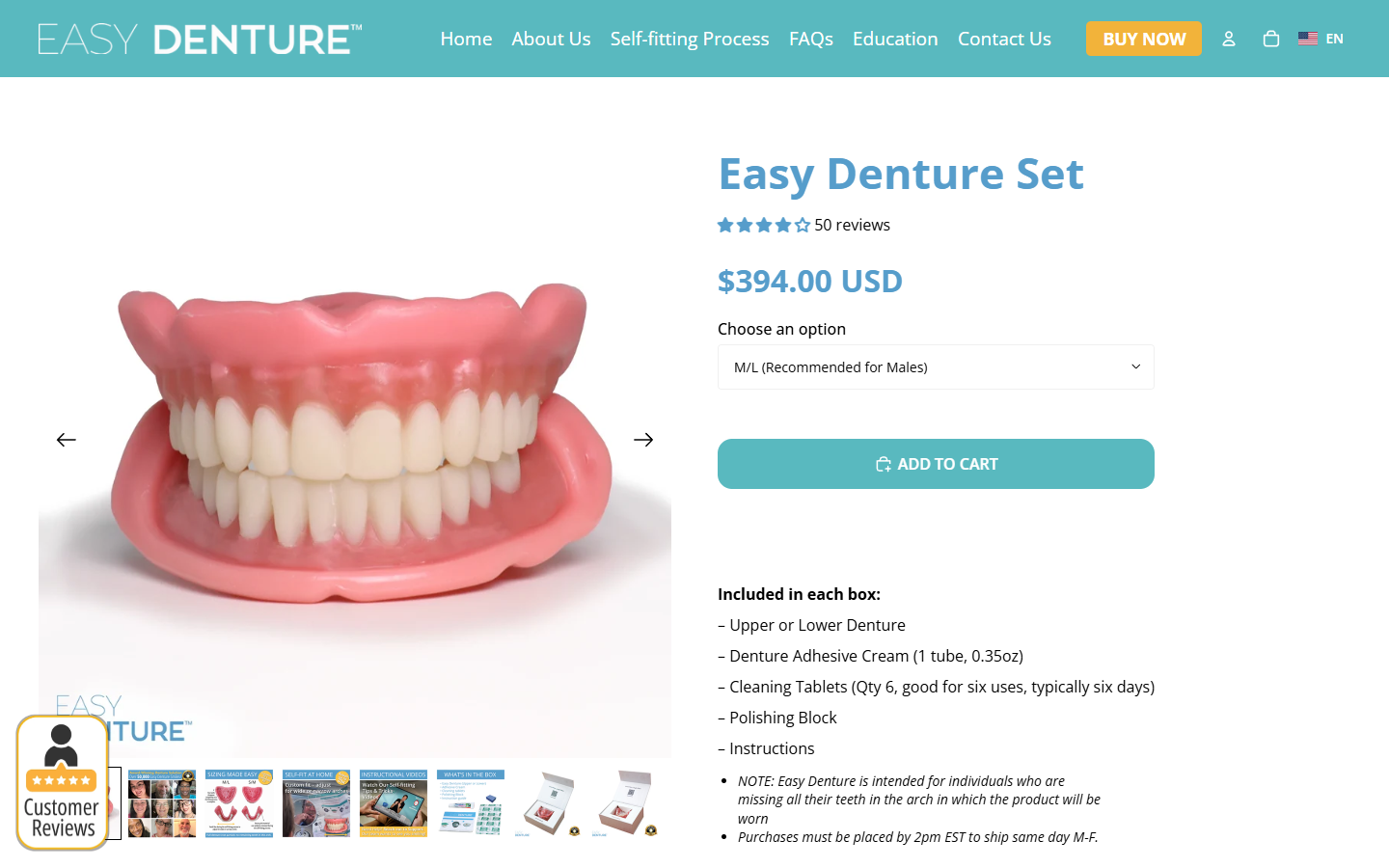
EasyDenture sells an upper-and-lower set for $394 on the product page reviewed. It describes a boil-and-bite appliance customers can adapt at home.
The seller says the product is intended for people missing all teeth in the arch where it will be worn. That limitation matters for anyone with remaining teeth.
The site also describes the product as cosmetic and non-medical. It tells customers to continue seeing a licensed dentist for oral health concerns.
We found a named business, Sonrisa, LLC, with a North Carolina contact address and phone number on the seller’s public pages.
That is not evidence of a fake storefront. The buyer concern is the difference between a self-fit online product and individualized professional care.
“FDA registered” does not mean “FDA approved”
EasyDenture prominently uses “FDA Registered” on its product page. Its FAQ also refers to an extensive approval process, wording that can easily be misunderstood.
The FDA explicitly says facility registration and device listing do not mean the agency approved, cleared, or authorized a device.
We did not independently establish the product’s regulatory classification or confirm a particular device listing. A registration claim alone cannot answer those questions.
Readers should not infer that the FDA tested this product’s fit for their mouth or endorsed the company’s self-fitting instructions.
The return policy creates a one-way decision after opening
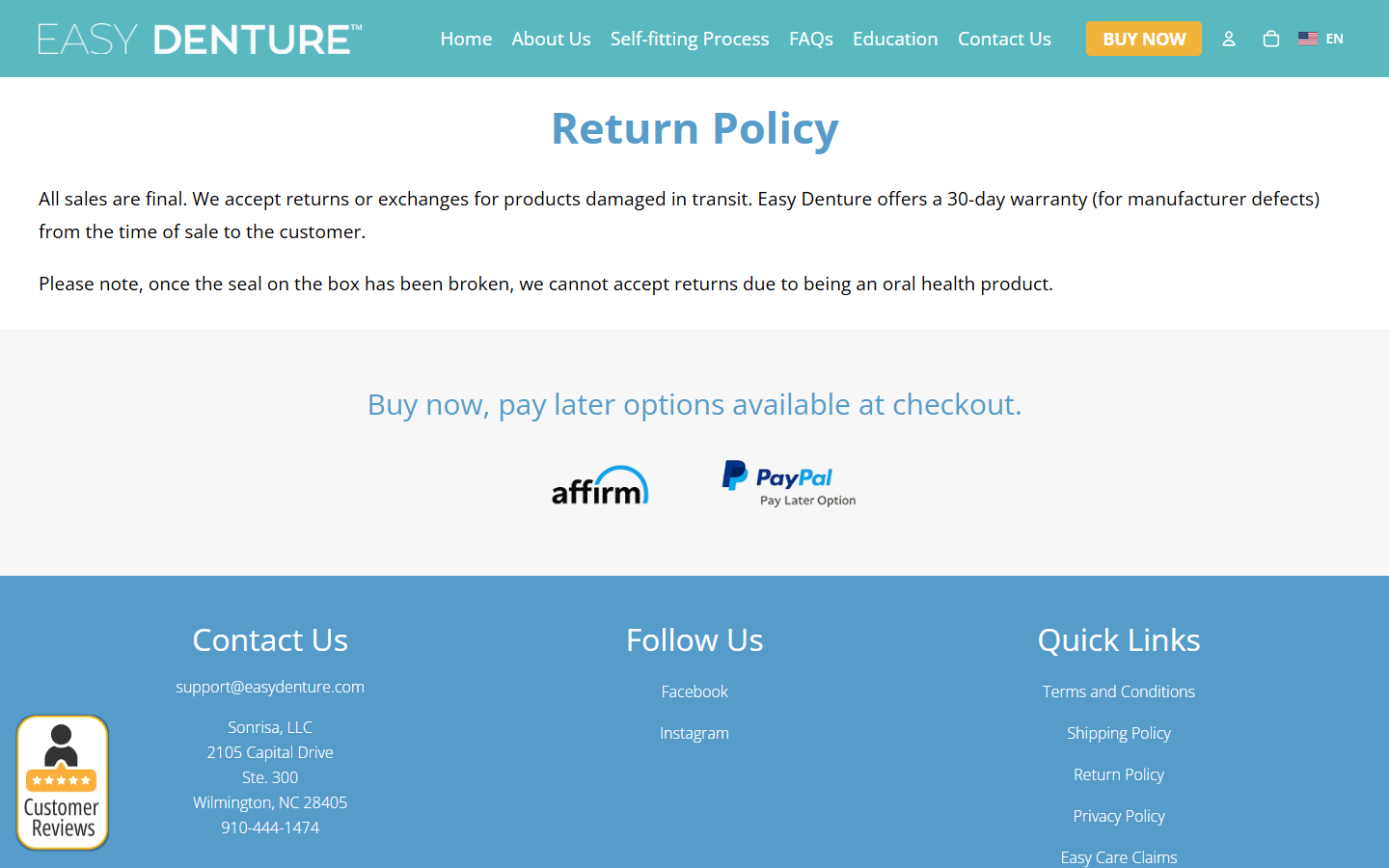
EasyDenture’s return policy says all sales are final, with exceptions for transit damage and a 30-day manufacturing-defect warranty.
It also says an opened box seal prevents ordinary returns because the item is an oral-health product. That is a substantial condition for a fit-sensitive purchase.
The seller offers an optional Easy Care subscription at $14.99 monthly for coverage and a replacement after 24 continuous months, according to its product page.
We did not find evidence that every denture order includes that subscription. Buyers should verify whether they selected it at checkout.
Our assessment is a buyer-risk investigation, not a finding that EasyDenture itself is a scam. The decision turns on:
- Whether your mouth matches the product’s intended use.
- Whether you can accept the no-return rule after breaking the seal.
- What “FDA registered” actually establishes and does not establish.
- Whether a professional fit assessment is needed for your situation.
- Whether the optional monthly coverage was added to your order.
The Medical Question Marketing Cannot Answer for You
A denture has to do more than look good in a product photograph. It must sit on living tissue while you speak, eat, and move.
That is why personal fit matters. A flexible appliance can still create pressure points or instability in a particular mouth.
The American Dental Association’s denture guidance describes follow-up dental visits to assess and adjust fit after insertion.
Its guidance also explains that mouths change over time. A product that initially feels acceptable may need later evaluation if it becomes loose or painful.
EasyDenture’s own disclaimer directs customers to a dentist for oral-health concerns. Readers should take that statement seriously, not treat it as fine print.
Someone with recent extractions, sores, infection, implants, remaining teeth, or complicated jaw anatomy should ask a dentist about suitability before ordering.
This article is not a diagnosis or fitting guide. It is a check on the claims and financial conditions surrounding a direct-to-consumer oral appliance.
How an EasyDenture Order Works
Step 1: The sales page frames the purchase as simple self-fitting
EasyDenture emphasizes convenience: no impressions, no routine fitting appointment, and the ability to adjust the appliance at home.
Those benefits may appeal to someone facing a long wait for care or worried about the cost of professionally made dentures.
The website describes the product as a backup, temporary, or long-term solution. That range should not be mistaken for an individualized recommendation.
Ask your dental professional whether a self-fit device fits your specific situation, especially if chewing function or tissue health is a concern.
Step 2: The buyer chooses an arch and size
The product page presents upper and lower options and two broad sizes. Its set includes both arches at the advertised price.
Two sizes cannot capture every person’s anatomy. The seller relies on home molding to bridge the gap between a standardized product and an individual mouth.
Read the sizing instructions before paying. Do not assume “recommended for males” or another broad label guarantees a proper fit.
The seller says the product is for an arch missing all natural teeth. If that condition does not describe you, stop and ask for professional advice.
Step 3: Checkout may offer optional continuing coverage
EasyDenture separately advertises “Easy Care” at $14.99 per month for a full set. The page says it must be added when buying the dentures.
Its promise includes specified damage coverage and a new set after 24 months of continuous subscription, subject to the actual terms.
That is a different financial commitment from a one-time appliance purchase. A customer should calculate two years of fees before comparing coverage with alternatives.
Look for a clear skip option and inspect the final order summary. Preserve a screenshot showing whether coverage was selected.
Step 4: The physical seal changes the return position
The seller’s return policy draws a firm line around the packaging seal. Ordinary fit dissatisfaction may not qualify for a refund once the seal is broken.
That creates a practical difficulty: a buyer may not discover fit problems until they open and attempt to adapt the appliance.
Before opening, inspect the shipment for damage, missing components, or the wrong size. Photograph anything unusual while the seal remains intact.
If the item arrived damaged, contact the company immediately and ask for written return instructions before attempting any adjustment.
Step 5: Self-fitting requires careful use, not guesswork
EasyDenture supplies instructions and fitting materials. Follow the manufacturer’s current directions rather than improvising a heating method seen in a social video.
Stop if the product causes pain, cuts, pressure sores, choking concerns, or a persistent unstable bite. A cosmetic product is not worth an avoidable injury.
The ADA cautions that poorly fitting dentures can contribute to sores or infections. Seek professional care if the appliance is not sitting properly.
Repeated home adjustments are not proof that the mouth will eventually accept a bad fit. Persistent problems require an examination.
Step 6: Warranty and refund requests follow different rules
A manufacturing defect is not the same as ordinary dissatisfaction with comfort. The seller offers a 30-day defect warranty, but says general sales are final.
Describe the issue precisely when contacting support. Include the order date, photographs, and whether the packaging seal was opened.
If you bought Easy Care, mention the subscription separately. Its coverage may follow a distinct claim process from the base product warranty.
Do not assume a warranty claim stops monthly coverage fees. Check and cancel any unwanted subscription through the specified billing route.
Company, Registration, and Fulfillment Checks
The seller’s name is available, but that does not validate every claim
EasyDenture lists Sonrisa, LLC, a Wilmington, North Carolina address, support email, and phone number. That gives buyers a contact trail.
We did not independently verify manufacturing location or the specific regulatory file behind the registration claim. The contact listing should not be stretched into those conclusions.
Ask for the exact product and manufacturer details if those facts matter to your decision. A brand address can be separate from a production facility.
A business address is not necessarily the return destination
The website’s company address appears on its public pages. Return instructions should still be requested directly before shipping an oral-health product back.
Sending a package to a listed office without an authorization may delay or defeat a claim. Keep a written record of the address support provides.
Use tracked shipping if a return is approved. Photograph the contents and label before handing over the parcel.
Support should resolve the specific order problem
Ask whether the issue is treated as transit damage, a manufacturing defect, a sizing concern, or a subscription claim. Each category can have different remedies.
Document any response about refunds, replacements, or extra charges. An encouraging verbal statement is less useful than a dated written promise.
If a problem affects eating or causes pain, do not wait for customer support before seeking dental care.
The supply chain and safety claim need separate proof
“FDA registered” is not a substitute for the FDA’s approval, clearance, or authorization pathways. Ask the seller what exact status applies to this product.
Likewise, a testimonial about fit cannot establish that a standardized denture is safe for every mouth. Individual anatomy and underlying oral conditions still matter.
Save the current label and instructions. If a clinician needs to evaluate a reaction or injury, those details will be more useful than the advertising headline.
How to Decide Whether This Product Fits Your Situation
First, identify the problem you are trying to solve. A temporary cosmetic appearance issue differs from restoring long-term chewing and oral health.
Second, examine the actual condition of your mouth. Recent surgery, sore tissue, remaining teeth, or implants make one-size marketing especially unreliable.
Third, compare total cost rather than a single headline price. Include any optional monthly coverage, adhesive, replacement supplies, and possible dental visits.
Fourth, decide whether a final-sale product is an acceptable experiment for you. Once opened, the return policy may leave little room for ordinary fit disappointment.
Finally, seek professional advice before delaying necessary care. A product may be useful for some buyers without being appropriate as a substitute for dental treatment.
Look at the order as a care decision, not only a shopping decision
People often seek a fast denture solution after a stressful dental loss. That urgency can make a confident sales page feel like the answer.
Give yourself time to ask what happens if the appliance does not fit. The return policy makes that question financially important.
Ask whether you need a temporary appearance solution, a backup denture, or a long-term appliance for eating. Those are different needs.
Consider how the product will be cleaned, stored, and evaluated if it rubs your gums. Comfort on day one is only part of the picture.
If you have been postponing a dental appointment because of cost, ask a clinic about payment options or community resources before deciding professional care is impossible.
The best answer may be a combination of temporary help and a dentist’s plan. The product page cannot make that personal decision for you.
What to Do If You Ordered EasyDenture and Have a Problem
- Stop using an appliance that hurts. Remove it if it causes pain, sores, choking concerns, or a bite problem. Ask a dentist to evaluate persistent symptoms.
- Keep the packaging and paperwork. Save the order confirmation, product label, fitting instructions, seal condition, and photographs of the appliance.
- Classify the issue before writing support. State whether the item arrived damaged, appears defective, was the wrong item, or simply does not fit comfortably.
- Request the relevant remedy in writing. Cite the published transit-damage or 30-day defect provision when it applies. Ask for authorized return or replacement instructions.
- Check for Easy Care billing. Review your receipt for the optional $14.99 monthly program. If unwanted, ask how to cancel and obtain confirmation.
- Get medical help when needed. A customer-service exchange cannot assess tissue damage or infection. A licensed dentist can examine your mouth and advise on safe alternatives.
- Escalate a genuine billing or warranty dispute. If the seller does not honor an applicable written promise, ask your card issuer about its dispute process and deadlines.
Do not send the appliance to an address from a search result without instructions. The wrong destination can complicate an otherwise valid request.
Also distinguish a product issue from a fake low-price seller. EasyDenture warns that imitators use its name; verify the exact site on your receipt.
Frequently Asked Questions
Is EasyDenture a fake product?
No evidence here establishes that. We found an operating seller and a real product offer. The concerns are self-fitting, regulatory wording, and restrictive returns.
Does FDA registration mean the FDA approved it?
No. The FDA says establishment registration or device listing does not, by itself, mean approval, clearance, or authorization.
Can I return an opened EasyDenture set if it does not fit?
The seller’s published policy says ordinary returns are not accepted after the seal is broken. Contact support about defects or transit damage separately.
Is Easy Care included with every order?
The website presents Easy Care as an optional monthly add-on. Check your own receipt and checkout selection rather than assuming it was included.
Can I use the appliance instead of seeing a dentist?
EasyDenture itself says the product is not a substitute for professional dental care. Ask a dentist about fit, pain, disease, or long-term use.
What if I purchased from a discounted lookalike site?
Save its URL, receipt, and package photos. Verify whether the seller is authorized through EasyDenture’s official site before relying on the brand’s warranty.
The Bottom Line
EasyDenture may appeal to buyers who understand the limits of self-fitting and accept a final-sale oral appliance. Its price does not remove the need for dental judgment.
Before opening the seal, confirm intended use, return conditions, optional monthly coverage, and what “FDA registered” actually means. Pain or poor fit warrants professional care.








