


An insurance card is easy to save on your phone and forget about until someone asks for proof of coverage.
The questions start when you need the policy itself and the person who sold it to you stops answering messages.
Overview
An insurance card arrived, but the premiums did not
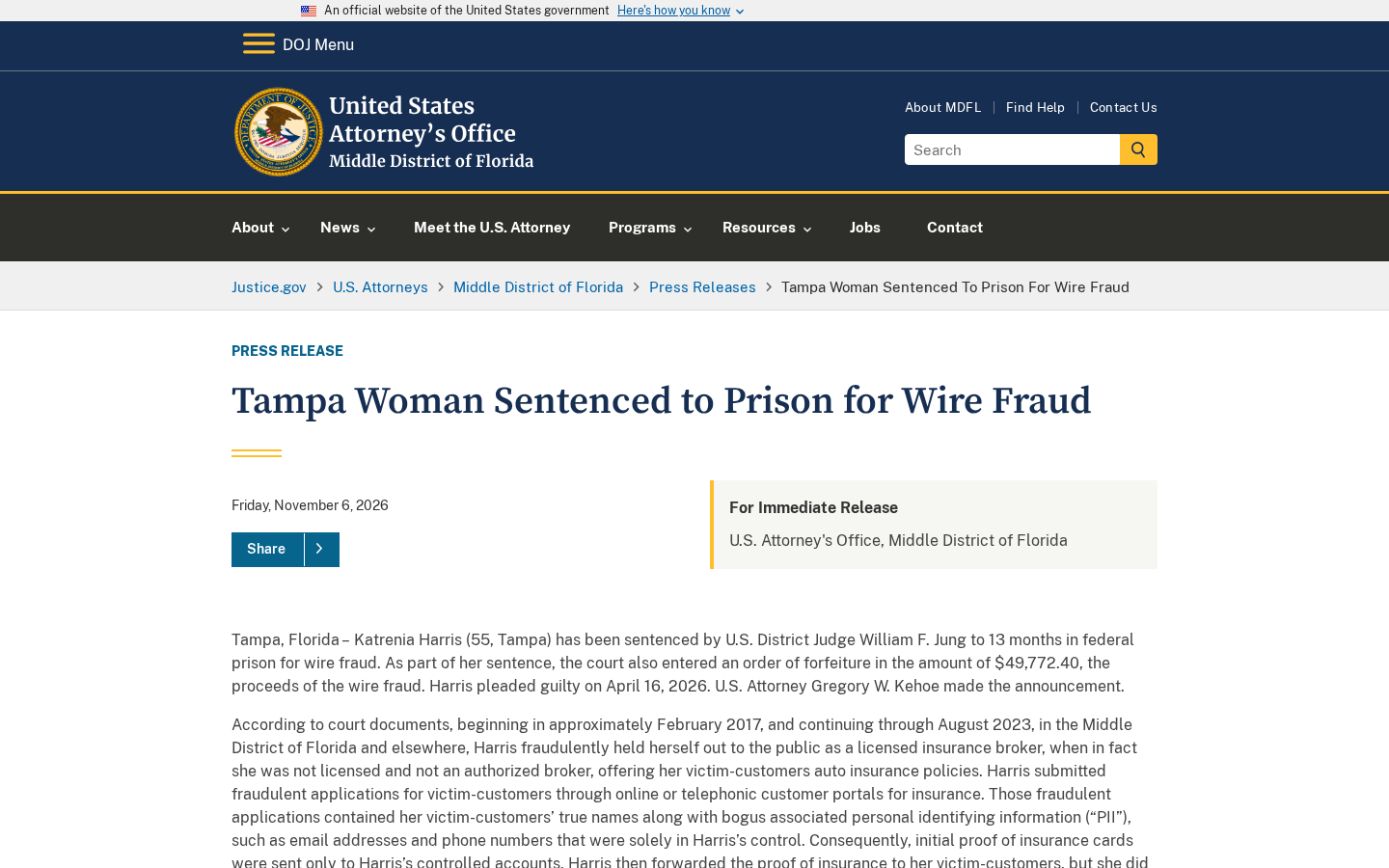
Between approximately February 2017 and August 2023, Katrenia Harris sold drivers auto policies while posing as a licensed insurance broker.
The Justice Department’s case summary says Harris forwarded proof of insurance cards that had come from insurers, then failed to pay the required premiums.
The insurers rescinded policies shortly after they began, and drivers who did not know about the rescissions ended up with unpaid claims.
Harris pleaded guilty to wire fraud in April 2026 and was sentenced to 13 months in federal prison that November.
Federal investigators identified more than 500 victims, and the court ordered Harris to forfeit the $49,772.40 she obtained from the fraud.
That amount represents the proceeds reported in the case, not an estimate of what motorists lost when claims went unpaid.
Why the card was so convincing
Drivers received a document that looked right because it came from the insurer after the initial application went through its system.
A saved card captures what the insurer could issue at one moment, while a coverage decision depends on the policy record.
That makes this case different from a seller who simply prints an invented policy number on a document and disappears.
Someone could show the card, match their name and vehicle, and still miss the fact that the premium never reached the insurer.
A person who needs proof quickly for a dealership or a vehicle registration has a reason to stop checking once it arrives.
For a buyer, the simplest backup is to get confirmation from the insurance company without depending on the seller to forward it.
What each piece of paperwork can tell you
Start with the information you already have, then use the carrier’s policy records to fill in what the documents cannot prove.
| What you have | What to confirm with the insurer |
|---|---|
| Card or digital proof | Policy status, effective date and covered vehicle |
| Receipt from the seller | Whether the premium appears in the carrier’s payment history |
| Notice of cancellation or rescission | Exact effective date and potential coverage gap |
| Welcome email forwarded by a seller | Email, phone and mailing address actually on file |
| Pending or denied claim | Written coverage decision and available review process |
- A policy number helps the company find a record, but it cannot tell you on its own whether coverage remains valid.
- A payment receipt can show that you paid someone, even if the company charging the premium has no matching payment.
- A recent insurer confirmation answers a different question from a card you saved when you first applied for the coverage.
A recurring or delayed charge can also have an ordinary explanation, so compare the actual dates before drawing a conclusion about fraud.
If the paperwork does not line up, call the carrier rather than relying on the person to whom you sent the money.
How the Scam Works
Step 1: The driver trusts someone who claims to be a broker
Harris offered auto insurance as though she were licensed to sell it, but federal prosecutors say she held no such license.
Buyers often rely on brokers to compare policies, so a seller gathering details about a driver or vehicle can seem entirely ordinary.
The issue was that Harris presented herself as authorized to do something she was not licensed or appointed to do.
A search through Florida’s insurance licensing resources can show whether the agent and company have authority before you give them money.
Search using the full legal name, not just a friendly name or the business label the person uses in a message.
Confirm that the person actually works with the carrier named on the quote, especially if their listing identifies a different agency.
Step 2: A real insurer receives an application with the wrong contacts
The applications used drivers’ real names, but some of the phone numbers and email addresses were under Harris’s control instead.
That meant buyers had no direct line into the application process even though a carrier had opened a record in their names.
Most drivers would focus first on whether the policy shows their vehicle, address and selection of coverage, which is understandable.
The email and phone are also worth checking because insurers can use them to reach the customer or help recover account access.
If a seller says the agency manages online access, ask how you can confirm what information the insurer has on file.
Someone answering on behalf of the insurance company should be able to explain how they verify you without involving an unknown intermediary.
Step 3: The buyer gets an insurance card and keeps driving
When the insurer sent proof to the contact information in its system, Harris received the card and forwarded it to the driver.
A driver who had been waiting for their paperwork now had something they could present, which made the transaction feel finished.
The document alone did not reveal whether Harris had paid the premium or whether the insurer was waiting for a payment.
For a future purchase, ask whether you should pay the carrier directly and what receipt the carrier will issue when you pay.
If the agency collects the money properly, it should still be possible to confirm the billing arrangement through the actual insurance company.
Screenshots of a banking transfer or payment app transaction can help show what you paid, but they cannot substitute for that confirmation.
Step 4: The drivers miss the gap until the policy is needed
Insurers rescinded policies shortly after they began because Harris had not made the required payments, according to the case records.
Harris did not tell the buyers what had happened, so drivers continued using their cars and some claims went unpaid.
The public case summary does not say which notices individual insurers sent or whether any particular driver tried to contact the insurer.
Those details matter in a real dispute, which is why you should ask for the record for your own policy.
Check whether the insurer considers the policy canceled, rescinded or still active, and request the dates rather than relying on the wording alone.
A new policy can address future driving, but it cannot tell you whether you were insured when an earlier incident occurred.
What to Verify Before Switching From an Old Policy
If you are replacing existing insurance, have the new carrier confirm its effective date and time before you arrange the old policy’s cancellation.
Compare covered drivers, vehicle identification numbers and stated use, since matching the premium does not mean you bought the same coverage.
Ask when the first payment is due and whether the quote you received included an initial premium or only an estimate.
If the seller offers to deal with your old insurer, confirm any cancellation directly so you know when that coverage ends.
Retain the confirmation from each insurer, because the records from only one side cannot tell you whether there was a gap.
If the car is financed or leased, check what your agreement requires and give the lender the new proof through its usual channel.
Do not treat the lender’s receipt of that card as a separate confirmation that the insurer has collected the required premium.
A dealership may be able to record your new card without being able to tell whether the insurer subsequently closed the account.
Ask how to sign into the carrier’s own customer account, which gives you a way to check upcoming bills and coverage notices yourself.
Set alerts to reach a phone or inbox you control instead of depending on the person who originally forwarded your paperwork.
If you authorized automatic payments, confirm the first payment cleared and review the insurer’s account before relying on the billing schedule.
When a payment cannot be located, keep your transaction record and ask how to avoid a lapse while the carrier investigates.
A verified broker can help you compare the policies, but the insurer should still be able to confirm your actual coverage.
Where the seller will not tell you which carrier issues the policy, do not send money just to obtain the name.
The time to ask who is responsible for the coverage is before you cancel the policy that already protects your vehicle.
If you are not sure whether a policy was ever effective, request the actual carrier records instead of relying on a booklet.
Keep the carrier’s reply next to the signed application so any difference in driver, address or vehicle can be traced promptly.
What to Do if You Have Fallen Victim to This Scam
-
Verify coverage before driving again
Find the named insurer on your own and call its published service number instead of relying on the seller’s messages.
Give the carrier your policy number and ask for the status, effective dates and covered vehicles in writing if available.
If you cannot confirm that your vehicle is covered today, do not drive it until valid coverage is in place.
-
Ask the carrier to review the account details
Tell the insurer that a person acting as an agent may have used contact information you do not control.
Ask how to verify the email, phone and mailing address securely, then update incorrect details following the company’s identity checks.
Request copies of billing notices and ask where they went, especially if you were never told about a missed payment.
-
Address any accident or open claim separately
If you already filed a claim, ask the carrier for a written decision with the coverage dates it relied on.
Save accident reports, medical or repair bills and correspondence without changing the originals to reflect what you learned later.
If you disagree with the decision or face a significant loss, ask a qualified local adviser about the available review process.
-
Save and report payments made to the seller
Collect the application, card, payment receipts, seller’s contact details and messages about when coverage was supposed to take effect.
Contact the bank, card issuer or payment service through a verified channel and describe how you authorized the payment and why you dispute it.
Ask what records the provider needs and what deadlines apply, since a successful dispute or transfer recall cannot be guaranteed.
-
File a complaint with your state insurance regulator
Florida’s insurance fraud guidance helps consumers distinguish unauthorized agents from insurers and explains how to verify before sending documents, money or personal information.
If you live elsewhere, use your own state’s insurance department and identify the person, carrier and policy when reporting the case.
Ask how to submit sensitive documents securely so you do not send unredacted driving records through an unverified email address.
-
Check whether more than your premium was exposed
Consider what information you shared, including driver license details, your date of birth or any forms listing your Social Security number.
If you have evidence of identity misuse, use IdentityTheft.gov for recovery steps suited to the information that may have been misused.
A request for a release fee or an offer to fix old coverage through an unsolicited caller creates another risk.
Frequently Asked Questions
Can an insurance card be genuine even if the seller is a fraud?
In the Harris case, initial proof came through insurer systems and was forwarded to drivers, which is why some cards looked right.
Check today’s policy status and the carrier’s payment record before using any copy of the card as reassurance about your coverage.
Does a payment app receipt prove the insurer got my money?
It can show the amount and destination of your payment, but the carrier’s ledger is what answers whether the premium arrived.
Ask the insurer to compare dates and amounts, and preserve the receipt for your bank or state regulator if necessary.
What if the carrier says the policy was rescinded?
Write down the effective date and ask what that decision means for your vehicle and any claims with dates near it.
Before driving again, obtain policy confirmation through an authorized insurer or agent rather than assuming the issue is only an administrative delay.
How can I check a Florida insurance broker’s license?
Use the state’s official insurance purchasing page to reach its licensing search, then verify the name and carrier relationship independently.
Be alert to a seller using details from a real licensed agent who has never handled your policy or taken your payment.
Will Harris’s forfeiture order pay the expenses from my accident?
The forfeiture amount reflects the proceeds identified by investigators and does not establish that a particular driver’s unpaid claim will be covered.
Check the insurer’s decision first and seek case information directly from the authorities, not from a person offering to sell you access.
Should I replace a disputed policy or leave it in place?
Tell the insurer about the dispute and ask what it considers active before you make changes that could leave another gap.
If current coverage cannot be verified, get new coverage from an authorized source before driving, while preserving records about the previous policy.
The Bottom Line
Do not buy auto coverage from a person whose license and carrier relationship you cannot confirm through sources they do not control.
If you already paid, call the insurer before driving and ask it to verify your policy dates, payment and account contacts.
The card belongs in your records, but the insurer’s answer is what tells you whether the coverage you expected is in force.

Join the discussion
0 commentsShare your experience or ask a question about this article.
Community experiences
Did this happen to you?
Your experience could help someone recognize the same scam. Submit a private report for our team to review.
I experienced this tooReports are reviewed before publication. Sharing publicly is always your choice.
Discussion
Start the conversation
Have a question or something useful to share? Add the first comment.