


The check a personal injury client takes home can be surprisingly different from the settlement amount they heard over the phone.
The closing paperwork should explain that difference clearly enough for someone who has never seen a law firm’s accounts.
Overview
The lawyer and the clients who trusted him
William Christopher Swett handled personal injury matters in South Carolina, where clients depended on him to explain what their cases cost.
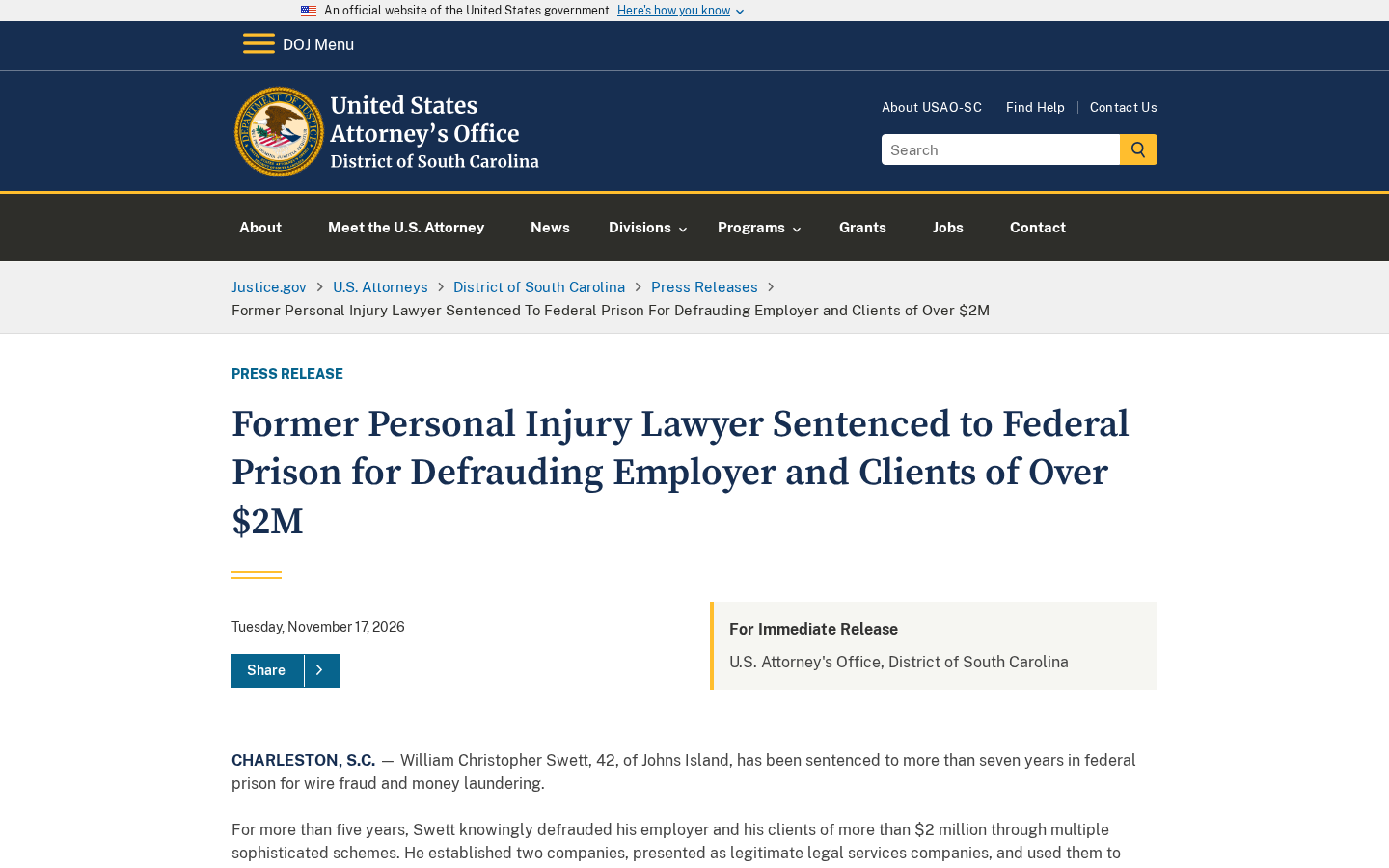
The Justice Department’s sentencing announcement describes more than five years of fraud that cost his employer and clients over $2 million combined.
Swett received an 87-month federal prison sentence for wire fraud and money laundering, followed by three years of court-ordered supervision.
The court ordered over $2.5 million in restitution, but the announcement does not say every affected client has received a payment.
The case matters because the people paying some of these expenses had already won money, sometimes after a long recovery.
Their dispute was not about whether a stranger could get them compensation, but whether the amount they received was right.
The difference between a lawyer’s fee and case expenses
A lawyer’s fee pays for legal work, while a case expense covers a separate cost associated with preparing or resolving your claim.
A copy of a medical record, a filing fee or a specialist’s report may be legitimate, depending on your agreement.
Knowing the category helps because asking who received an expense payment is a different question from asking how counsel calculated fees.
A higher deduction than you expected is worth asking about, but the amount alone cannot show that anyone invented the charge.
Begin with the version of your fee agreement you signed, including any amendments you received while the matter was active.
Then look for a closing statement that shows where the gross settlement went and how the firm calculated your share.
- Check the original settlement amount against the figure used at the top of the final calculation you received from counsel.
- Look for an explanation when the same provider and amount appear more than once under different descriptions on the statement.
- Put an unfamiliar provider on your question list, even if the amount seems small beside the size of the settlement.
What to check on a settlement statement
A useful statement tells you which expenses came from your case and gives you enough information to request records selectively.
Instead of disputing everything at once, mark the line you cannot explain and note which part of the paperwork is missing.
| Line on the statement | What to request |
|---|---|
| Lawyer’s fee | Signed agreement and the calculation used |
| Records or expert fee | Dated invoice tied to your matter |
| Medical lien or bill | Current balance and proof of payment |
| Reimbursement to the firm | Original expense record and payment trail |
| Amount paid to you | Closing statement and disbursement record |
A single expense can look quite different once you compare the name on the invoice with the name of the payee.
Sometimes those names differ for a legitimate reason, although the firm should still be able to tell you who got paid.
Ask for an explanation in writing so you can check it against your documents without trying to remember a conversation later.
How the Scam Works
Step 1: Ordinary costs make the paperwork believable
The expenses Swett submitted included travel, hotels and meals, categories that can be familiar to anyone who has reviewed business invoices.
The Justice Department says those expenses were illegitimate and that some costs related to more than a dozen fabricated clients.
A description can sound entirely normal without telling you who made the trip or what it had to do with your claim.
The same distinction applies when a bill lists a legal service but leaves out what records were collected for your case.
As a client, you do not need to know how the firm handles every expense before asking what yours covered.
Ask for the date, the matter number and the work performed, which are more useful than reading the description repeatedly.
Step 2: Reimbursements go to businesses controlled by the lawyer
Federal prosecutors say Swett set up two businesses that appeared to provide legal services and used them to collect false reimbursements.
A vendor name gave an expense somewhere to go on the books, even though it did not establish that work occurred.
That difference is hard to see when the only thing a client receives is a short description on a closing statement.
Someone reviewing vendor payments within a firm can ask for proof of work and check who actually controls an unfamiliar company.
If you are reviewing your own statement, the firm’s accounting contact can explain which records confirm that the vendor was paid.
A bill from a third party should not end the conversation when the firm cannot explain what that party actually delivered.
Step 3: False expenses reduce real settlement payments
The firm sometimes absorbed the costs, but prosecutors say most of the improper expenses were passed along to Swett’s clients.
That affected what clients took home, even when the other party had paid the agreed settlement amount for a legitimate case.
Someone comparing the bank deposit with the net figure on the statement could see a perfect match and still miss the problem.
To find an unsupported deduction, you have to look above the final number and check how the firm arrived there.
Start with unusually large charges, then look for repeated descriptions or costs appearing after the dated work was already complete.
Those are reasons to ask questions, not evidence to attach a fraud label before someone has checked the supporting documents.
Step 4: The lawyer uses fictitious cases as another source of money
The sentencing announcement also says Swett filed sham personal injury claims in relatives’ names and directed proceeds into accounts he controlled.
That was a separate part of the case from deducting false expenses on genuine claims, and the two should not be confused.
A client with an unexpected deduction does not need to prove anything about those other cases before asking for an accounting.
Likewise, an employer examining suspicious reimbursements should not assume the only possible loss is what appears in one client’s case file.
What connects the misconduct is Swett’s use of his position to direct money that his employer and clients trusted him to handle.
The practical lesson is to check both the reason for an expense and the record showing where the money went.
When the Firm Gives You a Stack of Receipts
Group the documents by provider instead of sorting only by date, because one provider may appear against several different expenses.
For each receipt, ask whether the firm paid it in full, received a credit or collected a separate reimbursement from anyone else.
If the amount was shared across cases, ask how the firm calculated your portion without requesting confidential information about other clients.
When one case involves several providers, an item can be counted twice if the ledger includes both an advance and its repayment.
Ask the firm to distinguish money it advanced from any outstanding balance the provider still claims you owe after settlement.
If expenses changed after you signed the closing statement, request the original and the revision rather than accepting only the updated total.
Look for a reason and a record for the adjustment, such as a late invoice or a credit that reduced the charge.
That comparison can resolve a bookkeeping error without obscuring a disputed expense that the documents still do not explain adequately.
When the firm says it cannot share an invoice, ask what it can provide to show the date, amount and service.
If the answer depends on a confidentiality rule or a disputed agreement, let an independent lawyer assess the relevant documents privately.
What to Do if You Have Fallen Victim to This Scam
-
Save the complete packet you received
Gather your signed agreement, settlement paperwork, closing statement, messages about expenses and the record of what reached your bank account.
Keep untouched copies of documents and attachments so you can show which version you received and when it arrived.
If you are missing paperwork, write down what you asked for and who at the firm responded to the request.
-
Build a simple ledger of the disputed lines
Make a list with the amount, date, description and any provider or payee named next to each disputed entry.
If you cannot tell whether an item is a fee, cost or lien, leave that question open in your notes.
This gives another reviewer a clear starting point without requiring them to read months of emails before they see the problem.
-
Go to the firm through a known number
Contact the firm’s main office and ask for a supervising lawyer or accounting contact who did not approve the original payment.
Request the itemized closing statement, invoices for disputed charges and records showing how the firm paid each provider you question.
If the lawyer left the firm, ask who now holds the client file instead of relying on forwarded contact details.
-
Get outside help if the explanation does not hold up
An independent lawyer in your state can help you assess the agreement, protect any deadlines and identify your options for recovery.
For South Carolina, use the state judiciary’s complaint instructions if you believe the conduct warrants review by the Office of Disciplinary Counsel.
The office asks for signed written complaints and supporting copies, and its instructions say emailed complaints will not be accepted.
A disciplinary complaint and a request to recover money serve different purposes, so ask what steps apply to each.
-
Verify any offer to recover the money
If someone says your name is on a restitution list, verify the claim through the court or the prosecuting office.
Do not send a fee, full bank credentials or a copy of your entire injury file to an unsolicited caller.
Use the contact details on the federal announcement if you need to find the official office that handled Swett’s case.
-
Keep working on any unresolved case or bills
Before signing a revised statement or stopping a payment, check whether medical balances or other legitimate obligations remain outstanding.
Ask an independent adviser whether a payment deadline, pending claim or signed release changes what you should do next.
Keep newer notices separate from the original documents so you can tell the reviewer what happened before and after your complaint.
Frequently Asked Questions
Can a lawyer deduct any expense they list on a closing statement?
A description on your statement does not explain whether the expense was permitted by the agreement or incurred for your case.
Compare the charge with your signed terms and ask for a dated invoice if the reason for the deduction remains unclear.
If two people disagree about what the agreement allows, have qualified local counsel review it before treating the disagreement as theft.
Does the settlement amount prove how much I should receive?
The gross settlement is the starting figure, while the net proceeds reflect fees, expenses and any other authorized amounts paid from it.
A correct net calculation can still include a charge that should never have appeared on the statement in the first place.
Ask about deductions individually rather than assuming that adding the columns correctly answers questions about how money was actually used.
Did the law firm lose money as well as the clients?
The Justice Department says the employer often absorbed false expenses, while most of the improper expenses were passed to clients.
It does not split the combined loss into separate totals for the firm and each group of clients.
A client trying to measure their own loss should use the paperwork for their claim rather than the federal case total.
Is a vendor without a public website necessarily fake?
Some providers do legitimate work without an active public website, so a missing search result is not enough to decide.
The better questions are what service was performed, whether the firm got something for it and how the payment was recorded.
Use those questions to narrow the inquiry before contacting third parties or making public accusations that the evidence may not support.
Will the federal restitution order automatically repay me?
A restitution order establishes an obligation, but it does not show when any particular person will receive money or how much.
Follow instructions from an independently verified court or victim assistance contact, and ask whether the office needs anything from you.
Treat anyone who asks for an upfront release fee as unverified, even if they can repeat figures from the public announcement.
What if I was given only a check and no explanation?
Ask the firm for the final accounting and a copy of the agreement it used to calculate the amount you received.
Tell them how much the check was and when it arrived, but leave your full banking details out of ordinary email.
If the office cannot explain the difference in writing, take your documents to an independent lawyer familiar with settlement disputes.
The Bottom Line
Do not let an unexplained charge disappear into the total on a settlement statement, especially when the firm cannot produce supporting records.
Start with the signed agreement and individual deductions, then escalate through an independent lawyer or the appropriate disciplinary office if necessary.
The amount printed on the check tells you what you received, but the underlying paperwork should tell you why.

Join the discussion
0 commentsShare your experience or ask a question about this article.
Community experiences
Did this happen to you?
Your experience could help someone recognize the same scam. Submit a private report for our team to review.
I experienced this tooReports are reviewed before publication. Sharing publicly is always your choice.
Discussion
Start the conversation
Have a question or something useful to share? Add the first comment.