


Once a park booking is paid, most people turn to the guest list and leave the receipt in their inbox.
The staff handling those bookings have another question to answer, long after the renter has stopped thinking about the card payment.
Overview
The bookings were real, but the city lost the money
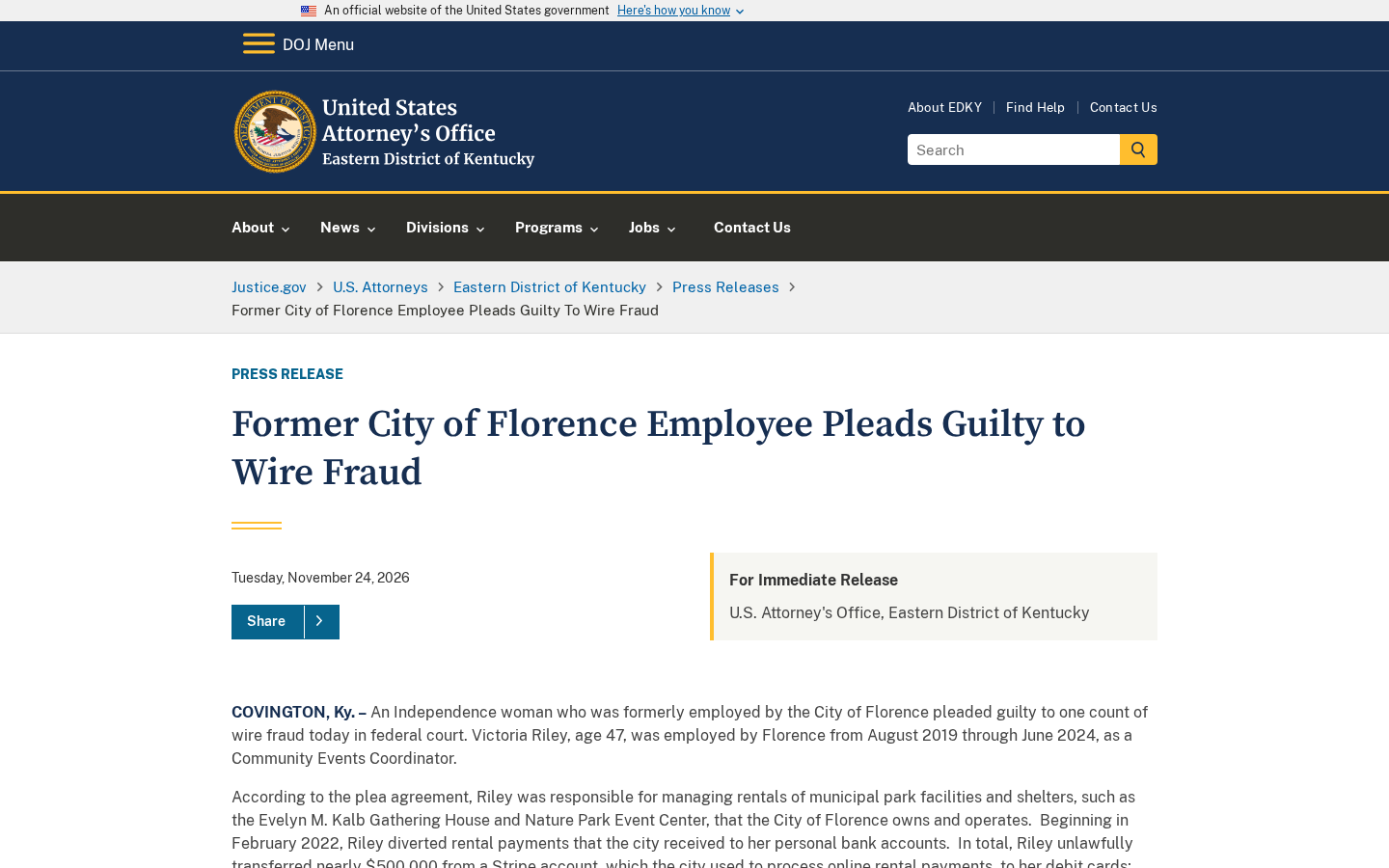
Victoria Riley oversaw rentals for the City of Florence, Kentucky, as a Community Events Coordinator from August 2019 through June 2024.
The bookings involved municipal venues, including the Evelyn M. Kalb Gathering House and Nature Park Event Center, along with park shelters.
The Justice Department’s November 24 announcement says Riley pleaded guilty to federal wire fraud for diverting nearly $500,000 from the city’s Stripe account.
The money came from rental payments the city had received, but Riley transferred it to her debit cards and used it herself.
The office announced a scheduled sentencing date of March 25, 2027, so the public update reports a guilty plea, not a sentence.
The case concerns a person inside the rental operation, rather than someone inventing a listing for a venue that did not exist.
A renter’s receipt and the city’s bank deposit answer different questions
If you booked a venue, your receipt is useful because it shows the payment you made and helps the city find it.
A finance team needs evidence from the other side of the payment, including what landed in an account the organization controls.
The federal announcement does not say customers needed to pay twice, that their reservations disappeared or that their card information was stolen.
It also does not describe a breach of Stripe, which the city used to process online payments for its own rentals.
A renter with an upcoming date should verify that booking through the city, while the city reviews its own receipt of the money.
For teams running similar operations, a confirmation email is not enough to establish that the organization ultimately received the payout.
Match each record to the question it can answer
A booking number connects a payment to a rental, but finance staff need more than that number to track the money.
The records below help show exactly where the information splits between the customer, the payment processor and the organization receiving funds.
| Record | What it shows |
|---|---|
| Reservation confirmation | Venue, date and booking status |
| Customer receipt | Amount and date of payment |
| Processor transaction report | Payments, refunds and fees affecting the balance |
| Payout history | Transfer date, amount and recorded destination |
| Organization’s bank statement | Deposits received by the approved account |
- Give the reservations team a booking reference and date, but do not send full card details to prove you paid.
- If you reconcile the books, check the destination as well as the amount, especially after a change to account access.
- Ask which member of staff checks payouts against the bank account, since reviewing a list of bookings will not catch everything.
These checks serve different people, and having them available makes it easier to investigate one discrepancy without alarming every past renter.
How the Scam Works
Step 1: Renters pay the city for real reservations
Florence processed payments for facilities the public could actually use, and Riley’s job put her in charge of managing those bookings.
A renter could receive the confirmation they expected while the city still had to track where its money went after payment.
The public facts do not indicate that Riley tricked customers into giving money to a sham company or invented the park facilities.
For people who still have an upcoming event, seeing this announcement alone is not a reason to abandon an otherwise valid reservation.
You can use the city’s official reservations page to find the department that handles payment questions for the facility you intend to use.
For staff, customer payments are the starting point in the records, not the final evidence that the operating account received them.
Step 2: Funds leave the city’s processor account for personal debit cards
Prosecutors say the diversion began in February 2022, well after Riley took the position and while she was still overseeing rentals.
Riley moved money from the city account to her debit cards, after which it was credited to her personal bank accounts.
The release does not say which account privileges or payout settings Riley used, and those technical details should not be assumed.
The control worth reviewing is whether a different person checked the payment destination against the city’s list of authorized bank accounts.
That question remains useful even when you do not know whether an unauthorized destination was added, modified or already present during a review.
It also keeps the investigation focused on confirmed transfers, rather than blaming the reservations team or the processor without evidence.
Step 3: Customers and finance can see entirely different parts of the record
A renter looking at their card statement could see a payment for the right amount without seeing where a payout went.
At the same time, a staff member looking only at reservation counts could see a busy calendar without seeing missing bank deposits.
This is why an independent comparison matters: neither a full calendar nor a payment receipt tells you where money eventually landed.
A mismatch can also have an ordinary explanation, including fees, refunds, disputes or differences between settlement dates and bank posting dates.
The next check is whether the processor lists a payout and whether a deposit with the same trace reaches an approved account.
When records remain inconsistent after accounting for timing and adjustments, assign someone outside daily booking work to review the remaining difference.
Step 4: The money is used personally and the case reaches federal court
The Justice Department says Riley used the diverted money for herself and pleaded guilty to one count of federal wire fraud.
The amount cited is nearly $500,000 transferred from the city’s payment account, not a charge that every individual customer must dispute.
Do not turn those figures into a full forensic account, because the public announcement does not detail every transfer or customer booking.
If a customer received the venue they paid for, the city’s loss and that customer’s transaction are still separate questions.
The city’s financial review can establish what happened to its funds without asking renters to decide whether the original charge was fraudulent.
If a caller uses the case to demand a replacement payment, verify that demand with the city before accepting it as genuine.
How to Check a Missing Payout Without Blaming the Wrong Person
Start by choosing a date range and matching reservations to accepted payments, because a canceled booking should not create expected revenue.
Check the processor’s settlement date and your bank’s posting date separately so a payout in transit does not get counted as missing.
Stripe’s payout reconciliation guidance explains how teams with automatic payouts can match them against the underlying payments, refunds, disputes and fees in the report.
For manual payouts, the same guidance points teams to the balance report, so choose the record that reflects how your organization operates.
Keep the report unchanged and annotate a working copy rather than silently adjusting figures until the expected and actual amounts match.
If several venues use one processor account, compare booking references or facility identifiers instead of treating all the income as one rental.
Assign responsibility for reviewing unexplained differences to someone who did not schedule the payout and can see the destination independently.
Have another authorized reviewer check changes to payout destinations before funds move, including when someone leaves or changes their duties.
That makes it easier to preserve normal operations while the finance team isolates a real issue in one part of the records.
Where deposits are refundable, keep them separate from fees earned by the venue so expected revenue does not include money due back.
When accounting for refunds, match the reason and booking reference against the original payment instead of subtracting a single unexplained adjustment.
A refund recorded against an individual reservation also gives the booking office something concrete to check when the renter calls.
If a payout goes to the right account but is smaller than expected, examine the underlying adjustments before concluding that funds were diverted.
When nothing reaches an approved destination, gather the payout reference so the processor can trace what happened without needing customers’ card numbers.
Set aside unfamiliar transactions for a second review rather than merging them into normal processing charges at the end of the month.
For venues with volunteers or seasonal staff, handover is a good time to verify that departing users no longer retain unnecessary access.
What to Do if You Have Fallen Victim to This Scam
-
Renters: confirm your booking before paying again
If your event is approaching, call the reservations office through the city’s published page and provide the event date and confirmation number.
Ask the office to confirm both the reservation and the payment it has recorded without sharing your entire bank statement.
Do not send a second payment to new instructions in a message until the city confirms those instructions separately.
-
Renters: preserve the payment history and dispute the right charge
Keep your original receipt and the entry on your card statement, especially if a new payment request describes the first as missing.
If there is a charge you did not authorize, call the issuer through its app or the number on your card.
A charge you made for a reservation is a different matter, so explain any duplicate or disputed service accurately when reporting it.
-
Finance teams: preserve the processor and bank records
Export the available reports for the affected period, and save the receiving bank statements and any change notifications alongside them.
Record who gathered the files and when, and limit access because the exports may contain personal information about individual renters.
Avoid changing entries that help show the original problem, even if you need to correct the accounting records afterward.
-
Finance teams: verify destinations before the next round of payments
Ask an authorized account owner to compare the recognized bank accounts with the destinations recorded for payouts during the affected period.
Contact the processor and bank through their verified fraud channels if you discover a destination your organization never approved.
Work with the account owner to protect future payments while maintaining records and any lawful instructions about the disputed transactions.
-
Separate public instructions from the internal investigation
If you work for the affected organization, coordinate with leadership and counsel before promising refunds or contacting every person who booked.
Give renters one verified route for questions and explain what they need to confirm without releasing financial or staff information.
Document known discrepancies separately from suspicions, and report them through the appropriate internal, bank and law enforcement channels for your organization.
-
Check any request that mentions a settlement or refund
If someone cites this prosecution and asks you to pay a fee for a refund, independently verify what the city announced.
Save unsupported requests to show the city or your bank and avoid using a link from the message to send evidence.
Do not assume the timing of a guilty plea or hearing means that anyone authorized a new collection or refund program.
Frequently Asked Questions
Were the Florence park rentals themselves fake?
No, the venues are real municipal facilities and the case concerns where some online rental payments went after the city received them.
Use the city’s actual reservation contact if you want to verify an event date, fee or balance for one of these facilities.
Did prosecutors say Stripe was breached?
The announcement describes transfers from the city’s Stripe account to Riley’s debit cards and does not report a breach of the processor.
An organization reviewing its own records should verify account access and payout destinations without jumping to conclusions about how the transfer occurred.
Do I need to cancel my card if I booked a shelter?
This case summary alone does not establish that your card number was stolen, so check your statement and confirm your actual reservation.
Contact your issuer if you find a charge you did not authorize or have another concrete reason to believe your card is at risk.
What if the city cannot find my payment?
Give the official reservations team your booking reference, the amount and payment date so it can trace the transaction against its records.
Get any revised instructions in writing from a city contact you verified, especially if you are asked to pay before the date.
Has Victoria Riley already been sentenced?
The Justice Department announced her guilty plea on November 24, 2026, and listed a sentencing hearing scheduled for March 25, 2027.
That is a hearing schedule from the prosecutor’s notice, not a prison term or a finding about money already paid back.
How can a small organization check for similar losses?
Have someone outside bookings compare payment reports with actual bank receipts, then investigate payouts that do not reach an approved destination.
Keep an independent record of payout changes and review it whenever duties change, including when someone no longer needs access.
The Bottom Line
Renters should verify the reservation through Florence’s official office and decline any second payment the city cannot independently confirm they owe.
Organizations should match rental receipts to approved bank deposits, because payments can reach a real processor and still go somewhere else.
If a payout is missing, preserve the records and contact the bank and processor through their known channels before making further changes.

Join the discussion
0 commentsShare your experience or ask a question about this article.
Community experiences
Did this happen to you?
Your experience could help someone recognize the same scam. Submit a private report for our team to review.
I experienced this tooReports are reviewed before publication. Sharing publicly is always your choice.
Discussion
Start the conversation
Have a question or something useful to share? Add the first comment.