


A trading statement can show positions, deposits and a rising balance without telling you who actually holds the money behind them.
That distinction rarely feels urgent while the numbers move in your favor, but it matters when you need the money back.
Overview
The promise was managed commodity options trading
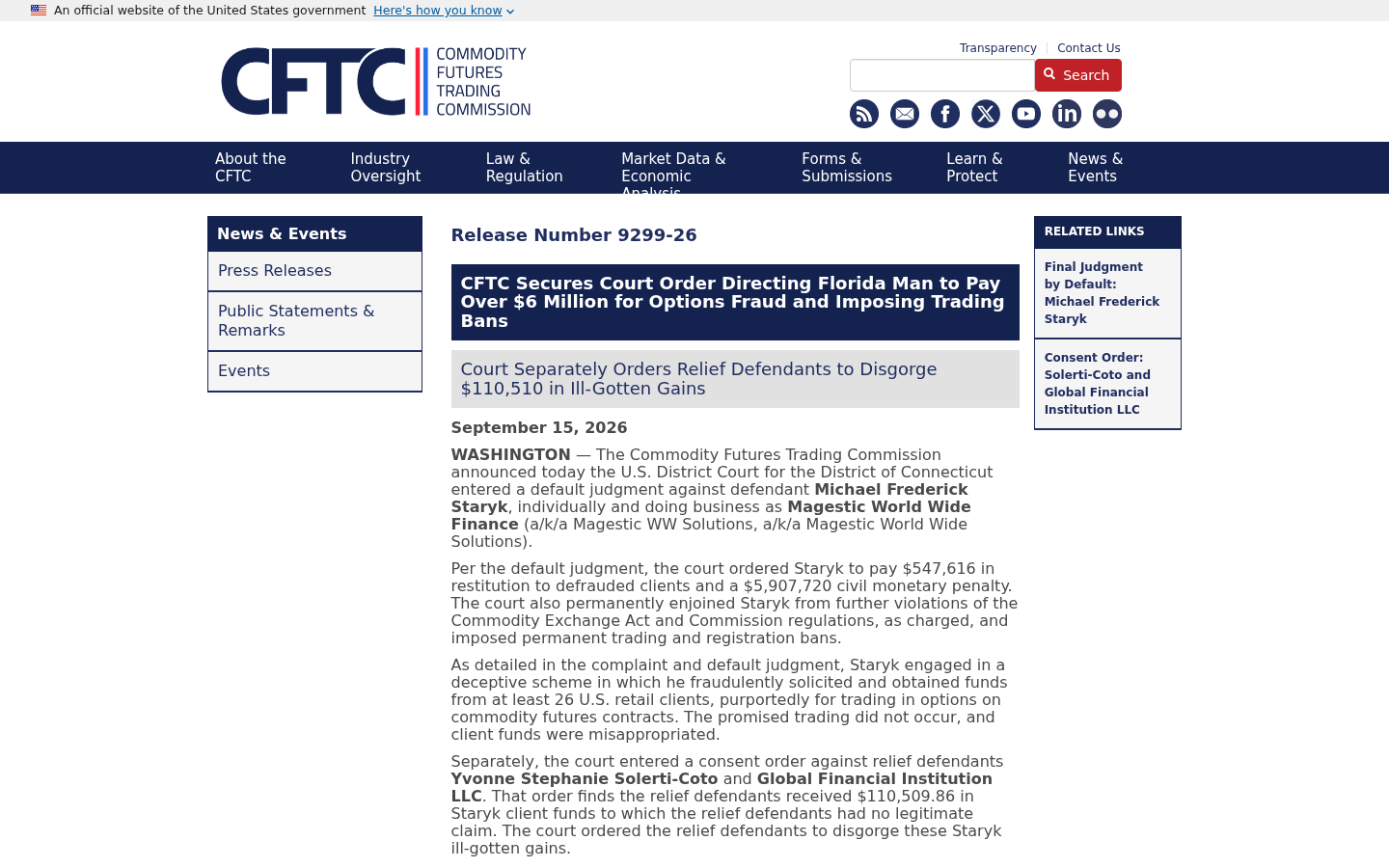
Michael Frederick Staryk did business as Magestic World Wide Finance, also known as Magestic World Wide Solutions and Magestic WW Solutions.
People who paid were told their money would be used to trade options on commodity futures contracts in accounts managed for them.
The federal court found the promised trades did not happen and the money from at least 26 retail customers was misappropriated.
The CFTC’s September 2026 release reports a default judgment against Staryk, including a $5,907,720 civil penalty and $547,616 in restitution.
The decision also imposed permanent trading and registration bans, and the agency says it resolved a civil enforcement case filed in 2024.
In a separate criminal case, Staryk had already pleaded guilty to conspiracy to commit wire fraud involving some of the same conduct.
A statement can be accurate about nothing but your deposit
According to the default judgment, clients were able to view statements that purported to show positions and earnings from options trading.
Technical details made the account look specific, but the report came from the same operation that had taken the investors’ money.
Even an accurate deposit figure can sit beside invented positions, so seeing the right starting number does not validate the rest.
What would have mattered was independent confirmation that a real trading account existed with a firm authorized to hold or trade the funds.
That firm’s statement or confirmation matters more than a login that could show whatever the person running the website chose to report.
The difference is not whether the site has enough detail, but whether you can verify the account with someone outside it.
The receiving account did not establish where the trades were placed
Court records say investors were given instructions to send money to bank accounts in the name of Global Financial, not Magestic.
A different beneficiary can have a legitimate explanation for a real investment, but the explanation needs confirmation before you send money.
| What you are shown | What to verify independently |
|---|---|
| A trading firm’s name | Exact legal name, registration and disciplinary history |
| Wire instructions | Account beneficiary and authority to receive client funds |
| Online position list | Whether the carrying broker confirms the account and trades |
| A small withdrawal | Source of payment and status of remaining funds |
| A government case number | Exact order, covered parties and instructions from the regulator |
- Check a person and the firm separately, especially if the individual introduces themselves under a name that never appears in writing.
- If a sender gives you a phone number for the carrying broker, find that firm’s number independently before calling to verify.
- Ask whether you would receive statements directly from the firm that holds the account, and what to expect before paying anything.
The civil judgment is about this operation, not a finding that every broker who uses a separate custodian is doing anything wrong.
How the Scam Works
Step 1: A call offers access to experienced traders
The court’s default judgment describes unsolicited calls in which the callers said experienced traders could manage commodity options and make investments grow quickly.
Investors were told the business had a presence in Connecticut and the United Kingdom, according to findings in the civil order.
The callers’ confidence could make it feel as though the investor only needed to decide whether the proposed strategy fit them.
Another question came first: whether the person was entitled to solicit the investment and whether their employer was who they said it was.
The order says that Staryk and others used aliases in some communications, leaving customers without an obvious name to look up.
If you cannot get both the legal name and enough information to distinguish an adviser from someone with a similar name, stop there.
Step 2: Payment instructions lead somewhere other than a trading account
Some clients wired money after being told that accounts would be opened and managed to trade options on their behalf.
The instructions named accounts held as Global Financial, which did not independently establish that a broker was opening the promised individual account.
Court findings describe money being diverted, including transfers involving recipients in Costa Rica, instead of being used for the promised trades.
A bank receiving a wire does not automatically tell you whether its customer is authorized to run the investment you were sold.
Compare the recipient’s name with the contract before paying, and ask the firm that holds the investment to explain any difference.
If there is no account confirmation from a firm you can contact directly, a clear wire receipt won’t make the deal safer.
Step 3: Online statements give investors reasons to stay
Customers obtained access to online statements, where account summaries and reported earnings made it look like the money had been invested.
The order describes a company report that claimed annual returns above 8% since May 2018 for its supposedly defensive portfolio.
That was the operation’s claim, not a verified return, and the court found it lacked the track record its marketing described.
People were also asked for additional investments, a request that might look reasonable if their first balance appeared to have grown.
A genuine position should be verifiable through the carrying firm without forcing you to rely on screenshots from the adviser who solicited you.
A login, detailed chart or prompt reply from customer service cannot answer whether the positions on the screen were ever opened.
Step 4: Trying to withdraw exposes the missing money
In one instance described in the order, a client who sought a withdrawal was told an additional investment could help recover funds.
The client returned a withdrawal form, but the purported balance in the account never arrived, according to the court’s account.
When small payments were made to clients, the order says the amounts came from other clients rather than profit from trading.
A partial payment can buy the seller more time and convince a customer that the rest will come with another deposit.
Do not use one completed transfer as proof that there is a reserve of money backing the remaining balance on the screen.
By late 2022, the findings say communications stopped and the website came down, though the public enforcement actions continued afterward.
Four Checks Before You Trust a Managed Trading Offer
Identify the adviser on the phone
Get the name used for regulatory registration and compare it with what the person gave you on the call or website.
Ask for a callback through the firm’s published number if a salesperson’s identity is unclear or the name appears in several listings.
Even a valid registration can belong to someone being impersonated, so a real entry does not settle whether this caller is genuine.
Ask who carries the account
Determine which firm holds the funds and trades, and ask what information it gives clients who need to verify a statement.
If you are told that only the seller can see or explain where your funds sit, do not send a deposit.
Get this answer before asking about returns, because a discussion about performance cannot establish who holds the customer assets being offered.
Follow the payee name
Read the name on the payment instructions against the account agreement and ask the carrying firm to confirm the destination independently.
Do not make a small trial payment just because the seller says you can verify everything after the first transfer clears.
If the bank details change, repeat the verification using an established number rather than continuing the email thread that announced the change.
Ask how a withdrawal would be documented
Ask the carrying broker what genuine withdrawal instructions look like before relying on a form provided by the seller of the investment.
Look at how funds and fees are recorded, not just whether someone promises you can withdraw whenever the market happens to be open.
When more money is demanded to solve an existing withdrawal problem, pause and verify whether the independent firm knows anything about it.
What to Do if You Have Fallen Victim to This Scam
-
Stop sending money and preserve the instructions
Do not make an additional investment or pay a withdrawal charge just because someone says your previous deposit will otherwise be lost.
Download messages, trading statements and receipts you can still access without installing software or giving the sender any new information.
Record the dates, the requested amounts and the claimed reason for each transfer so a reviewer can follow what happened.
-
Contact the institution that actually sent your payment
Call the bank or other payment provider using its established contact details and ask for the team that handles suspected fraud.
For a wire, ask whether a recall is possible and supply the beneficiary name and the transfer reference when needed.
The bank may be unable to get the money back, but an early request gives it more information to act on.
-
Check the firm and its adviser through official records
Use the CFTC’s registration guidance to reach NFA BASIC and search the exact firm and individual names used to sell the investment.
Compare regulatory history, current status and independently obtained contact information without assuming that a similar name belongs to the same person.
The registration guidance explains that exemptions can apply, which is different from treating an unexplained missing record as proof of authority.
-
Send evidence to the regulator through its official channel
Use the CFTC’s complaint instructions and mention the case number or release number if the names and documents match the Staryk operation.
Attach useful records through the supplied channel, but do not send a password or a recovery code as evidence of access.
It helps to identify which account details you can verify and which numbers appeared only on the site that took your money.
-
Make a separate note of anything that was returned
Record what you deposited, what actually returned to your bank and which amounts appeared only as gains in the trading portal.
Keep the original transfers beside your summary so you can correct an error without losing the source of each amount.
Someone offering to recover the balance may quote account figures that were never backed by funds, so start with the actual payments.
-
Verify recovery messages before replying
Look up the relevant agency or court if someone says a restitution order has created a refund in your name.
A real order does not make a stranger’s fee request legitimate, and the wrong contact could expose your banking details again.
Ask an independent adviser about your own deadlines if the bank and enforcement agency cannot explain what remedy is still available.
Frequently Asked Questions
Are Magestic World Wide Finance and Magestic WW Solutions the same case?
The CFTC lists both names as aliases in its announcement about the civil default judgment entered against Michael Frederick Staryk.
Use the case number and names in the order to check whether a business with a similar name is actually related.
Were commodity options actually bought for the clients?
The court found that the trading described to clients did not occur and the displayed account statements were false or misleading.
The case therefore involved stolen funds, not a genuine options position whose value fell because prices moved against the investor.
Did everyone who received some money get legitimate profits?
Court records say the occasional payments came from other clients’ money, so the fact that one payment cleared did not validate the trades.
Compare deposits and actual withdrawals separately, and do not assume that the difference between them is the same as the portal balance.
Is the entire amount in the $6 million headline restitution?
No, the court ordered $547,616 in restitution and a larger $5,907,720 civil monetary penalty against Staryk, which are separate obligations.
Those figures are not confirmation of collection or a schedule for distributing payments to individual investors who lost money.
What did the court decide about the relief defendants?
A separate consent order required Yvonne Stephanie Solerti-Coto and Global Financial Institution LLC to give up $110,509.86 in client funds.
The court found they had no legitimate claim to the funds, but neither was criminally convicted by that consent order.
Does a past trading ban matter when the caller uses a new firm name?
Staryk’s 2004 CFTC order shows why checking the adviser as well as the firm’s name can uncover information missing from marketing materials.
Search current registration and past regulatory actions independently before deciding whether to trust anyone with funds for a managed account.
The Bottom Line
Do not send money to an options seller if you cannot verify the adviser, the recipient and the account through independent records.
If you already paid, stop additional transfers, call the sending bank and use the CFTC’s official channel to report the operation.
A statement from the seller tells you what they want you to see, while a real account can be checked without them.

Join the discussion
0 commentsShare your experience or ask a question about this article.
Community experiences
Did this happen to you?
Your experience could help someone recognize the same scam. Submit a private report for our team to review.
I experienced this tooReports are reviewed before publication. Sharing publicly is always your choice.
Discussion
Start the conversation
Have a question or something useful to share? Add the first comment.