


The caller says there’s a warrant and that you can help resolve it. Another person seems to know the same story, down to the accusations.
Hearing the same story twice can feel like confirmation, especially when each caller sounds sure the other one is right.
Overview
The Marksville case involved a fake CIA investigation
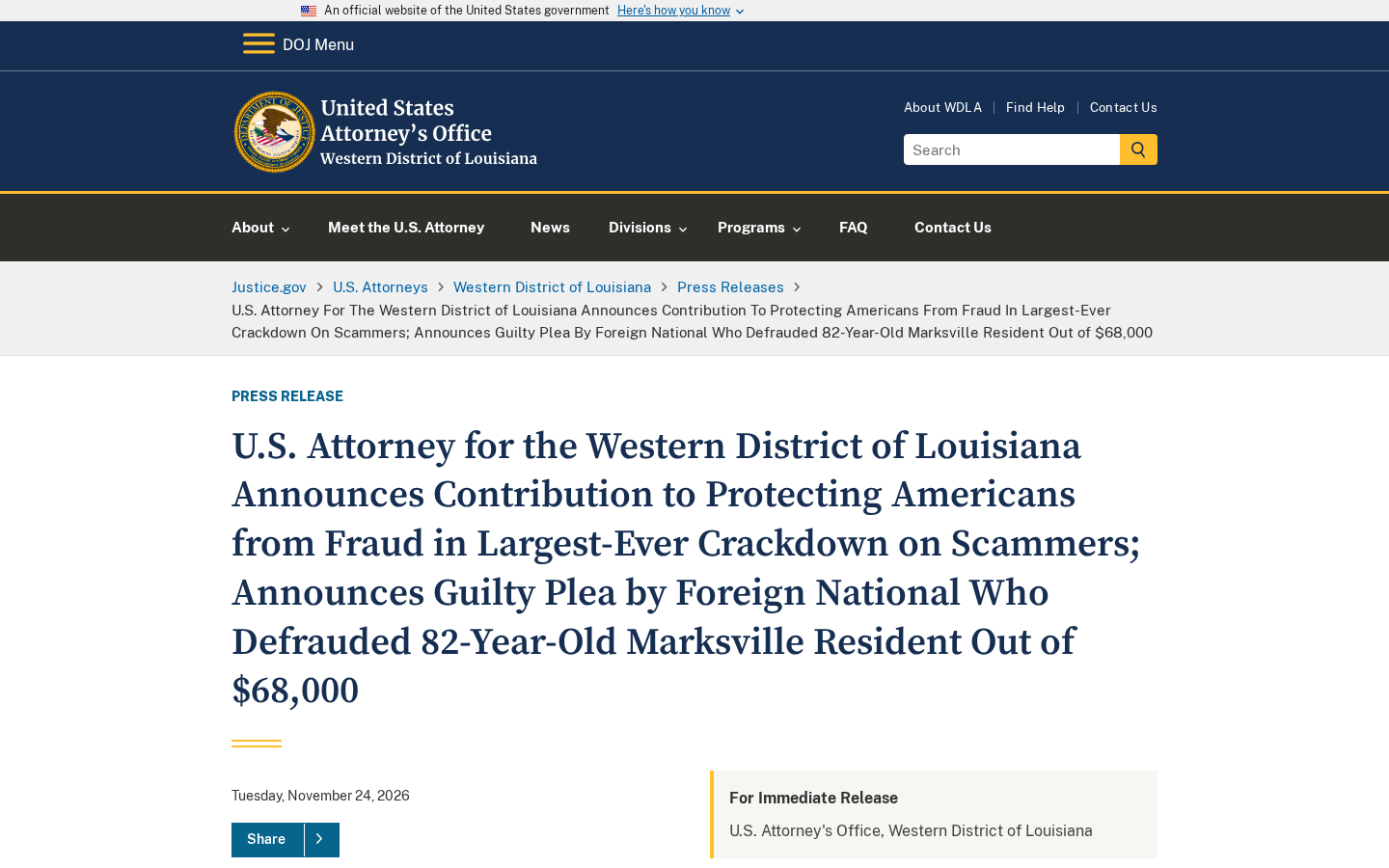
Federal prosecutors say people posing as officials used calls and texts to convince an 82-year-old Marksville, Louisiana resident that she faced federal warrants and arrest.
The Western District of Louisiana’s November 24, 2026 release identifies CIA and local police identities used by the group. The supposed investigation and warrants were fabricated.
The victim handed over $68,000 in cash across two meetings. The documented payment method was a handoff, not a wire transfer or an online transaction.
Ganesh Bista collected cash twice
The federal account says Bista traveled to Marksville and collected $30,000 on November 5, 2024. He collected another $38,000 on November 7 after further communications from others.
Bista pleaded guilty on October 2, 2026 in connection with the case. The November announcement listed February 16, 2027 as the scheduled sentencing date, not a sentence already imposed.
Prosecutors describe calls and texts from the group and cash pickups by Bista. Do not assume the same individual sent every message or that a local officer participated.
What makes a second contact unhelpful as verification
- Another caller repeating the accusation may be relying on information from the same group.
- A text identifying your local agency does not prove the caller works there.
- Someone collecting cash in person is not evidence that a court approved the demand.
- Giving money once does not obligate you to meet anyone a second time.
The warning applies even when the caller sounds calm or claims to be protecting you. Use an independent agency number before acting on what they say.
How the Marksville Fake CIA Cash Pickup Scam Worked
Step 1: Calls and texts borrowed authority from real institutions
The group purported to include CIA agents and paralegals as well as representatives of the Marksville Police Department. Prosecutors did not describe involvement by those real agencies in the scam.
When several people make the same allegation, they can make it sound like separate offices have verified it. That is not true if the same group directs you to them.
Do not use a name or phone number that only came from the call. Look up the agency on its public site and place a separate call.
Step 2: A supposed federal warrant made payment feel urgent
The release says callers invented an investigation and threatened to take the victim into custody unless she obeyed. There were no genuine warrants supporting those demands.
Threats can make a person focus on ending the call instead of checking what the caller is asking. You do not have to settle the accusation with the caller.
If you worry there might be a real warrant, get somewhere safe and contact verified authorities or an independent attorney. Do not pay to check the claim.
Step 3: Cash was collected instead of being paid through a real court
The group directed the victim to withdraw funds to resolve the supposed warrants. Bista met her to collect cash rather than directing her to a genuine government payment process.
The FTC’s government impersonation guidance warns against demands for cash or other payments from callers threatening you. The place of the handoff does not establish the demand’s legitimacy.
If you have withdrawn cash but haven’t given it away, do not take it to the appointment. Contact your own bank privately and ask how to secure it.
Step 4: The first meeting did not end the demand
After the first $30,000 handoff, the group stayed in contact. A second meeting two days later cost another $38,000, bringing the documented loss to $68,000.
A group that says this is the last payment is not giving you a reliable guarantee. If another message comes after money changes hands, stop rather than trying to finish.
Keep the original messages even if they upset you. The gaps between calls, withdrawals and meetings can help officials understand which people and transactions were involved.
Where the group has set a second deadline, tell officers when it is. That is more useful than trying to identify who would have arrived on your own.
If a relative finds the cash already gone, help record the first handoff and check for another planned pickup. Tell officers promptly if a meeting is still scheduled.
How to Break Contact When a Cash Pickup Is Already Planned
Separate your immediate safety from the claim about a warrant
If you are still at the bank, tell a staff member privately that someone on the phone wants you to hand cash to a person you do not know.
If you are en route, do not go to the meeting. Get to a safe place and contact someone you trust or local law enforcement using your own number.
If you believe there is an immediate threat to your safety, call emergency services. Do not confront a person who arrives to collect money or follow them to gather evidence.
Do not act on a text telling you that refusing the meeting adds another charge. Preserve it and ask verified authorities how to proceed.
Verify through an agency the caller does not control
Find the agency’s official website and use its public number. If the caller named a local police department, start with the actual department in that jurisdiction.
Explain that a caller claiming some federal authority demanded cash for warrants. Ask which office should check the claim and what to do if someone is expected to arrive.
Give the agency the name or reference that was already provided. Don’t first call a number in the message just to hear what appears to be a switchboard.
If the official contact cannot check the alleged case, ask for the appropriate court or law enforcement office. End contact with the original caller while you verify.
Help someone without making them feel they have to defend the payment
Start with the next decision: is money still at home, did a handoff happen or is another meeting planned? That determines what must happen first.
Ask to help find the bank’s number or write down the timeline. Give the person room to explain what made the call sound official rather than blaming them.
If the person received repeated contacts, help them block the numbers after preserving the records. Remind them that the same group can appear under a different name later.
What to Tell Your Bank or Family After the First Call
Say exactly who asked for cash and why
A bank employee can do more with a clear explanation than with a request for a large withdrawal. Say that a caller said cash would clear a supposed warrant.
If you are waiting in line while the caller stays connected, step away and end the call. You can ask to speak somewhere private without explaining to the stranger.
Tell the bank if someone instructed you what to say about the withdrawal. The bank needs information from you, not the explanation the person requesting the cash supplied.
If your usual account suddenly looks different after the call, tell the bank about that too. Ask it to check unauthorized changes and pending payments you did not make.
Ask what the bank can confirm about the withdrawal, including the time and amount. Keep the receipt rather than sending a picture to the person demanding the cash.
Work out whether another meeting could happen
Review the most recent message first. If it mentions a meeting, confirm whether the family member is at home, at a branch or already on the way.
If you believe someone is headed to their home and there is immediate danger, contact emergency services. Do not go to the collection point to interrupt it on your own.
If an instruction involves a location or a person you might recognize, note the details for law enforcement. Don’t arrange to see the person to make your report more complete.
Ask the person to call you or police if a new number reaches out. Agree that no one will leave home or take out cash because of another message.
If your family member normally uses one trusted person for financial help, involve them with permission. Keep other people out of the conversation unless their support is actually needed.
Make an evidence record nobody needs to rebuild later
Write the call dates, amounts and places in order. If the bank confirms a withdrawal time different from what you remembered, keep both and label their sources.
Keep threatening language in the original private message rather than spreading it publicly. Report the effect it had and whether the sender asked you to keep the matter secret.
If you have already deleted a conversation, save whatever records remain. A branch receipt or call log can still help even when the original exchange is incomplete.
Later calls might claim they are correcting the first one. If the person knows how much you paid, verify what they say through the official office anyway.
Keep the name of the agency you actually reached and the case number it gave you. Use that record to verify follow-up rather than the caller’s assurances.
If you are helping as a witness, describe what you personally saw and label anything you were told by someone else. That distinction matters when reconstructing a cash handoff.
What to Do If You Have Fallen Victim to This Scam
-
Cancel the handoff and take care of your safety. Disconnect from the caller and do not return to a meeting location to check whether someone is there.
If someone has your home address and threatens to come, tell local police what happened. Do not tell the caller where you moved the cash or where you are going.
-
Contact your bank even if the payment was cash. Ask it to preserve records of the withdrawal and tell it whether someone also saw your account details.
If the cash is still in your possession, ask the bank about securing or redepositing it. Do not give it to someone claiming they can return it to law enforcement.
A cash withdrawal is not the same as a reversible card charge. Ask what records the bank can provide to support an investigation.
-
Write down each communication and meeting time. Keep the original texts, call history and withdrawal receipts. Note what the caller claimed and where the pickup occurred.
If you remember details such as a vehicle or direction of travel, tell officers rather than trying to track anyone yourself. Mark what you’re sure of and what you’re not.
Record the amounts separately for separate meetings. That way, a bank or investigator can connect each handoff to the right transaction.
-
Report the incident through verified public channels. Contact local authorities about an in-person cash pickup and use IC3 if the incident involved internet-enabled communications.
If the Marksville case appears relevant, reach the Western District of Louisiana through justice.gov and refer to case 1:25-CR-00101. Similar wording does not prove cases are linked.
Keep any report references and tell the office if another demand comes in. Do not arrange a new handoff to try to help on your own.
-
Expect another claim to come from a different identity. One person may now describe themselves as a recovery agent or promise to send the cash back.
Do not pay a fee or share private data to prove you deserve the money. Check unexpected calls through the actual agency that already has your report.
Frequently Asked Questions
Did the CIA or Marksville police ask the woman for money?
The federal release describes impersonation of those agencies, not a real demand. The claimed warrants and threats of arrest were part of the fraud.
Why did another person know the same details about the warrant?
People working together can repeat one another’s claims. Call a contact you found independently to check whether the named agency knows anything about the demand.
How much money was collected in the Marksville case?
The DOJ says the victim gave $30,000 at the first meeting and $38,000 at a second meeting two days later, for a total of $68,000.
Do I need to go to an appointment if I already agreed?
Do not go to a pickup a suspicious caller arranged. Get somewhere safe and ask local authorities for help if anyone is coming to where you are.
Did the guilty plea already result in a sentence?
The release reported Bista’s guilty plea and said sentencing was scheduled for February 2027. It did not say the court had already imposed a prison term.
Will reporting the withdrawal automatically get the cash back?
Reporting gives authorities a record of what happened, but it does not guarantee repayment. Preserve the evidence and verify any recovery instructions with your actual case contact.
The Bottom Line
Do not give cash to a caller or courier claiming a warrant will disappear. Hang up, skip the meeting and verify the story through a contact you found yourself.
If you handed over money, tell local authorities and your bank. Keep the records and refuse a second meeting or a fee to recover the first payment.

Join the discussion
0 commentsShare your experience or ask a question about this article.
Community experiences
Did this happen to you?
Your experience could help someone recognize the same scam. Submit a private report for our team to review.
I experienced this tooReports are reviewed before publication. Sharing publicly is always your choice.
Discussion
Start the conversation
Have a question or something useful to share? Add the first comment.